Bible Concepts

God's Name
The first reference to God appears in Genesis 1, where we learn that God is "Elohim."
"In the beginning, Elohim (God), created the heavens and the earth.”
The word Elohim conveys that He is the all-powerful Creator, having absolute sovereignty and is Ruler of the universe. He is the One who spoke the universe into existence with His incredible creativity and power.
Elohim ias actually the plural of "Ĕlōah," which is a Hebrew word meaning "gods" or "godhood". Although the word is grammatically plural, in the Hebrew Bible it most often takes a singular verbal meaning and refers to a single deity, particularly the God of Israel. Although there a a variety of grammatical reasonings for the use of a plural term when referencing a unity, Christians recognize this usage as likely a reference to the "Trinity."
God began to reveal more about Himself in his dealings with Abraham, (Abram). Having earlier promised Abram that he would have a son (and become a father of many nations), God returned and conferred upon Abram and Sarai the new names of Abraham and Sarah. He also introduced himself by the name, "El-Shaddai."
The name “El” is translated hundreds of times as “God,” emphasizing the omnipotence, power, and the might of the transcendent One who created all. The “Shaddai” part re-emphasizes His power to do anything He wants. Latin Vulgate scholars and some in the modern era connect this name to a root word that refers to God’s profound ability to compel nature to do things contrary to nature. Interestingly, there is another word, "shad," which may be related.This word is translated in our Bibles as “breast,” and is related to the tender care of God to nourish, satisfy, and provide for us all.
Centuries after His covenant with Abraham, God revealed his name to Moses by the burning bush before the exodus event. Moses asked God by what name he should refer to God when going to deliver the Israelites. God answered that Moses should tell the Israelites that “I am who I am” has sent him, (in Hebrew, "YHWH"). By connecting God's name to the statement “I am,” the scripture indicates that God is the self-existent one who is committed to a future continuing presence. (This is reaffirmed in Mal 3:6, where God reminds the prophet that “I am Yahweh; I do not change.”)
Many think that the connection to the verb “to be” or “to become” needs to be understood to mean that God is one who acts and brings things into being. This links God to creation in general and to the particular creation of Israel as a people who have a special relationship with God.
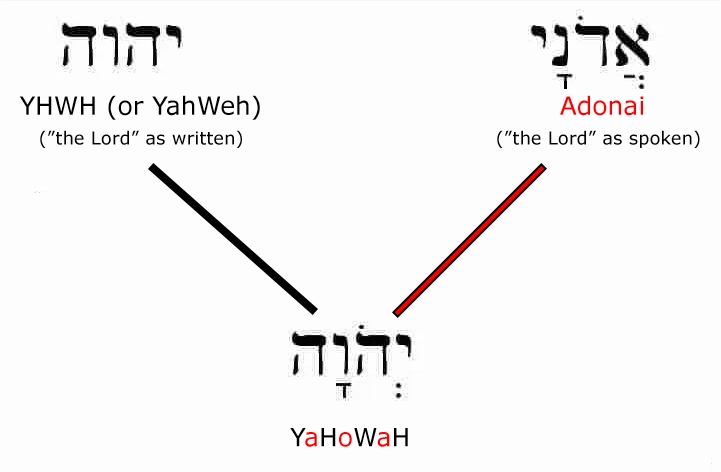
An interesting part of history has been the loss of the proper pronunciation of the Hebrew word YHWH. The majority opinion today is that “Yahweh” is the original pronunciation and that it is a name meaning “He is.” The name eventually ceased to be pronounced because later Jews thought it too holy to be uttered and feared violating Exodus 20:7, “You shall not misuse the name of the LORD your God....” The only time this name was pronounced was by the high priest on the Day of Atonement, while in the inner sanctum of the temple, the Holy of Holies. Following the destruction of the Temple in A.D. 70, the pronunciation of the name was lost.
In the Greek translation of the Hebrew scriptures known as the Septuagint, the Holy Name was rendered as "kyrios," meaning "Lord" or "Master." The Hebrew version of this word was "Adonai." Because the original Hebrew writing had only consonants and no vowels, later Hebrew scribes often added "pointing," (so-called "diacritical marks") to represent vowel sounds in written Hebrew, adding precision and clarity. When medieval Jewish scribes added vowels to YHWH in the manuscripts of the Bible, they chose not to add the original vowels because of the sanctity of the name. Instead, they added the vowels that are found in the word “Adonai.” Thus, the Hebrew consonants yod-heh-vav-heh and the vowels from the word “Adonai” became, Y-a-H-o-W-a-H. Because the Latin language had no Y, this was rendered as J, and the missing letter W became V, leading to the word, "Jehovah."
English translations of the Hebrew Bible commonly refer to God as “Lord,” and the term is often written in all capital letters (Lord or LORD). Not meant as decorative, these capital letters are a signal that a special Hebrew term is being translated, which is, YHWH, the personal name for God. The majority opinion today is that “Yahweh” is the original pronunciation and that it is a verbal name meaning “He is.”
Therefore, God’s active presence is emphasized, rather than his mere state of being. It is comforting to note that an abbreviated form of Yahweh is preserved in the Hebrew name Joshua and in the Greek name Jesus, both of which mean, “The Lord (Yahweh) saves.”
More on Video See Video 2 See Video 3


© 2026 AVisitWithJesus
"For God so loved the world, that he gave his only begotten Son,
that whosoever believeth in him should not perish, but have everlasting life."