Luke the Historian: Archaeology, History, and Reliability
Introduction
Among the writers of the New Testament, Luke stands apart for both the scope of his work and the explicit historical method he claims to employ. Together, the Gospel of Luke and the Acts of the Apostles account for more than a quarter of the New Testament. Luke addresses his writings to a named individual, Theophilus, and states plainly that his purpose is to provide an orderly and well-investigated account based on earlier sources and eyewitness testimony (Luke 1:1–4)).
For generations, critics have questioned whether Luke should be read primarily as a theologian or as a historian. Over the past century and a half, archaeological discoveries have increasingly shown that Luke’s detailed knowledge of geography, political administration, and social customs reflects careful research and first-hand familiarity with the first-century Roman world.


A Short Biography
Luke is traditionally identified as the author of both the Gospel bearing his name and the Book of Acts. Early Christian writers such as Irenaeus, the author of the Muratorian Canon, and Eusebius unanimously affirm this attribution. Luke himself never names himself directly, but the internal evidence of Acts strongly supports his identity.
According to Colossians 4:14, Luke was a physician, a detail consistent with his occasional medical vocabulary and interest in healing narratives. He was almost certainly a Gentile, making him the only non-Jewish author of the New Testament. Luke was highly educated, writing in refined Greek and demonstrating familiarity with Greco-Roman literary conventions.
Luke traveled extensively with the Apostle Paul, as indicated by the so-called “we passages” in Acts (e.g., Acts 16:10–17); Acts 20:5-15; Acts 27:1-28:16). These passages place Luke as an eyewitness to many of the events he records. Most scholars date the composition of Luke–Acts between AD 60 and 85, with many favoring a date prior to the destruction of Jerusalem in AD 70.
Archaeological and Historical Corroboration of Luke–Acts
Political Officials and Administrative Titles
One of the most striking features of Luke’s writing is his consistent use of correct political titles, which varied from province to province throughout the Roman Empire.
-
Sergius Paulus (Acts 13:7):
Luke refers to Sergius Paulus as the proconsul of Cyprus. Roman inscriptions discovered on Cyprus name a Lucius Sergius Paulus who held this office. Luke’s use of the title anthypatos(proconsul) is historically precise.
References: F. F. Bruce, The Book of Acts; G. L. Huxley, “Sergius Paulus,” Greek, Roman and Byzantine Studies. -
Gallio, Proconsul of Achaia (Acts 18:12-17):
The Delphi Inscription, dated to AD 51–52, mentions Gallio as proconsul during the reign of Claudius.
This inscription provides one of the most secure chronological anchors in the New Testament.
References: A. Deissmann, Light from the Ancient East; F. F. Bruce, Acts.
Cities, Geography, and Urban Details
- Philippi (Acts 16): Luke correctly describes Philippi as a Roman colony and refers to its magistrates using appropriate Greek terminology. Excavations confirm the city’s Roman status and civic organization.
- Nazareth: Archaeological evidence, including first-century tombs and domestic remains, confirms habitation at Nazareth during the time of Jesus, countering earlier claims that the town did not exist.
- Jerusalem Topography: Archaeological work around the Temple Mount and the City of David confirms features such as gates, pools, and roadways consistent with Luke’s descriptions of Jerusalem prior to AD 70.
Events and Cultural Practices
- The Census of Luke 2: While long debated, modern research into Roman census practices shows that Luke’s account fits known administrative patterns better than previously assumed, including censuses conducted over extended periods.
- Paul’s Sea Voyage and Shipwreck (Acts 27): Luke’s nautical terminology and description of sailing conditions demonstrate technical accuracy. James Smith’s classic study, The Voyage and Shipwreck of St. Paul, remains influential among maritime historians.
Luke as a Historian: Comparison with Tacitus, Suetonius, and Josephus
Luke’s historical method aligns closely with the standards of Greco-Roman historiography. Like historians such as Tacitus and Josephus, Luke names officials, situates events within political frameworks, and demonstrates concern for chronology and geography.
Tacitus is often more overtly political and cynical in tone, while Suetonius favors anecdotal biography. Josephus, writing from a Jewish priestly perspective, provides an invaluable parallel witness to the same period. Luke’s writing is more restrained, orderly, and narrative-driven, avoiding sensationalism.
“Luke is a historian of the first rank… not merely trustworthy… but possessed of the true historic sense.”
— Sir William Ramsay, St. Paul the Traveller and the Roman Citizen
Archaeology cannot prove theological claims, but it can test historical accuracy. On that measure, Luke consistently proves to be a careful, informed, and reliable historian. From inscriptions and civic titles to city layouts and maritime practices, the archaeological record repeatedly confirms Luke’s familiarity with the world he describes.
The cumulative evidence strongly supports reading Luke–Acts not as legendary fiction, but as serious ancient history written within living memory of the events it records.
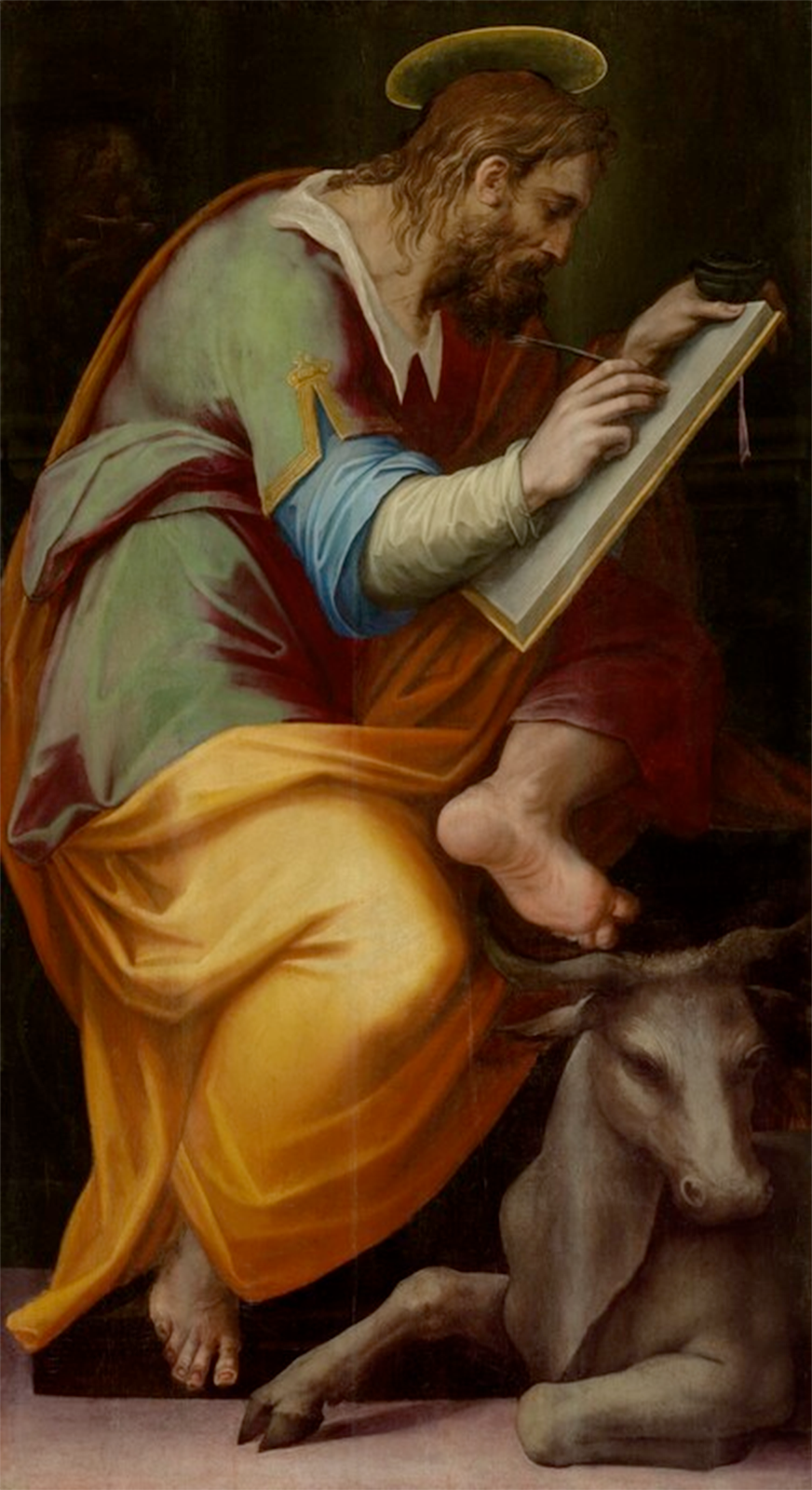
Click to Enlarge
Saint Luke
(1570-1571) Giorgio Vasari
The Saint Luke and Saint Mark panels were part of a commission from Pope Pius V in 1569 to decorate the newly built Torre Pio (Pius Tower) in the Vatican. The project, for which Vasari was knighted by the pope, was finished in two years.
In the upper chapel, dedicated to the Archangel Michael, Vasari’s Coronation of the Virgin occupied the main altar while elaborately framed mirrors flanked either side of the chapel doorways. Large panel paintings of the four evangelists–Saint Matthew, Saint Mark, Saint Luke, and Saint John–were set within these mirrors.
© 2026 AVisitWithJesus
"For God so loved the world, that he gave his only begotten Son,
that whosoever believeth in him should not perish, but have everlasting life."