Adad-nirari II
Adad-nirari II was the Assyrian king who began the sustained military recovery that eventually produced the Neo-Assyrian Empire.

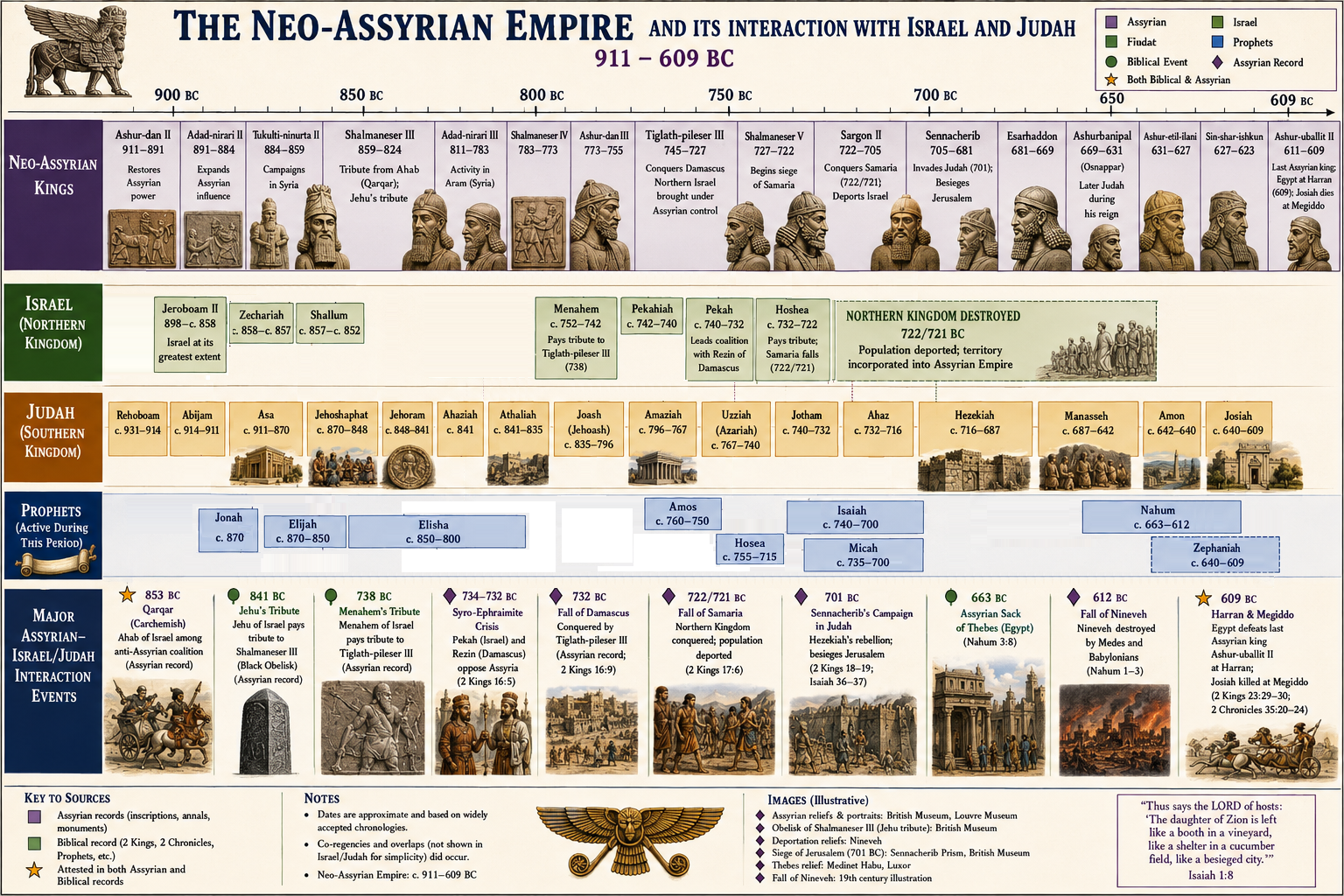
Adad-nirari II was the Assyrian king who began the sustained military recovery that eventually produced the Neo-Assyrian Empire.

Tukulti-Ninurta II consolidated the territorial recovery begun by his father and prepared Assyria for the major expansion of the ninth century BC.

Ashurnasirpal II transformed Assyria into a formidable imperial power and made Kalhu, modern Nimrud, a spectacular royal capital.

Shalmaneser III repeatedly campaigned in Syria and is especially important for biblical history because his inscriptions name Ahab of Israel and depict tribute from Jehu.

Shamshi-Adad V restored royal control after a dangerous civil war and maintained Assyria's position through campaigns in Babylonia and the east.

Adad-nirari III restored strong Assyrian involvement in Syria and received tribute from western rulers during the era of Joash and Jehoash of Israel.

Shalmaneser IV ruled during a period when powerful Assyrian officials limited the practical authority of the crown.

Ashur-dan III ruled during years of plague, revolt, and weakening central authority in Assyria.

Ashur-nirari V was the last king of Assyria's weakened mid-eighth-century phase before Tiglath-Pileser III seized the throne and renewed imperial expansion.

Tiglath-Pileser III rebuilt Assyria into a highly centralized empire and intervened decisively in Israel and Judah, where the Bible also calls him Pul.

Shalmaneser V began the final siege of Samaria after Hoshea of Israel rebelled against Assyrian rule.

Sargon II consolidated Assyrian control over the former kingdom of Israel, campaigned widely across the empire, and is named directly in Isaiah.
© 2026 AVisitWithJesus
"For God so loved the world, that he
gave his only begotten Son,
that whosoever believeth in him should
not perish, but have everlasting life."