Jesus as God
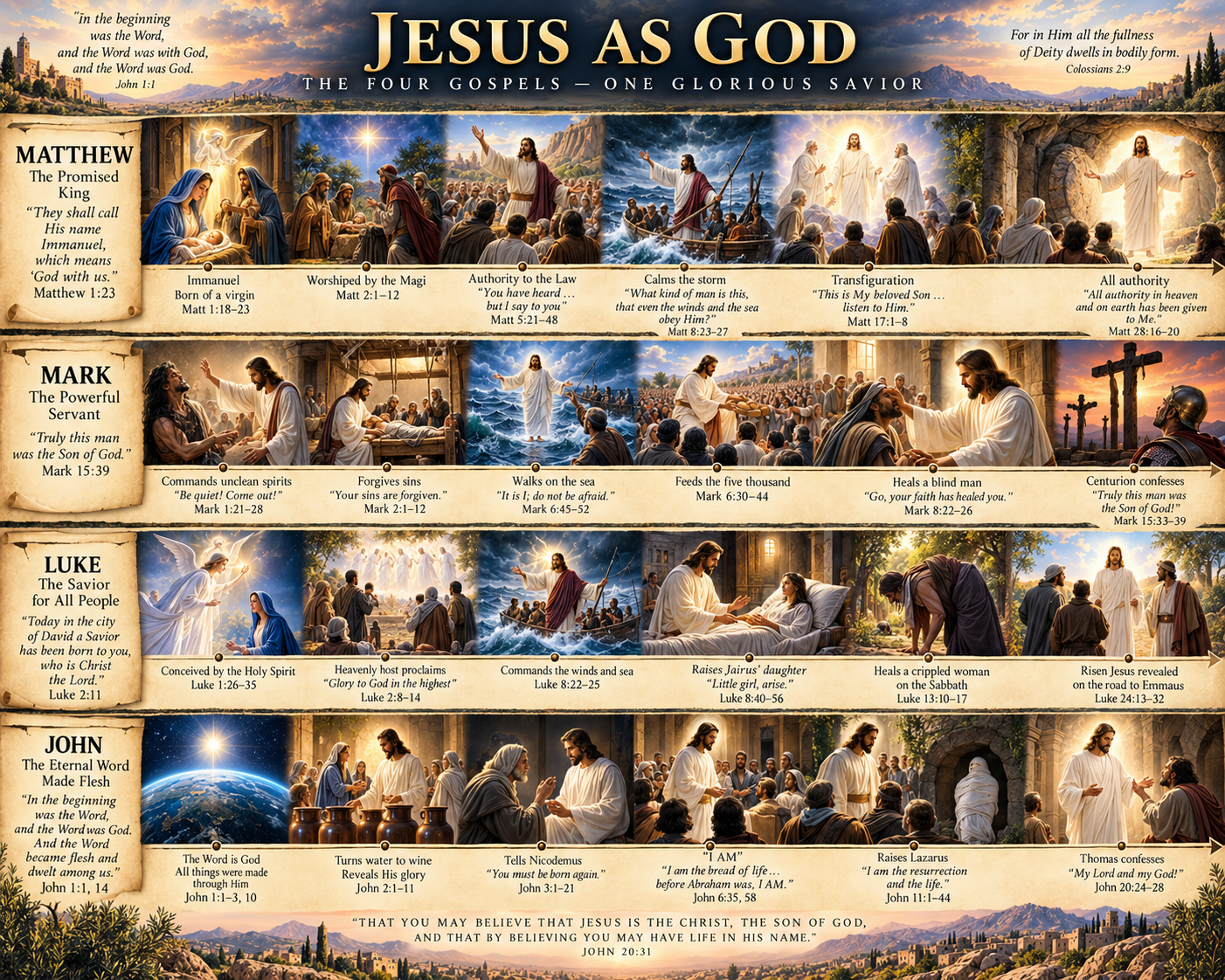
The Gospels never record Jesus saying the exact sentence, “I am God.” Yet they repeatedly portray Him saying and doing things Scripture associates with God, accepting divine titles and testimony, exercising divine prerogatives, and fulfilling Old Testament passages concerning YHWH. Explore the cumulative evidence across all four Gospels.
Click timeline image to enlarge
Showing 85-96 of 130 evidence records.
Jesus Is the Meeting Place of Heaven and Earth
John 1:47-51
What Jesus said or did: Jesus promises that the disciples will see heaven opened and God's angels ascending and descending upon the Son of Man.
Why this points to His divinity: This anticipates John's Temple and divine-presence themes: access to God is concentrated in Jesus.
Read the full evidence
Jesus Identifies His Body as God's Temple
John 2:13-22
What Jesus said or did: Jesus speaks of raising the destroyed temple in three days, and John explains that he was speaking about the temple of his body.
Why this points to His divinity: Identifying Jesus' body as the locus of divine presence strongly advances John's incarnational Christology.
Read the full evidence
The Son of Man Descended from Heaven
John 3:13
What Jesus said or did: Jesus describes the Son of Man as the one who descended from heaven.
Why this points to His divinity: It is direct evidence of pre-existence without requiring this verse alone to establish eternal existence.
Read the full evidence
God Gives His Unique Son for Eternal Life
John 3:16-18
What Jesus said or did: God gives his unique Son so that those believing in him have eternal life; condemnation is linked to refusing belief in the Son's name.
Why this points to His divinity: The unique Son occupies the decisive saving role in God's love for the world.
Read the full evidence
The Son from Heaven Is Above All
John 3:31-36
What Jesus said or did: The one from above is above all, speaks God's words, gives the Spirit without measure, has all things placed in his hand, and is the object of faith for eternal life.
Why this points to His divinity: The concentration of divine roles makes this a strong cumulative statement of Jesus' unique status.
Read the full evidence
Jesus Gives the Living Water of Eternal Life
John 4:10-14
What Jesus said or did: Jesus tells the Samaritan woman that he can give living water which becomes a spring welling up to eternal life.
Why this points to His divinity: The claim anticipates John 7, where Jesus again summons the thirsty to come to him and John identifies the gift with the Spirit.
Read the full evidence
Jesus Makes Himself Equal with God
John 5:16-18
What Jesus said or did: Jesus defends his Sabbath work by saying his Father is working and he is working; John says his opponents understood him to be making himself equal with God.
Why this points to His divinity: John explicitly frames the controversy as involving equality with God, then develops that equality in function and honor in verses 19-23.
Read the full evidence
The Son Does What the Father Does and Receives the Father's Honor
John 5:19-23
What Jesus said or did: Jesus says the Son does whatever the Father does, gives life to whom he wills, exercises judgment, and must be honored just as the Father is honored.
Why this points to His divinity: This is one of the strongest Synoptic-or-Johannine statements of divine function and honor while preserving personal distinction between Father and Son.
Read the full evidence
The Dead Hear the Son's Voice and Live
John 5:24-29
What Jesus said or did: Jesus says the dead will hear the voice of the Son of God and live, and that all in the tombs will hear his voice and rise for life or judgment.
Why this points to His divinity: Raising all the dead and determining the judgment associated with resurrection are unmistakably divine-scale prerogatives.
Read the full evidence
Jesus Walks on the Sea and Says I Am
John 6:16-21
What Jesus said or did: Jesus approaches the disciples walking on the sea and tells them, 'I am; do not be afraid.'
Why this points to His divinity: Jesus performs an action associated with YHWH's sovereignty and accompanies it with language that participates in John's larger 'I am' pattern.
Read the full evidence
Jesus Is the Bread from Heaven Who Gives Eternal Life
John 6:32-40
What Jesus said or did: Jesus identifies himself as the bread of life sent from heaven, promises eternal life to believers, and says he will raise them at the last day.
Why this points to His divinity: The combination of heavenly origin, life-giving identity, and authority to raise believers at the last day is strongly divine in scale.
Read the full evidence
Jesus Says He Came Down from Heaven
John 6:41-51
What Jesus said or did: Jesus repeatedly says he came down from heaven and again promises to raise believers at the last day.
Why this points to His divinity: This is strong evidence that John's Jesus understands his life as a heavenly descent, not merely an earthly prophetic vocation.
Read the full evidence