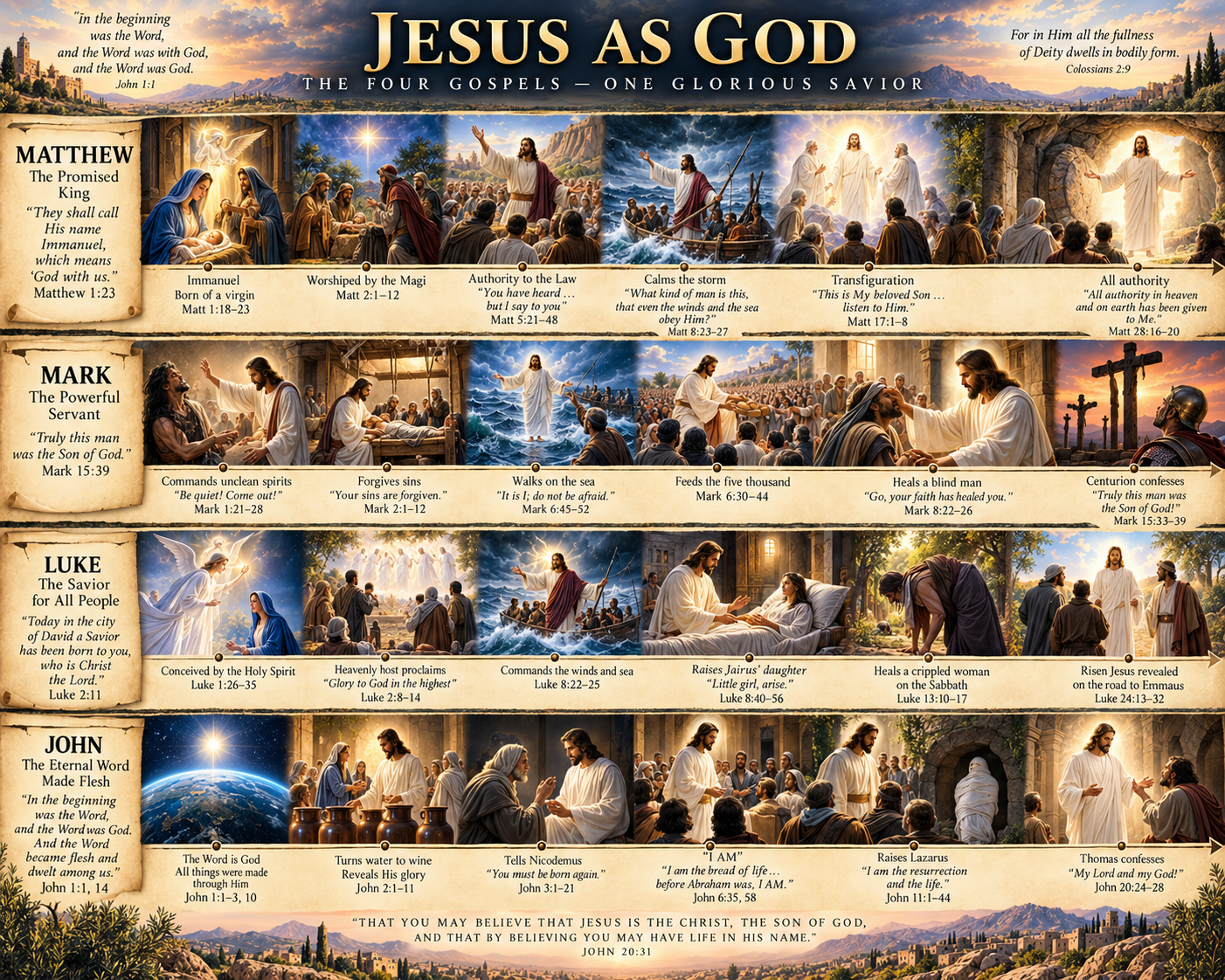
Jesus as God
The Gospels never record Jesus saying the exact sentence, “I am God.” Yet they repeatedly portray Him saying and doing things Scripture associates with God, accepting divine titles and testimony, exercising divine prerogatives, and fulfilling Old Testament passages concerning YHWH. Explore the cumulative evidence across all four Gospels.
Click timeline image to enlarge
Showing 1-12 of 35 evidence records.
John Prepares the Way of the Lord for Jesus
Luke 1:16-17; Luke 1:76
What Jesus said or did: John is said to go before the Lord God and to prepare the Lord's ways; in Luke's narrative John actually prepares for Jesus.
Why this points to His divinity: The argument rests on Luke's narrative use of YHWH texts, not on a bare title. It is strong evidence that Jesus is included in the divine visitation anticipated by Scripture.
Read the full evidence
The Holy Child Is the Son of God
Luke 1:32-35
What Jesus said or did: Gabriel announces that Jesus will be Son of the Most High and Son of God, will receive David's throne, and will reign forever.
Why this points to His divinity: Royal sonship alone would not prove deity, but Luke fills the title with features that make Jesus' sonship unique and foundational to his identity.
Read the full evidence
Elizabeth Calls Jesus My Lord
Luke 1:39-45
What Jesus said or did: Filled with the Holy Spirit, Elizabeth calls Mary the mother of her Lord.
Why this points to His divinity: The word Lord alone is not proof of deity, but its placement within Luke 1-2 and the inspired character of Elizabeth's testimony make it strong cumulative evidence.
Read the full evidence
A Savior Is Born Who Is Christ the Lord
Luke 2:8-14
What Jesus said or did: The angel announces the birth of a Savior who is Christ the Lord, followed by heavenly praise to God.
Why this points to His divinity: The shepherds go to see the child and later glorify and praise God.
Read the full evidence
Simeon Sees God's Salvation in Jesus
Luke 2:25-35
What Jesus said or did: Simeon takes Jesus in his arms and declares that his eyes have seen God's salvation, prepared for all peoples.
Why this points to His divinity: Simeon blesses God and prophetically describes Jesus' future significance.
Read the full evidence
Jesus Calls God His Father
Luke 2:41-50
What Jesus said or did: At age twelve Jesus explains that he must be in his Father's house or about his Father's affairs.
Why this points to His divinity: Mary and Joseph do not understand the saying.
Read the full evidence
Do Not Put the Lord Your God to the Test
Luke 4:9-12
What Jesus said or did: When Satan tests Jesus at the Temple, Jesus answers with the command not to put the Lord God to the test.
Why this points to His divinity: Because the Christological implication is indirect and debated, this record is appropriately Supporting.
Read the full evidence
Jesus Forgives the Paralytic's Sins
Luke 5:17-26
What Jesus said or did: Jesus forgives a paralytic's sins, perceives his critics' thoughts, and heals the man to demonstrate the Son of Man's authority to forgive sins.
Why this points to His divinity: Luke deliberately presents Jesus exercising the disputed divine prerogative and validating that authority through healing.
Read the full evidence
The Son of Man Is Lord of the Sabbath
Luke 6:1-5
What Jesus said or did: Jesus declares that the Son of Man is Lord of the Sabbath.
Why this points to His divinity: Lordship over a divine covenant institution is an extraordinary claim and contributes strongly to Luke's portrait of Jesus' authority.
Read the full evidence
Jesus Raises the Widow's Son at Nain
Luke 7:11-17
What Jesus said or did: Jesus compassionately stops a funeral and directly commands a widow's dead only son to arise; the young man sits up and speaks.
Why this points to His divinity: Fear seizes the crowd; they glorify God, call Jesus a great prophet, and say God has visited his people.
Read the full evidence
Jesus Performs the Signs of the LORD's Coming
Luke 7:18-23
What Jesus said or did: Asked whether he is the coming one, Jesus points to the blind seeing, lame walking, deaf hearing, dead rising, and good news reaching the poor.
Why this points to His divinity: The force lies not in miracle-working alone but in the correspondence between Jesus' works and Isaiah's promised divine salvation.
Read the full evidence
Who Is This Who Even Forgives Sins?
Luke 7:36-50
What Jesus said or did: Jesus declares the woman's sins forgiven and tells her that her faith has saved her and that she may go in peace.
Why this points to His divinity: The guests question Jesus' identity because he forgives sins.
Read the full evidence