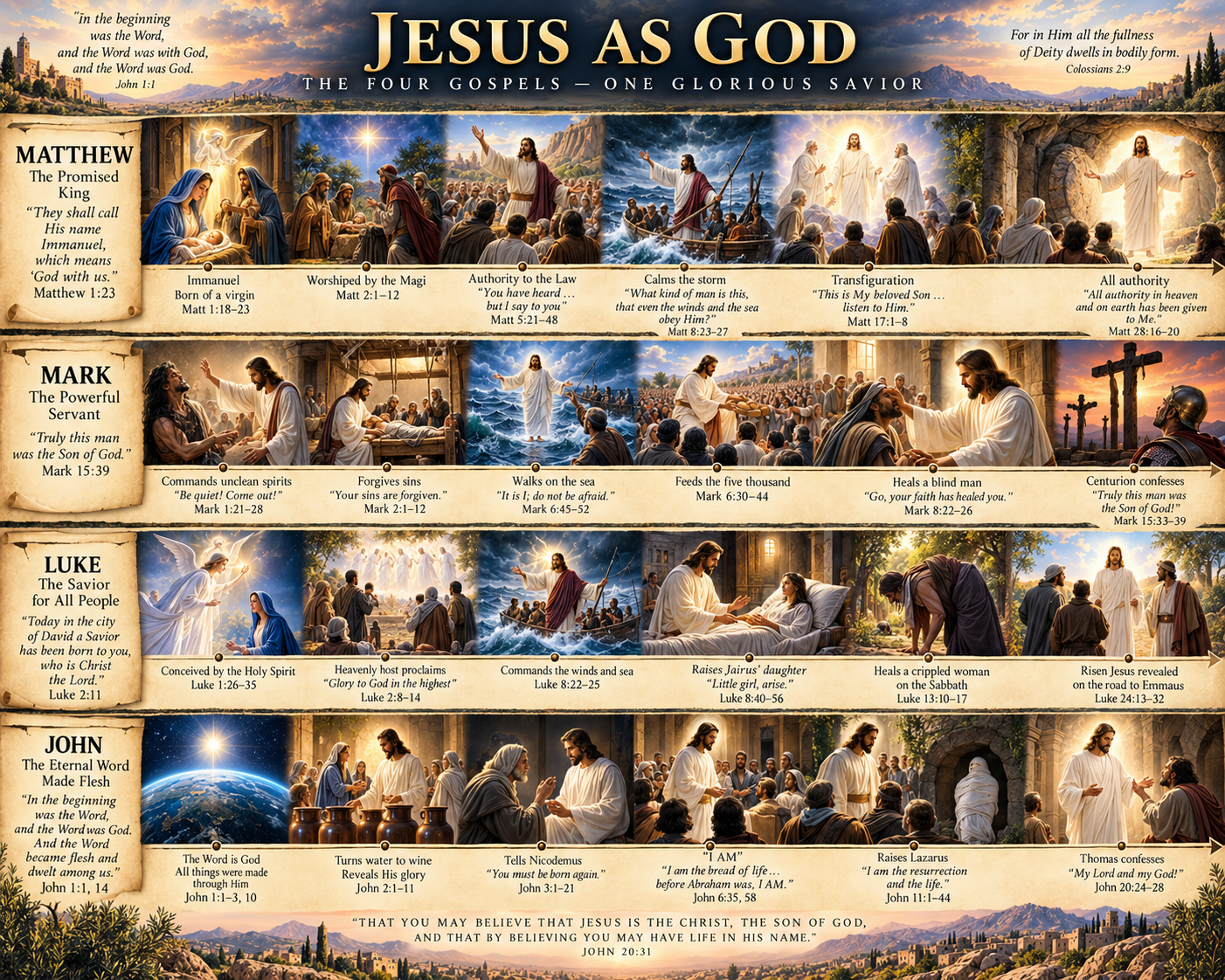
Jesus as God
The Gospels never record Jesus saying the exact sentence, “I am God.” Yet they repeatedly portray Him saying and doing things Scripture associates with God, accepting divine titles and testimony, exercising divine prerogatives, and fulfilling Old Testament passages concerning YHWH. Explore the cumulative evidence across all four Gospels.
Click timeline image to enlarge
Showing 97-108 of 130 evidence records.
Eternal Life Depends upon Jesus
John 6:53-58
What Jesus said or did: Jesus says that participation in him is necessary for life, that those who feed on him have eternal life, and that he will raise them at the last day.
Why this points to His divinity: Jesus places himself personally at the center of eternal life and future resurrection.
Read the full evidence
Jesus Gives the Living Water of the Spirit
John 7:37-39
What Jesus said or did: Jesus publicly invites the thirsty to come to him and drink; John explains that he spoke about the Holy Spirit believers would receive.
Why this points to His divinity: John places Jesus in the role of the divine source from whom life-giving water and the Spirit are received.
Read the full evidence
Jesus Is the Light of the World
John 8:12
What Jesus said or did: Jesus declares that he is the light of the world and that whoever follows him will have the light of life.
Why this points to His divinity: The claim participates in the Prologue's identification of life and light with the divine Word.
Read the full evidence
Jesus Is from Above and Faith in I Am Is Necessary
John 8:23-24
What Jesus said or did: Jesus contrasts his heavenly origin with his hearers' earthly origin and says they will die in their sins unless they believe that 'I am.'
Why this points to His divinity: No single grammatical feature should be overstated, but within John's cumulative pattern this is strong evidence of divine identity.
Read the full evidence
When the Son of Man Is Lifted Up, You Will Know I Am
John 8:28-30
What Jesus said or did: Jesus says that when the Son of Man is lifted up, his hearers will know that 'I am.'
Why this points to His divinity: The passage contributes to a deliberate sequence culminating in John 8:58 rather than standing as an isolated proof.
Read the full evidence
Before Abraham Was, I Am
John 8:52-59
What Jesus said or did: Jesus says Abraham rejoiced to see his day and concludes, 'Before Abraham was, I am.'
Why this points to His divinity: This is among John's strongest sayings for Jesus' transcendent and eternal identity. The argument does not depend on claiming that every occurrence of ego eimi is a divine-name formula.
Read the full evidence
The Healed Man Believes in and Worships Jesus
John 9:35-38
What Jesus said or did: After Jesus reveals himself to the healed man, the man confesses belief and worships Jesus.
Why this points to His divinity: The accepted worship/homage is strong cumulative evidence when read within a Gospel that has already identified Jesus as God.
Read the full evidence
Jesus Is the Good Shepherd of God's Sheep
John 10:1-16
What Jesus said or did: Jesus identifies himself as the good shepherd who knows his sheep, gives them abundant life, and lays down his life for them.
Why this points to His divinity: The claim is strong because Jesus fulfills a role Ezekiel explicitly assigns to YHWH himself while also fulfilling messianic expectation.
Read the full evidence
Jesus Has Authority to Take Up His Life Again
John 10:17-18
What Jesus said or did: Jesus says he has authority to lay down his life and authority to take it up again.
Why this points to His divinity: The saying gives Jesus an extraordinary authority over his own death and resurrection without erasing his obedient relationship to the Father.
Read the full evidence
No One Can Snatch Jesus' Sheep from His Hand
John 10:27-30
What Jesus said or did: Jesus gives his sheep eternal life, says no one can snatch them from his hand or the Father's hand, and concludes, 'I and the Father are one.'
Why this points to His divinity: The unity claim is grounded in shared saving action and sovereign security. The Father and Son remain personally distinct while acting with divine unity.
Read the full evidence
I and the Father Are One
John 10:30-33
What Jesus said or did: Jesus declares, 'I and the Father are one,' and his opponents say they intend to stone him because, being a man, he makes himself God.
Why this points to His divinity: The passage explicitly places the question of Jesus' deity within the narrative and connects it to his unity with the Father.
Read the full evidence
The Father Is in Jesus and Jesus Is in the Father
John 10:34-39
What Jesus said or did: After citing Psalm 82, Jesus calls himself the Son of God and tells his hearers to recognize that the Father is in him and he is in the Father.
Why this points to His divinity: The mutual-indwelling claim intensifies rather than dissolves the unique relationship expressed in John 10:30.
Read the full evidence