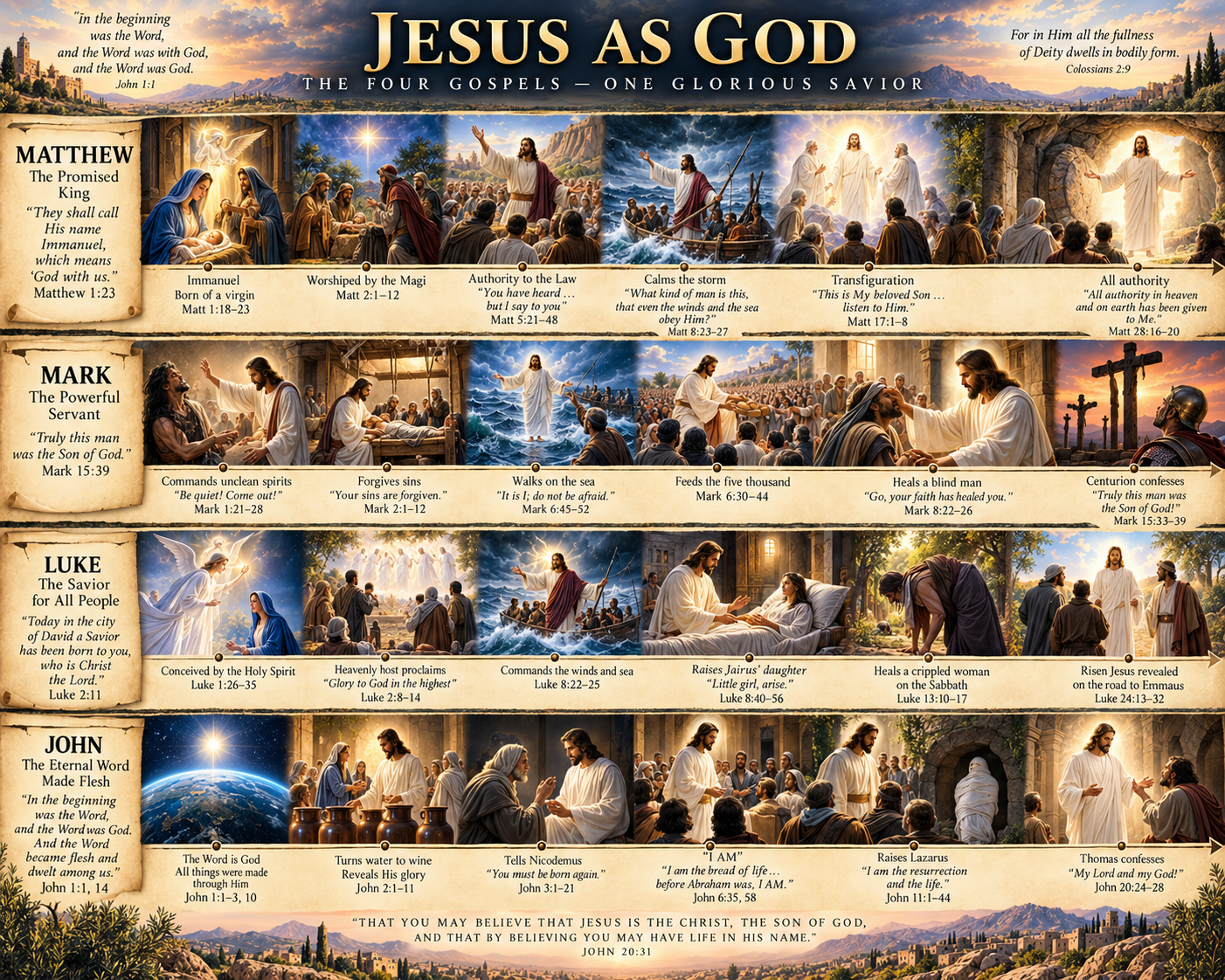
Jesus as God
The Gospels never record Jesus saying the exact sentence, “I am God.” Yet they repeatedly portray Him saying and doing things Scripture associates with God, accepting divine titles and testimony, exercising divine prerogatives, and fulfilling Old Testament passages concerning YHWH. Explore the cumulative evidence across all four Gospels.
Click timeline image to enlarge
Showing 121-130 of 130 evidence records.
Jesus Is the True Vine and Source of Fruitful Life
John 15:1-6
What Jesus said or did: Jesus identifies himself as the true vine and says that disciples can bear fruit only by abiding in him because apart from him they can do nothing.
Why this points to His divinity: The saying is not a direct YHWH identification, but the absolute dependence of disciples upon abiding in Jesus contributes strongly to his life-giving identity.
Read the full evidence
Jesus Sends the Holy Spirit from the Father
John 15:26-27; John 16:7-15
What Jesus said or did: Jesus says he will send the Helper from the Father and later repeats that if he goes away he will send the Spirit to the disciples.
Why this points to His divinity: Jesus' authority to send the divine Spirit and his claim that all the Father's possessions are his are strongly Christological.
Read the full evidence
Jesus Came from the Father and Returns to the Father
John 16:28
What Jesus said or did: Jesus summarizes his mission by saying he came from the Father into the world and is leaving the world to go to the Father.
Why this points to His divinity: It supports John's repeated distinction between Jesus' earthly birth and his prior existence with the Father.
Read the full evidence
Jesus Shared the Father's Glory Before Creation
John 17:1-5
What Jesus said or did: Jesus asks the Father to glorify him in the Father's presence with the glory he had with the Father before the world existed.
Why this points to His divinity: This is direct first-person testimony to pre-creation existence and shared divine glory, making it one of John's strongest deity passages.
Read the full evidence
The Father Loved the Son Before the Foundation of the World
John 17:20-24
What Jesus said or did: Jesus says the Father loved him before the foundation of the world and asks that believers behold his glory.
Why this points to His divinity: The passage strengthens John's presentation of eternal personal relationship between Father and Son while preserving their distinction.
Read the full evidence
Jesus Says I Am and His Arresters Fall Before Him
John 18:4-8
What Jesus said or did: When Jesus identifies himself with ego eimi, the armed party draws back and falls to the ground; Jesus then voluntarily gives himself into their custody.
Why this points to His divinity: For that reason the record is retained as Supporting rather than made to carry independent proof of deity.
Read the full evidence
The Risen Jesus Gives the Holy Spirit to His Disciples
John 20:19-23
What Jesus said or did: The risen Jesus commissions his disciples, breathes on them, and tells them to receive the Holy Spirit.
Why this points to His divinity: The action joins resurrection, new creation, divine breath, and Jesus' authority to give the Spirit.
Read the full evidence
Thomas Confesses Jesus as My Lord and My God
John 20:24-29
What Jesus said or did: Thomas addresses the risen Jesus directly as 'My Lord and my God,' and Jesus responds to the confession as Thomas' belief.
Why this points to His divinity: This is one of the clearest direct identifications of Jesus as God in the New Testament and forms a literary inclusio with John 1:1.
Read the full evidence
Life Is Found in Jesus' Name
John 20:30-31
What Jesus said or did: John says his signs were written so readers may believe Jesus is the Christ and Son of God and, believing, have life in his name.
Why this points to His divinity: The Gospel's stated goal confirms that its high Christology is not abstract speculation but the basis of saving faith.
Read the full evidence
The Risen Jesus Entrusts His Sheep to Peter
John 21:15-17
What Jesus said or did: The risen Jesus repeatedly commands Peter to feed and tend 'my' lambs and sheep.
Why this points to His divinity: The scene reinforces Jesus' fulfillment of the divine-shepherd role and his continuing authority over his people.
Read the full evidence