Apologetics Investigations
All people have questions about God and about faith.
For committed Christians, the answers to those questions can prove a bulwark to their faith, while for others, the same answers may incline them toward a closer and more patient study of the claims of Christianity.
It can be helpful to structure one's queries as a series of "investigations," each of which examines one of the essential issues that underpin Christianity. We have assembled here such a series of inquiries, each of which can be examined in isolation, or as part of a progressive series that leads to important summary statements about the claims of the Christian faith.

These eighteen investigations are arranged as a sequence. They begin with questions about historical evidence and testimony, then move through the Gospels, archaeology, manuscripts, and the earliest Christian witnesses.
The final investigations concentrate on the Resurrection of Jesus and ask what explanation best accounts for the evidence that has been considered.
You may begin with Investigation 1 and proceed in order, or enter the series at any question that interests you.
Investigation 01
Historical Evidence
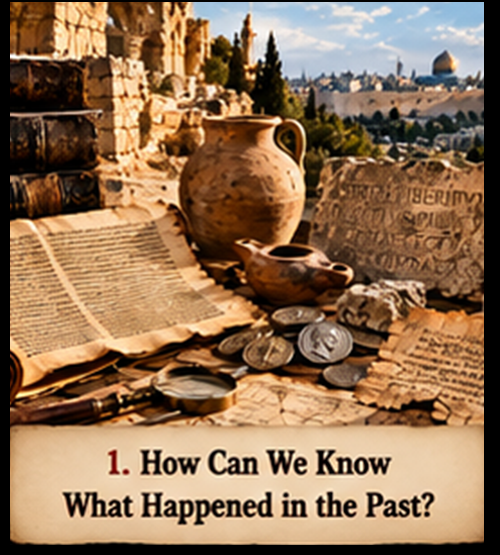
How Can We Know What Happened in the Past?
Historical events cannot be repeated in a laboratory, but they can be investigated. We begin by considering how documents, eyewitness testimony, archaeology, corroboration, historical context, and competing explanations can help us determine what most reasonably happened in the past.
Investigation 02
Miracles and History
Can Miracles Be Considered as Historical Explanations?
The resurrection is an extraordinary claim because it involves the action of God. Before considering the evidence, we must ask whether miraculous events should automatically be ruled out or whether the evidence should be allowed to lead us toward the best explanation.
Investigation 03
Best Explanation
How Do We Decide Which Explanation Best Fits the Evidence?
Historical investigation often involves choosing among competing explanations. We consider how explanatory power, consistency with known evidence, unnecessary assumptions, and the ability to account for the whole picture can help us evaluate competing claims.
Investigation 04
The Cumulative Case
What Happens When the Evidence Is Considered Together?
Few historical conclusions depend upon one decisive piece of evidence. Christianity presents a cumulative case involving testimony, documents, archaeology, historical setting, fulfilled expectations, the origin of Christian belief, and especially the resurrection of Jesus.
Investigation 05
Eyewitness Testimony
Can Eyewitness Testimony Be Trusted?
Much of what we know about history ultimately depends upon testimony. We examine what makes testimony trustworthy and whether familiar objections to eyewitness evidence actually undermine the Gospel accounts.
Investigation 06
Gospel Witnesses
Were the Gospel Writers in a Position to Know What Happened?
The reliability of the Gospels depends partly upon whether their authors and sources were positioned to know what they recorded. We examine their relationship to Jesus, the apostles, the earliest Christian communities, and the events they describe.