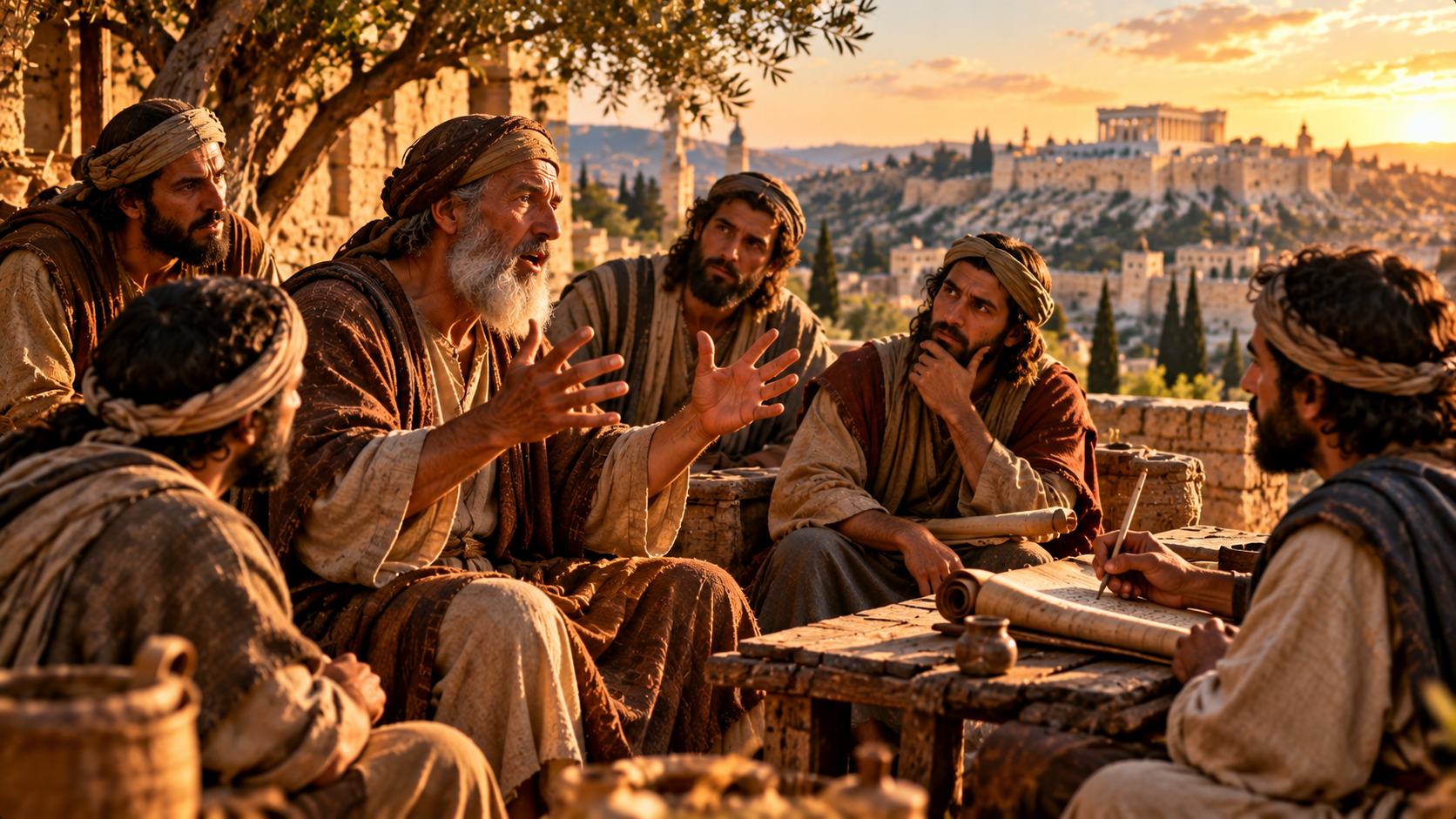
Much of what we know about the world comes from other people.
We trust reports about events we did not personally see. We listen to people who were present. We compare their accounts with other evidence. This is true in everyday life, in courts, and in the study of history.
Of course, eyewitnesses can make mistakes. People do not remember every detail perfectly. Two witnesses may notice different things. A person can even lie.
But none of this means that eyewitness testimony is worthless.
The sensible question is not, "Can a witness ever be wrong?" The answer is obviously yes.
The better question is, "When does a witness deserve to be believed?"
That question matters greatly when we turn to the Gospels and the earliest Christian testimony about Jesus.
The Question
What makes testimony credible, and how should we evaluate accounts written by people claiming knowledge of extraordinary events?
What We Know
Good testimony can bring us close to an event we did not personally witness.
When we evaluate it, several simple questions can help.
Was the person in a position to know?
A witness is most useful when he actually saw or heard the event, or when he received his information from people who did.
This is why the New Testament repeatedly draws attention to witnesses.
Luke begins his Gospel by saying that accounts of Jesus had been handed down by those who were "eyewitnesses, and ministers of the word." He then says that he had carefully followed the matter so that he could write an orderly account (Luke 1:1-4).
John also places great importance on testimony. Near the crucifixion account he says that the one who saw what happened bore witness so that others might believe (John 19:35). Near the end of the Gospel, the writer again points to the testimony behind the account (John 21:24).
Does the witness distinguish seeing from hearing?
A trustworthy account does not have to pretend that the writer personally witnessed everything.
Luke does not claim to have followed Jesus through Galilee. Instead, he tells us that he investigated what had been handed down by eyewitnesses.
That kind of distinction matters. It allows us to ask where the information came from rather than assuming that every writer must have seen every event himself.
Do other sources support the testimony?
A witness becomes more useful when parts of the account can be checked.
Names can be compared. Places can be located. Rulers and public events can be examined. Customs and geography can be tested against what is known of the time.
As we continue, we will see that the Gospel accounts contain many details of this kind.
Do differences automatically mean that someone is wrong?
No.
Two people can witness the same event and remember different details. One may notice a person whom another barely mentions. One may summarize a conversation while another gives more detail. One writer may arrange material differently because he is emphasizing a different point.
Differences deserve examination. Real contradictions should not be ignored. But variation by itself is not proof that testimony is false.
What reason would the witness have to deceive us?
Motive also matters.
Did the witness gain money, power, or safety from the claim? Was there an obvious reason to invent the story? Or did the testimony bring hardship and opposition?
This question does not prove that sincere people are always correct. A person can sincerely believe something that is mistaken.
But sincerity and accuracy are different questions. We should ask both.
Why It Matters
Christianity began with testimony.
The apostles did not merely announce a new philosophy. They said that they had seen and heard things.
John writes, "that which we have seen and heard declare we unto you" (1 John 1:3). Peter tells his readers that the apostles had not followed "cunningly devised fables" but had been eyewitnesses of Christ's majesty (2 Peter 1:16).
Most importantly for our investigation, the earliest Christians proclaimed that Jesus had been raised from the dead and had appeared to witnesses.
Paul names Peter, the Twelve, James, other apostles, a large group of believers, and finally himself when recounting appearances of the risen Christ (1 Corinthians 15:3-8).
If those claims are connected to people who were in a position to know what happened, they deserve serious attention.
That is why the question of eyewitness testimony is not a side issue. It leads directly into the historical foundation of the Christian faith.
Questions & Challenges
Human memory is not perfect.
We should acknowledge that plainly.
People forget details. Later experiences can affect how events are remembered. Stories can be shortened, expanded, or told with different emphasis. Strong emotion can make some details unforgettable while others fade.
These facts give us reasons to examine testimony carefully. They do not give us a reason to discard all testimony.
There is also an important difference between remembering the main event and remembering every small detail surrounding it.
A person may clearly remember that a friend was injured in an accident while being uncertain about exactly where everyone was standing. Uncertainty about the smaller detail does not erase the central event.
The same caution should guide our reading of the Gospels. We should not demand that four accounts use identical words or include exactly the same details. At the same time, apparent differences deserve thoughtful examination rather than automatic dismissal.
Another challenge is that the Gospel writers were Christians.
They believed in Jesus and wanted others to believe.
That fact should be recognized, but belief does not automatically make a witness unreliable. A person may become deeply convinced precisely because of what he believes he saw and experienced.
The question remains the same: What did these witnesses know, and how well does their testimony stand up when compared with the rest of the evidence?
Eyewitness testimony must be examined carefully, including what a witness could observe, remember, communicate, and preserve.
Considering the Evidence
Eyewitness testimony should neither be accepted blindly nor rejected automatically.
It should be examined.
That is exactly what we will do with the Gospel accounts.
We will ask whether the people behind them were close enough to Jesus and the earliest Christian community to know what happened. We will look for signs that the accounts reflect real people and real places. We will examine their differences rather than hiding them. We will compare their testimony with archaeology, history, and sources outside the New Testament.
We will also ask what happened to the people who first proclaimed that Jesus had risen from the dead.
None of these questions, by itself, settles the truth of Christianity.
But together they help us decide whether the testimony at the heart of the Christian faith deserves our confidence.
Our next question follows naturally:
Were the Gospel writers and their sources actually in a position to know what happened?
Continue exploring this question through related material already available on A Visit With Jesus.
People
Jesus' Apostles
Explore the Twelve Apostles, their roles in the Gospel accounts, biblical information about their lives, and traditions concerning their later ministries.
Follow the Bible from the origins of Israel's Scriptures through Jesus and the apostles, the New Testament writings, manuscript transmission, canon recognition, translation, printing, and modern Bible versions.
Evidence
Resurrection and the Early Church
Explore the central place of the Resurrection in apostolic preaching and the repeated claim of the apostles that they were witnesses to what God had done in Jesus Christ.
In Summary
Much of what we know about history ultimately depends upon testimony. We examine what makes testimony trustworthy and whether familiar objections to eyewitness evidence actually undermine the Gospel accounts.