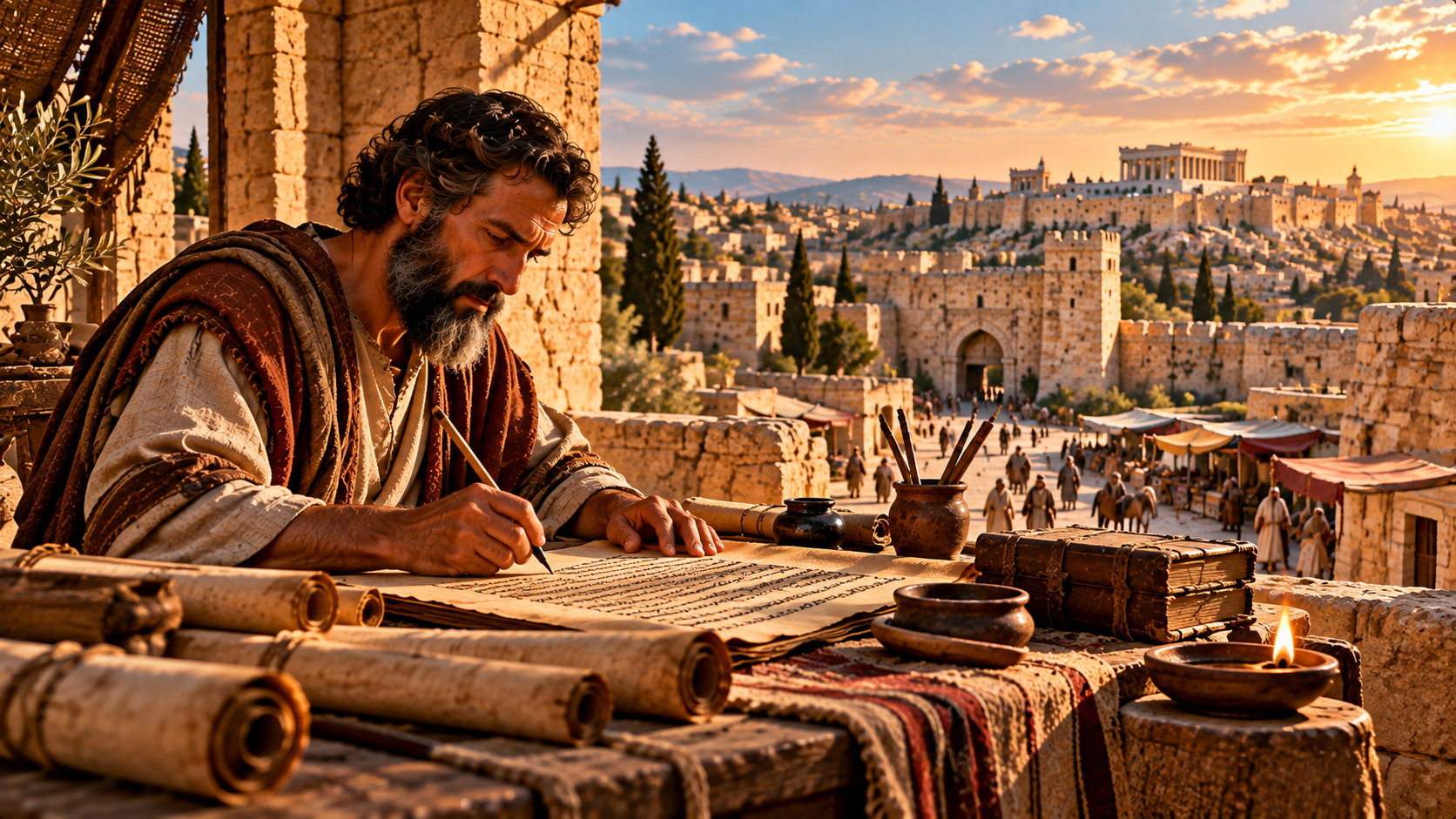
Were the Gospel Writers in a Position to Know What Happened?
The Gospels tell us about the life, teaching, death, and Resurrection of Jesus.
But where did their information come from?
This question matters. A story written centuries later by people far removed from the events would deserve very different treatment from an account rooted in the first generations of the Christian Church.
The four Gospels did not appear in a distant world that had forgotten Jesus and His apostles. They arose within the early Christian community that had been formed by their preaching and testimony.
Christian tradition identifies the four Gospel writers as Matthew, Mark, Luke, and John. The evidence for each is not identical. Matthew and John were associated with the apostolic circle. Mark was remembered as closely connected with Peter. Luke openly tells us that he drew upon earlier accounts and eyewitness testimony.
We should therefore look at each Gospel carefully and ask a straightforward question:
Was the writer, or the testimony behind his account, close enough to the events to know what happened?
The Question
Were the authors and sources behind the Gospels close enough to Jesus, His followers, and the events they describe to preserve reliable information?
What We Know
The four Gospels come to us from the first generations of Christianity.
They are not anonymous legends that first appeared hundreds of years after Jesus. Early Christians preserved names for these books and also preserved traditions about where their information came from.
Matthew
From early in the Church's history, the first Gospel was associated with Matthew, the tax collector whom Jesus called to become one of the Twelve (Matthew 9:9; 10:2-4).
An early Christian writer named Papias, whose work is known to us through later quotations, connected Matthew with a collection of the sayings of Jesus. Exactly how Papias' statement relates to the Gospel of Matthew as we now have it has been discussed for centuries.
Still, the early attribution is important. The Church did not remember this Gospel as a book that appeared from nowhere. It connected it with the apostolic generation.
Mark
Mark was not one of the Twelve, but early Christian testimony connects his Gospel closely with Peter.
Papias said that Mark served as Peter's interpreter and carefully wrote down what he remembered of Peter's teaching about Jesus. The statement does not answer every question about how Mark composed his Gospel, but it shows how early Christians understood the source behind it.
The New Testament itself places a man named Mark within the apostolic world. Acts mentions John Mark, and Peter affectionately refers to "Marcus my son" (1 Peter 5:13).
If the early tradition is correct, Mark brings us the preaching and memories of one of Jesus' closest disciples.
Luke
Luke tells us more directly how he worked.
He begins by acknowledging that others had already written accounts. He says that the information had been handed down by eyewitnesses. He then explains that he had carefully investigated these things before writing his own orderly account (Luke 1:1-4).
Luke does not claim to have personally witnessed Jesus' ministry. He claims something different: careful investigation based upon material connected with those who did.
The book of Acts continues the story and at several points shifts into "we" language, describing journeys in which the writer presents himself as part of the traveling group (Acts 16:10-17; 20:5-15; 27:1-28:16).
Early Christian tradition identified this writer with Luke, a companion of Paul who is named in the New Testament (Colossians 4:14; Philemon 24).
John
The fourth Gospel repeatedly emphasizes witness and testimony.
At the crucifixion, the Gospel says that the person who saw what happened bore witness so that others might believe (John 19:35). Near the end, it points to "the disciple" whose testimony stands behind the account (John 21:24).
Early Christian tradition associated the Gospel with John and with the apostolic circle in Asia Minor.
Questions remain about the exact way the Gospel reached its final written form. But the book itself asks to be read as testimony rooted in someone who knew the events it describes.
The important point
We do not need to pretend that every question about Gospel authorship has been answered.
The more important fact for our investigation is that the Gospels arose close to the earliest Christian witnesses. They belong to the world of the apostles and the communities formed by their testimony.
That gives us good reason to examine what they say rather than dismissing them as late stories created long after the people who knew Jesus were gone.
Understanding who stood behind the Gospel accounts includes asking how close their sources were to the people, places, and events they describe.
Why It Matters
The Christian faith depends upon what happened to Jesus.
If the Gospels were written in a much later age with no meaningful connection to the people who knew Him, their testimony would be far less useful.
But the New Testament places us within the first generations of the Church.
Paul knew Peter and James (Galatians 1:18-19). Luke says that he investigated material handed down by eyewitnesses. John emphasizes testimony from someone who saw. Early Christian tradition connects Mark with Peter and Matthew and John with the apostolic generation.
This does not mean that every sentence in a Gospel came directly from an eyewitness standing beside Jesus at that moment.
It means that the Gospel tradition was formed and written within living reach of those who had known Jesus and those who had learned directly from them.
That is exactly the setting in which we would hope to find reliable information about His life.
Questions & Challenges
Gospel authorship is often presented as though there are only two choices.
Either we can prove beyond all doubt that Matthew, Mark, Luke, and John personally wrote every word attributed to them, or the Gospels must be treated as anonymous and unreliable.
That is too simple.
The books themselves do not begin with modern title pages saying, "I, Matthew, wrote this book." The familiar Gospel titles come from the early Church's identification of the books.
Questions can therefore be asked about how those names became attached to the Gospels and about the exact role each named author played in producing the final text.
Those are fair questions.
But uncertainty about one part of authorship does not erase everything else we know.
Luke explicitly describes his use of earlier accounts and eyewitness sources. John repeatedly emphasizes testimony. Early Christian writers preserve traditions connecting Mark with Peter and the Gospel of Matthew with the apostolic generation. The Gospels also display detailed knowledge of the first-century world that we will examine later.
We should therefore avoid two extremes.
We should not claim more certainty than the evidence allows about every detail of how each Gospel was composed.
But neither should we assume that an ancient book becomes historically useless simply because it was written differently from a modern biography.
The real question is whether the Gospels preserve trustworthy testimony about Jesus.
Considering the Evidence
The evidence places the Gospels much closer to Jesus than the idea of slowly developing legends written in a distant age would suggest.
Matthew is connected by early tradition with the apostolic generation. Mark is connected with Peter. Luke openly tells us that he investigated eyewitness material. John presents his account as rooted in testimony.
The details are not identical for all four books, and we should not pretend that they are.
But together they give us a collection of accounts arising from the world created by Jesus' first followers.
That makes the next question especially important.
Being close to witnesses is valuable. But do the Gospel accounts themselves show signs of familiarity with the people, places, customs, and events they describe?
If they do, we should expect to find those marks throughout the narratives.
That is what we will examine next.
Do the Gospels show signs of eyewitness testimony?
Continue exploring this question through related material already available on A Visit With Jesus.
People
Jesus' Apostles
Explore the Twelve Apostles, their roles in the Gospel accounts, biblical information about their lives, and traditions concerning their later ministries.
Explore the life and ministry of Jesus, the people and places around Him, His first-century setting, His crucifixion and Resurrection, and evidence concerning His place in history.
History
History of the Bible
Follow the Bible from the origins of Israel's Scriptures through Jesus and the apostles, the New Testament writings, manuscript transmission, canon recognition, translation, printing, and modern Bible versions.
In Summary
The reliability of the Gospels depends partly upon whether their authors and sources were positioned to know what they recorded. We examine their relationship to Jesus, the apostles, the earliest Christian communities, and the events they describe.