Do the Gospels Show Signs of Eyewitness Testimony?
A person who truly knows a place often reveals that knowledge without trying.
He knows which road leads where. He remembers the names of towns and neighborhoods. He knows local customs. He may mention a building, a gate, a pool, or a landmark simply because it belongs to the story.
The Gospels contain many details like these.
Jesus does not move through an imaginary landscape. He travels through Galilee and Judea. He enters named towns. He crosses the Sea of Galilee. He goes up to Jerusalem. The writers mention rulers, religious groups, festivals, buildings, pools, roads, customs, and people by name.
None of these details, standing alone, proves that every event in the Gospels happened exactly as described.
But together they allow us to ask an important question:
Do these accounts sound like stories rooted in the real world of first-century Judea and Galilee?
The Question
Do the names, places, customs, incidental details, and other features of the Gospel accounts suggest familiarity with the people and world they describe?
What We Know
The Gospel writers often include details that can be compared with what is known about the world in which Jesus lived.
They know real places
The Gospels name places such as Nazareth, Capernaum, Bethany, Bethsaida, Jericho, Jerusalem, the Mount of Olives, the Sea of Galilee, and the Jordan River.
Sometimes the descriptions become surprisingly specific.
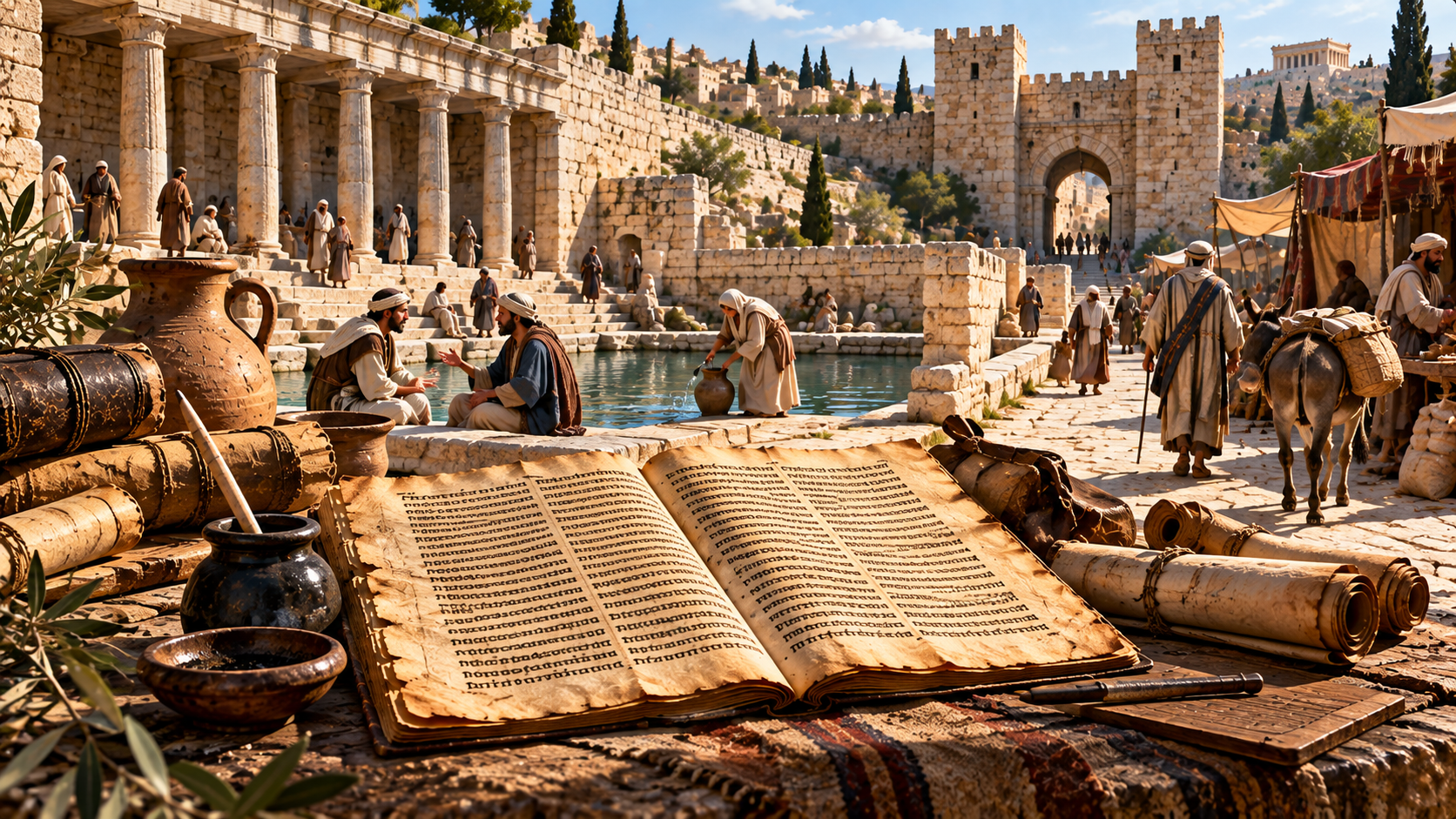
John describes a pool in Jerusalem called Bethesda near the Sheep Gate and says that it had five covered areas or porticoes (John 5:2). For a long time, that unusual description puzzled readers. Archaeological work at the site revealed a pool complex whose arrangement can account for the five porticoes.
John also sends the man born blind to wash in the Pool of Siloam (John 9:7). Archaeology has uncovered a large pool from the late Second Temple period in the area described by the Gospel.
Discoveries such as these do not prove the miracles that John reports. Archaeology cannot tell us whether Jesus healed a man beside a pool. But it can show that the writer knew places that belonged to the Jerusalem of Jesus' time.
They know the geography
The Gospel writers repeatedly move Jesus and His disciples through a recognizable landscape.
They distinguish Galilee from Judea. They know that Jerusalem stands above much of the surrounding country, which helps explain the biblical language of going "up" to Jerusalem. They place Bethany near the Mount of Olives and describe journeys around the Sea of Galilee.
These details are often part of the story rather than the point of the story. That makes them useful when asking whether the writers knew the world they described.
They name particular people
The Gospels are filled with names.
We meet Peter, Andrew, James, John, Matthew, Mary Magdalene, Martha, Lazarus, Jairus, Bartimaeus, Joseph of Arimathea, Pontius Pilate, Herod, Caiaphas, and many others.
Some are major figures. Others appear briefly and disappear from the story.
Named people can matter because they make a story more specific. Instead of saying only that "someone" did something, the account sometimes identifies who the person was.
They know local customs and institutions
The Gospels refer naturally to synagogues, the Temple, Passover, purification practices, Sabbath observance, Roman taxation, Jewish burial customs, religious leaders, and tensions between different groups.
The writers do not stop every few sentences to explain this world as though it were foreign to them. Much of it simply forms the background of their accounts.
They preserve small and seemingly unnecessary details
Eyewitness accounts often contain details that are not essential to the main point.
Mark tells us that Jesus had the crowd sit on the "green grass" before the feeding of the five thousand (Mark 6:39). John remembers that Peter warmed himself beside a charcoal fire during Jesus' trial (John 18:18). John later describes another charcoal fire beside the Sea of Galilee when the risen Jesus met His disciples (John 21:9).
Such details do not prove the events by themselves. But they contribute to the impression that the Gospel stories are attached to remembered places, people, and circumstances rather than floating free of history.
Why It Matters
Christianity is not built around a teacher who lived in an undefined past.
Jesus entered a particular world.
He taught in Galilee. He traveled to Jerusalem. He interacted with fishermen, tax collectors, priests, Roman officials, and ordinary families. He was crucified under Pontius Pilate.
The Gospel writers repeatedly place Him within that world.
This matters because their historical details can sometimes be checked. When archaeology or other ancient evidence confirms a place, a title, a custom, or a feature that a Gospel writer describes, it gives us another reason to take that writer's knowledge of his setting seriously.
It does not prove every claim in the Gospel.
But it strengthens the case that we are reading accounts rooted in the world they claim to describe.
Questions & Challenges
We should be careful not to ask archaeological evidence to do more than it can.
Finding the Pool of Siloam does not prove that Jesus healed the blind man there. Confirming the existence of Pontius Pilate does not prove everything the Gospels say about His trial. Knowing that a town existed does not prove that every reported event in that town occurred.
That distinction is important.
Historical details can help establish that a writer knew his setting. They cannot automatically establish every action or conversation he reports.
There is another caution.
Not every proposed identification is equally certain. Archaeologists sometimes disagree about ancient sites. New discoveries can change earlier conclusions. Even the interpretation of well-known locations may be debated.
Christians do not need to exaggerate such evidence.
Our case is stronger when we say exactly what a discovery shows and stop there.
The question in this investigation is not whether archaeology can prove the Gospel. It is whether the Gospels repeatedly display knowledge of the people and world in which their events are said to have occurred.
There is substantial evidence that they do.
Considering the Evidence
The Gospels contain more than broad statements about Jesus.
They place Him among named people, in identifiable towns, on recognizable roads, beside known bodies of water, within Jewish customs, and under rulers who belong to the history of the period.
Sometimes archaeology gives us an unexpected glimpse of that world.
The Pool of Bethesda provides a good example. John's unusual reference to five porticoes once seemed difficult to picture. Excavation of the pool complex helped explain how such a description could fit an actual Jerusalem site.
The Pool of Siloam provides another. John names it in the account of the man born blind, and remains of a large Second Temple-period pool have been uncovered in the area.
Again, neither discovery proves the miracle associated with the place.
What they do show is that John knew a Jerusalem that archaeology can still recognize.
As similar details accumulate across the Gospels, they become part of our larger investigation of their reliability.
But another question immediately follows.
If the Gospels preserve genuine testimony, why are their accounts not identical? Why does one writer include something another leaves out? Why do details sometimes appear to differ?
Those questions should not be avoided.
They are the subject of our next investigation:
Why do the Gospel accounts differ?
Names, locations, customs, geography, and incidental details provide opportunities to examine how closely the Gospel accounts reflect their historical setting.
Continue exploring this question through related material already available on A Visit With Jesus.
Background
Jesus & His World
Explore the life and ministry of Jesus, the people and places around Him, His first-century setting, His crucifixion and Resurrection, and evidence concerning His place in history.
Explore biblical locations, ancient Israel, Jerusalem, maps, the Temple, and the lands and journeys associated with Scripture.
Archaeology
Bible Archaeology
Explore archaeological discoveries, ancient inscriptions, manuscripts, artifacts, relics, reports, and video collections related to the historical world of the Bible.
In Summary
The Gospels contain numerous references to particular people, locations, customs, routes, political figures, and seemingly incidental details. We consider whether these features support the claim that the accounts preserve genuine historical memory.