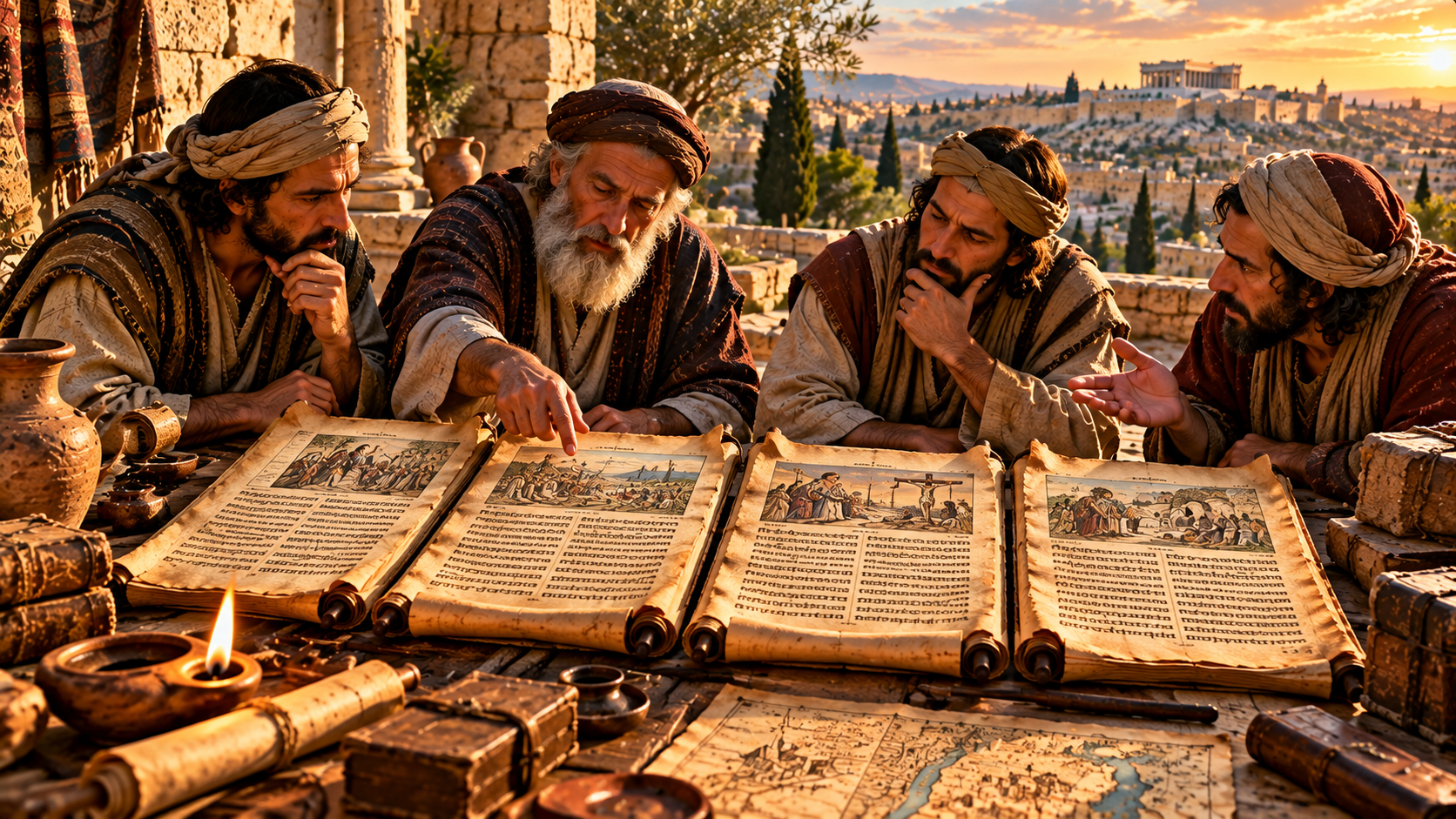
Anyone who reads the four Gospels carefully will notice that they are not identical.
Matthew may include a detail that Mark leaves out. Luke may tell an event more briefly. John may record a conversation that none of the other Gospel writers mentions. Sometimes the wording differs. Sometimes events are arranged differently.
For some readers, these differences are troubling.
But should four accounts of the same person be expected to say exactly the same things in exactly the same words?
If they did, we might have a different question: Why do we need four Gospels at all?
The differences deserve careful attention. We should not hide them or pretend they do not exist. But neither should we assume that every difference is a contradiction.
The better question is what kind of differences we are seeing and whether the accounts can still be understood as truthful testimony about the same Jesus.
The Question
Do differences among Matthew, Mark, Luke, and John undermine their testimony, or are differing details compatible with independent accounts of the same events?
What We Know
The four Gospel writers tell the same central story while making different choices about what to include and how to tell it.
Different writers select different details
No writer can include everything that happened.
John says this openly near the end of his Gospel. Jesus did many other things that were not included in his book (John 20:30; 21:25).
Selection is therefore unavoidable.
One writer may mention two people while another focuses on the one who speaks. One may name a person while another leaves the person unnamed. One may give a fuller version of a conversation while another summarizes it.
Leaving out a detail is not the same as denying that it happened.
Different writers emphasize different things
Each Gospel has its own shape and emphasis.
Matthew often draws attention to the fulfillment of Scripture. Mark moves rapidly through Jesus' ministry and gives vivid accounts of His actions. Luke frequently supplies historical setting and shows particular concern for people easily overlooked by society. John includes extended conversations and signs that point toward the identity of Jesus.
These differences do not give us four different Jesuses. They allow us to see the same Jesus through four presentations.
Ancient writers did not always report events the way modern writers do
We should be careful about expecting ancient biographies to follow every modern writing convention.
Ancient writers could shorten an account, paraphrase a speaker, emphasize one participant, or arrange material for the purpose of their narrative. Historians can observe similar practices in other ancient biographies.
This does not mean that ancient writers were free to invent whatever they wished.
It means that truthful reporting did not require a word-for-word transcript or identical arrangement in every account.
Some differences can be understood quite naturally
Consider the healing of the blind near Jericho.
Matthew mentions two blind men (Matthew 20:29-34). Mark focuses upon one and names him Bartimaeus (Mark 10:46-52). Luke also concentrates upon one blind man (Luke 18:35-43).
Mark and Luke do not say that only one man was present. They simply tell the story through the man who receives their attention.
This is a simple example of why difference does not automatically equal contradiction.
Some differences are more difficult
Not every Gospel difference can be explained in one sentence.
Readers have long discussed the wording of sayings, the order of events, the accounts of Jesus' birth, the details surrounding His trial, and the Resurrection narratives.
Those passages deserve patient study.
We do not strengthen the Christian case by pretending that every question is easy. We strengthen it by dealing with the texts honestly.
Why It Matters
Four Gospels give us something one account alone could not provide.
They allow us to compare testimony.
We see substantial agreement about the central course of Jesus' life. He ministered publicly, gathered disciples, taught about the Kingdom of God, performed deeds that His followers understood as miracles, came into conflict with religious leaders, went to Jerusalem, was crucified under Pontius Pilate, was buried, and was proclaimed risen by His followers.
At the same time, the writers do not simply repeat one another word for word.
Their differences remind us that we are reading distinct accounts with different selections and emphases.
For believers, this means we do not need to fear careful comparison of the Gospels.
Reading them together can deepen our understanding of Jesus rather than weaken it.
Questions & Challenges
There are two easy mistakes to make when Gospel accounts differ.
The first is to declare a contradiction too quickly.
If one writer mentions one angel at the empty tomb while another mentions two, that is not automatically a contradiction. Mentioning one does not necessarily mean that only one was present.
The second mistake is to force every difference into an elaborate explanation that the text itself never gives us.
Sometimes Christians have proposed complicated harmonizations simply because they felt that every detail had to be made identical.
We do not need to do that.
Ancient biographical writing allowed authors to select, summarize, paraphrase, emphasize, and arrange material in ways that may differ from modern expectations. Studies comparing the Gospels with other ancient biographies have shown that differences of this kind were not unusual.
This gives us room to read the Gospel writers on their own terms.
At the same time, genuine difficulties should be acknowledged. If two passages appear hard to reconcile, we can say so. We can examine possible explanations without pretending to know more than we do.
Faith does not require us to be afraid of the text.
The Gospel writers sometimes describe the same events differently, inviting careful comparison of what each account includes and emphasizes.
Considering the Evidence
The Gospel differences are real.
So is their remarkable agreement about Jesus.
Matthew, Mark, Luke, and John select different events and details. They sometimes arrange or describe material differently. Yet they bring us repeatedly to the same first-century Jewish teacher who gathered disciples, proclaimed the Kingdom of God, performed remarkable works, went to Jerusalem, died by crucifixion, and became the center of the Christian proclamation that He had risen from the dead.
We should therefore do neither of two things.
We should not erase the differences.
And we should not allow the mere existence of differences to erase the agreement.
The four accounts deserve to be read carefully, individually, and together.
So far, however, much of our investigation has taken place inside the Gospels themselves.
That raises the next question.
Can anything outside these accounts help us determine whether the world and events they describe are historically grounded?
That is where we turn next:
Is the Gospel record corroborated by other evidence?
A reasoned chronology of the burial, empty tomb, Resurrection appearances, forty-day period, and Ascension assembled from the Gospel accounts, Acts, and 1 Corinthians.
In Summary
The four Gospels are not identical accounts. We examine their differences openly and ask whether variation should be understood as contradiction, normal selection and emphasis, or evidence that the writers were not merely copying a standardized story.