Is the Gospel Record Corroborated by Other Evidence?
The Gospels do not stand alone in an empty historical world.
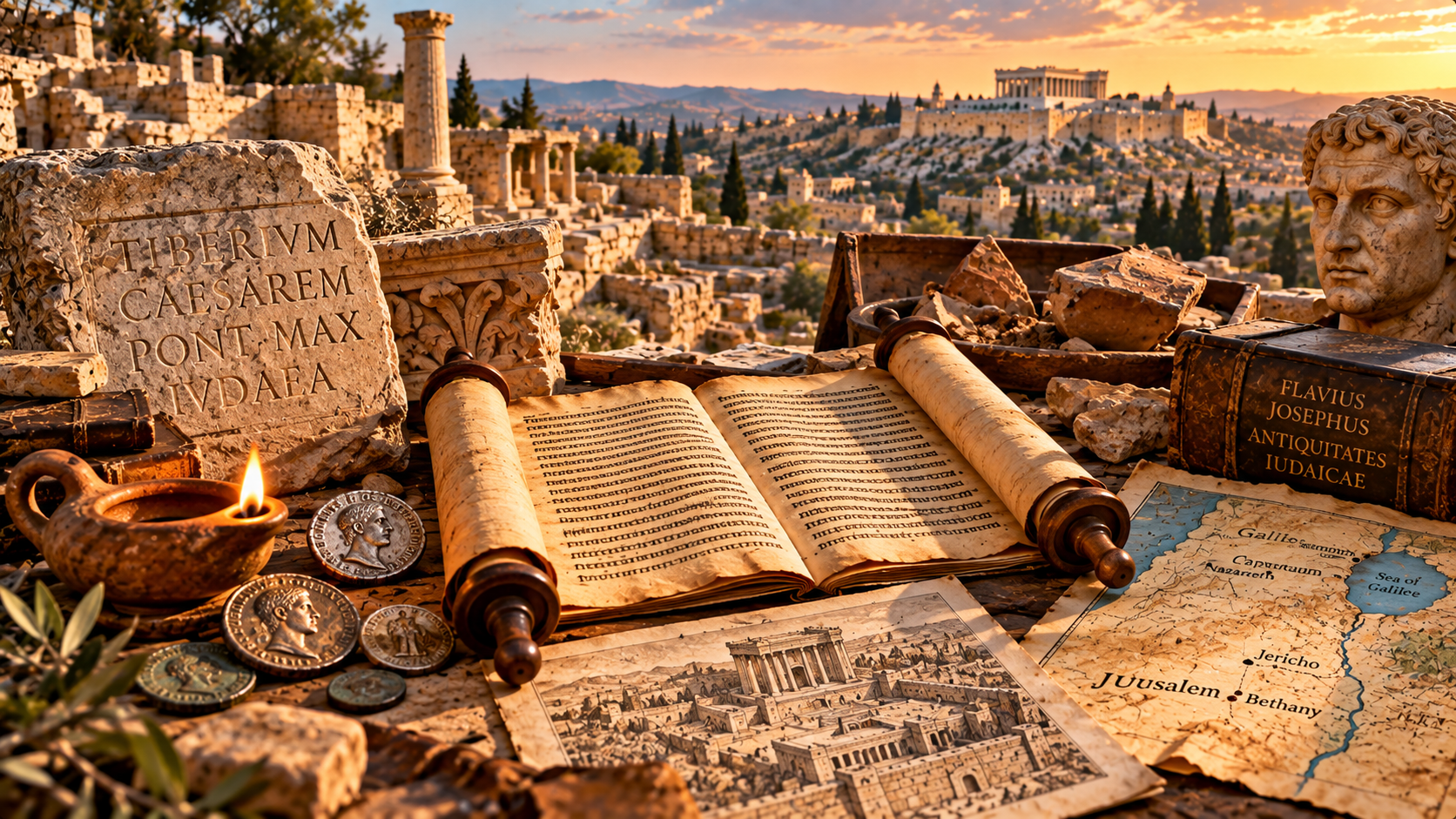
They name rulers, priests, cities, regions, customs, and public events. Many of these can be compared with evidence that comes from outside the Gospel accounts.
That outside evidence does not retell the Gospel for us. Nor should we expect it to. A Roman inscription, a Jewish historian, or an archaeological discovery was created for its own purpose.
But sometimes independent evidence meets the biblical account at a particular point.
A ruler named in Scripture appears in an inscription. A high priest is mentioned by another ancient writer. A city, building, title, or custom fits what is known from archaeology and history.
Each connection gives us another opportunity to ask whether the Gospel writers knew the world they described.
The Question
Can people, places, events, customs, and historical circumstances described in the Gospels be confirmed from evidence outside the Gospel accounts themselves?
What We Know
Corroboration simply means that one source receives support from evidence that does not depend upon it.
The New Testament provides many opportunities for this kind of comparison.
Pontius Pilate
All four Gospels place the crucifixion of Jesus under the authority of Pontius Pilate.
Pilate is not known only from Christian writings. The Jewish historian Josephus and the Roman historian Tacitus both mention him.
There is also physical evidence.
In 1961, archaeologists at Caesarea Maritima discovered a damaged Latin inscription bearing the name of Pontius Pilate and identifying him as prefect of Judea. The stone had been reused in later construction, but its surviving inscription provides direct evidence for the Roman official named in the Gospel accounts.
Caiaphas
The Gospels identify Caiaphas as the high priest involved in the events leading to Jesus' crucifixion.
Josephus independently tells us that Joseph Caiaphas was appointed high priest during the Roman administration before Pilate arrived and that he was later removed from office.
This places Caiaphas within the same first-century political and religious world described by the New Testament.
An ornate ossuary discovered near Jerusalem bears an inscription commonly read as "Joseph son of Caiaphas." It has often been associated with the Gospel high priest. That identification is possible and interesting, but it is not certain enough that our case needs to depend upon it.
Herodian rulers
The New Testament mentions several members of the Herodian family. Their reigns and political relationships are also known from sources outside Scripture.
Josephus provides extensive information about Herod the Great and his successors. This allows the political setting described in the Gospels and Acts to be compared with another ancient account.
Luke and Acts can be tested beyond Judea
The same writer who gave us the Gospel of Luke also wrote Acts.
Acts moves through many cities and names a number of public officials. Some of those details can be checked independently.
One important example is Gallio. Acts 18 says that Paul was brought before Gallio while Gallio was proconsul of Achaia.
An inscription discovered at Delphi preserves the name of Lucius Junius Gallio and identifies him as proconsul. Because the inscription can be dated closely, it also provides an important point for dating Paul's time in Corinth.
Corroboration comes in different forms
Sometimes the support is a name on a stone. Sometimes it is a reference in another ancient writer. Sometimes archaeology confirms a place or building. Sometimes a title used for an official fits what is known from inscriptions.
No one example proves the Gospel message.
What matters is that the New Testament repeatedly gives us historical details that can be compared with evidence outside itself.
Archaeology, geography, inscriptions, historical writings, and other sources can be compared with the people, places, and events described in the Gospels.
Why It Matters
Christianity makes claims about real events involving real people.
Jesus was not said to have been crucified "long ago in a distant land." The Gospels place His death during the government of Pontius Pilate, within the religious leadership of men such as Caiaphas, in Jerusalem during the first century.
Those details expose the accounts to examination.
That is a strength, not a weakness.
When independent evidence confirms people, offices, places, and circumstances found in Scripture, it does not prove every word surrounding them. But it shows that the biblical writers were describing a world that can still be recognized through history and archaeology.
For believers, this is another reminder that our faith is rooted in events Christians believe actually occurred in human history.
Questions & Challenges
Corroboration can easily be exaggerated.
If archaeology confirms that Pontius Pilate existed, that does not by itself prove that Jesus rose from the dead.
If Josephus confirms that Caiaphas was high priest, that does not prove every conversation reported in the Gospels.
If an inscription confirms Gallio as proconsul, that does not prove everything Acts tells us about Paul.
We should say only what the evidence allows us to say.
There is also no reason to expect outside sources to confirm every person or event in Scripture. Most people in the ancient world left no surviving inscription, book, or archaeological identification. Much of what once existed has disappeared.
Silence is therefore not the same as contradiction.
At the same time, genuine conflict between a biblical account and strong outside evidence would deserve attention. Our purpose is not to collect only evidence we like. It is to investigate honestly.
The repeated points of contact between the New Testament and independently known history are valuable because they allow portions of its historical setting to be tested.
Considering the Evidence
The Gospel writers describe a recognizable first-century world.
Pontius Pilate appears in Christian, Jewish, Roman, and inscriptional evidence. Caiaphas appears in the Gospels and in Josephus. The Herodian rulers belong to well-documented regional history. Acts names Gallio with the title that independent inscriptional evidence confirms.
These are not proofs of the Resurrection.
They are something more basic.
They show that the New Testament repeatedly intersects with history outside its own pages.
That matters because reliable historical writing should survive comparison with the world it claims to describe.
We have already touched upon archaeology several times. It deserves a closer look of its own.
What can physical discoveries actually tell us about the Gospels? What can they confirm, and what can they not prove?
That is our next investigation:
Does archaeology support the world described in the Gospels?
Continue exploring this question through related material already available on A Visit With Jesus.
Archaeology
Bible Archaeology
Explore archaeological discoveries, ancient inscriptions, manuscripts, artifacts, relics, reports, and video collections related to the historical world of the Bible.
Explore ancient references to Jesus and early Christianity found outside the New Testament, including Jewish and Roman writers and other extra-biblical sources.
History
Roman Administration of Judea
A chronological reference to the Roman prefects, procurators, kings, and legates who administered Judea from AD 6 through the second century.
Place
Places & Geography
Explore biblical locations, ancient Israel, Jerusalem, maps, the Temple, and the lands and journeys associated with Scripture.
In Summary
The Gospel writers describe a real historical world. We examine whether other ancient sources, inscriptions, archaeology, geography, names, customs, and political history confirm details found within their accounts.