Does Archaeology Support the World Described in the Gospels?
Archaeology gives us something written sources cannot.
It allows us to see what remains of the physical world in which people lived.
Archaeologists uncover houses, streets, pottery, coins, tombs, inscriptions, pools, tools, and places of worship. These discoveries can help us understand what daily life was like in the time of Jesus.
Archaeology cannot excavate a sermon. It cannot uncover a conversation between Jesus and His disciples. It cannot dig up the Resurrection.
But it can ask whether the Gospels place those events in a world that really existed.
When we compare the Gospel accounts with discoveries from first-century Galilee and Judea, we find many points where the physical evidence helps us understand the setting described in Scripture.
The Question
What has archaeology discovered about the people, places, institutions, geography, and culture described in the New Testament?
What We Know
The land in which Jesus lived has been studied by archaeologists for generations.
The results allow us to see parts of His world with remarkable clarity.
Nazareth was a real Jewish settlement in the time of Jesus
The Gospels identify Nazareth as the town in Galilee where Jesus grew up.
Archaeology has uncovered remains from the Early Roman period there, including domestic structures, pottery, storage features, tombs, and evidence associated with Jewish practices.
These discoveries help us picture Nazareth not as the large modern city that exists today, but as a small Jewish settlement in the Galilee of Jesus' time.
Some ancient structures in Nazareth have later Christian traditions associated with the family of Jesus. Those traditions are interesting, but archaeology cannot presently prove that a particular surviving house was the home of Jesus, Mary, and Joseph.
What archaeology can establish much more securely is that Nazareth itself was inhabited during the period in which the Gospels place Jesus there.
Capernaum belonged to the world of first-century Galilee
Capernaum became an important center of Jesus' Galilean ministry. The Gospels describe Him teaching there, entering homes, healing the sick, and calling disciples from the surrounding area.
Excavations have revealed a village beside the Sea of Galilee with remains extending through the Roman period.
A later monumental synagogue still dominates the site. Beneath it are earlier remains. Scholars continue to debate whether those remains can be securely identified as the first-century synagogue mentioned in the Gospels.
That uncertainty is worth stating clearly.
We do not need to claim that archaeologists have found the exact synagogue where Jesus taught in order to appreciate what Capernaum reveals about the kind of lakeside community in which the Gospels place much of His ministry.
Jewish practices leave physical traces
The Gospels describe a deeply Jewish world.
They speak of purification, Sabbath observance, synagogues, the Temple, Passover, burial customs, and debates about religious practice.
Archaeology throughout Judea and Galilee has uncovered ritual baths, stone vessels, tombs, inscriptions, and other remains associated with Jewish life during the late Second Temple period.
These discoveries give physical form to customs that appear naturally throughout the New Testament.
Jerusalem can still be recognized beneath the modern city
Jerusalem is central to the final chapters of all four Gospels.
Archaeology has uncovered portions of the city from the late Second Temple period, including streets, pools, monumental construction, ritual baths, and remains connected with the Temple environment.
We have already considered the Pools of Bethesda and Siloam. They are good examples of places named by John that belong to the Jerusalem known through archaeology.
Such discoveries do not prove the events John places there. They do show that his narrative is attached to identifiable locations in the city.
Roman crucifixion has left rare physical evidence
The crucifixion of Jesus stands at the center of all four Gospels.
Ancient writers leave no doubt that Romans used crucifixion, but physical remains of crucified people are rare.
In a first-century Jewish tomb at Giv'at ha-Mivtar in Jerusalem, archaeologists discovered the remains of a man commonly called Yehohanan. An iron nail remained driven through his right heel bone.
This man was not Jesus, and the discovery tells us nothing directly about Jesus' crucifixion.
What it does provide is physical evidence that a Jewish man in Roman-period Jerusalem could be executed by crucifixion and afterward placed in a tomb.
That makes the discovery especially useful for understanding the physical and burial world described in the Passion accounts.
Why It Matters
Archaeology matters to Christians because biblical faith repeatedly enters the physical world.
The Gospels speak about towns that could be visited, rulers who governed, buildings people entered, roads they traveled, tombs in which bodies were placed, and a cross upon which Jesus died.
That makes Christianity open to historical investigation.
Archaeology cannot tell us whether Jesus is the Son of God. It cannot decide whether His death atoned for sin. It cannot demonstrate His Resurrection by uncovering an artifact.
Those questions require other kinds of evidence.
But archaeology can help us determine whether the writers who told His story knew the world in which they placed Him.
Again and again, the physical setting revealed by archaeology gives us a recognizable first-century Jewish and Roman world.
Questions & Challenges
Biblical archaeology has sometimes suffered from exaggerated claims.
A discovery is announced as "proof of the Bible." A building is identified with a biblical person when the evidence is uncertain. A disputed inscription is presented as though every scholar agrees about it.
AVWJ should avoid that approach.
Archaeology is most valuable when we allow a discovery to say exactly what it can say.
A first-century house in Nazareth shows us something about life in Nazareth. It does not prove that Jesus lived in that particular house.
A pool in Jerusalem can confirm a location known to a Gospel writer. It cannot prove the miracle associated with that pool.
The pierced heel of Yehohanan provides physical evidence of Roman crucifixion and burial in first-century Jerusalem. It does not tell us how Jesus was positioned on His cross or prove the Gospel account of His death.
Even the remains beneath the later synagogue at Capernaum require care. Scholars disagree about whether they establish the presence of the particular first-century synagogue described in the Gospels.
None of these limitations weakens the value of archaeology.
They help us use it responsibly.
Considering the Evidence
Archaeology does not hand us Christianity in the form of an artifact.
What it gives us is the world in which the Gospel story took place.
Nazareth was inhabited. Capernaum was a Galilean lakeside community. Jerusalem contained pools, streets, ritual facilities, monumental buildings, and tombs belonging to the period. Jewish religious practices left physical traces throughout the land. Roman crucifixion was not merely a literary idea; one victim from Jerusalem still bears the nail that pierced his heel.
These discoveries do not prove every event reported by Matthew, Mark, Luke, and John.
They do something quieter but important.
They repeatedly show that the Gospel narratives inhabit a real and recognizable first-century world.
We have now examined evidence from inside the Gospels, from archaeology, and from historical points of contact outside them.
There is another kind of outside evidence we should consider.
What did writers who were not Christians say about Jesus and the movement that followed Him?
That is our next investigation:
What do non-Christian sources tell us about Jesus?
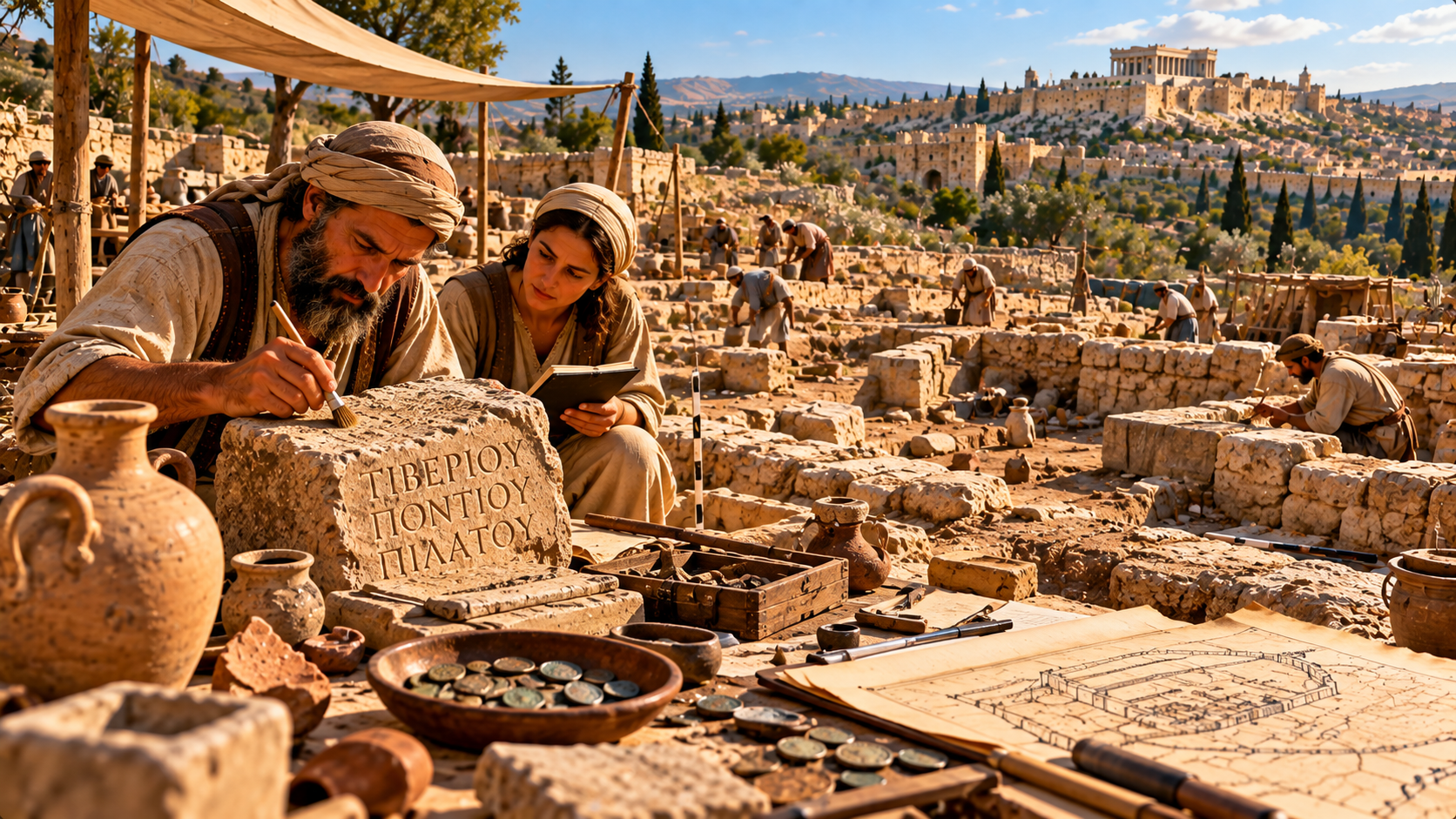
Archaeological discoveries allow us to compare the physical remains of the ancient world with the setting described by the Gospel writers.
Continue exploring this question through related material already available on A Visit With Jesus.
Archaeology
Bible Archaeology
Explore archaeological discoveries, ancient inscriptions, manuscripts, artifacts, relics, reports, and video collections related to the historical world of the Bible.
Explore the history of biblical archaeology together with AVWJ links to New Testament papyri and the Dead Sea Scrolls.
Manuscript
Rylands Library Papyrus P52
An early papyrus fragment of the Gospel of John containing portions of John 18:31-33 and 18:37-38.
Place
Places & Geography
Explore biblical locations, ancient Israel, Jerusalem, maps, the Temple, and the lands and journeys associated with Scripture.
In Summary
Archaeology cannot prove every event recorded in Scripture, but it can test whether biblical writers accurately describe their historical environment. We examine discoveries that illuminate the world in which Jesus and the earliest Christians lived.