What Happens When the Evidence Is Considered Together?
Important conclusions often do not rest upon one piece of evidence.
Instead, many different facts begin to point in the same direction.
Think of a rope made from many strands. A single strand may be easy to break. Woven together, the strands can become remarkably strong.
The case for Christianity is much like that.
Our faith does not depend upon one archaeological discovery, one ancient manuscript, one outside reference to Jesus, or one argument about the Resurrection. We can examine many different kinds of evidence. Each tells us something. Together they can give us a much fuller picture.
This is why we should resist the temptation to ask whether one fact, standing alone, "proves Christianity." A better question is what happens when all the evidence is considered together.
The Question
Can many individually limited pieces of evidence become persuasive when they point toward the same conclusion?
What We Know
As this investigation continues, we will encounter many different kinds of evidence.
Some concern the people who wrote the Gospels. Some concern the world they described. Others concern what happened after Jesus was crucified.
These pieces do not all do the same job. Nor do they need to.
The Gospels can be examined as historical accounts
We can ask whether their writers were in a position to know what they recorded. We can examine the names, places, customs, rulers, geography, and everyday details found in their accounts.
We can also ask why the four Gospels sometimes tell the same event differently and whether those differences undermine or support their value as testimony.
Archaeology can test the world they describe
Archaeology cannot dig up the Sermon on the Mount or place the Resurrection in a museum case.
But it can tell us whether people, places, buildings, customs, and institutions described by biblical writers belonged to the world they claimed to know.
When archaeology repeatedly fits the setting described in Scripture, that becomes one more part of the larger picture.
Writers outside the New Testament can add another perspective
Ancient non-Christian writers do not tell the Christian story for us. That is not their purpose.
Yet some of them refer to Jesus, His execution, His followers, or the spread of the Christian movement. Their testimony can be compared with what Christian sources report.
The New Testament text itself can be examined
The books of the New Testament were copied by hand for centuries. We can ask how well their wording has been preserved and how confidently we can know what the original authors wrote.
This matters because historical investigation depends upon having reliable access to the documents we are trying to examine.
The Resurrection brings several lines of evidence together
When we reach the final part of our investigation, we will consider Jesus' death, His burial, the empty tomb, the reported appearances, the early proclamation of the Resurrection, and the changed lives of people such as Paul and James.
Each part deserves to be examined on its own.
Then we must step back and look at them together.
An explanation that deals with one fact may sound reasonable until we ask whether it can also account for the others. The larger picture can therefore tell us more than any single piece viewed by itself.
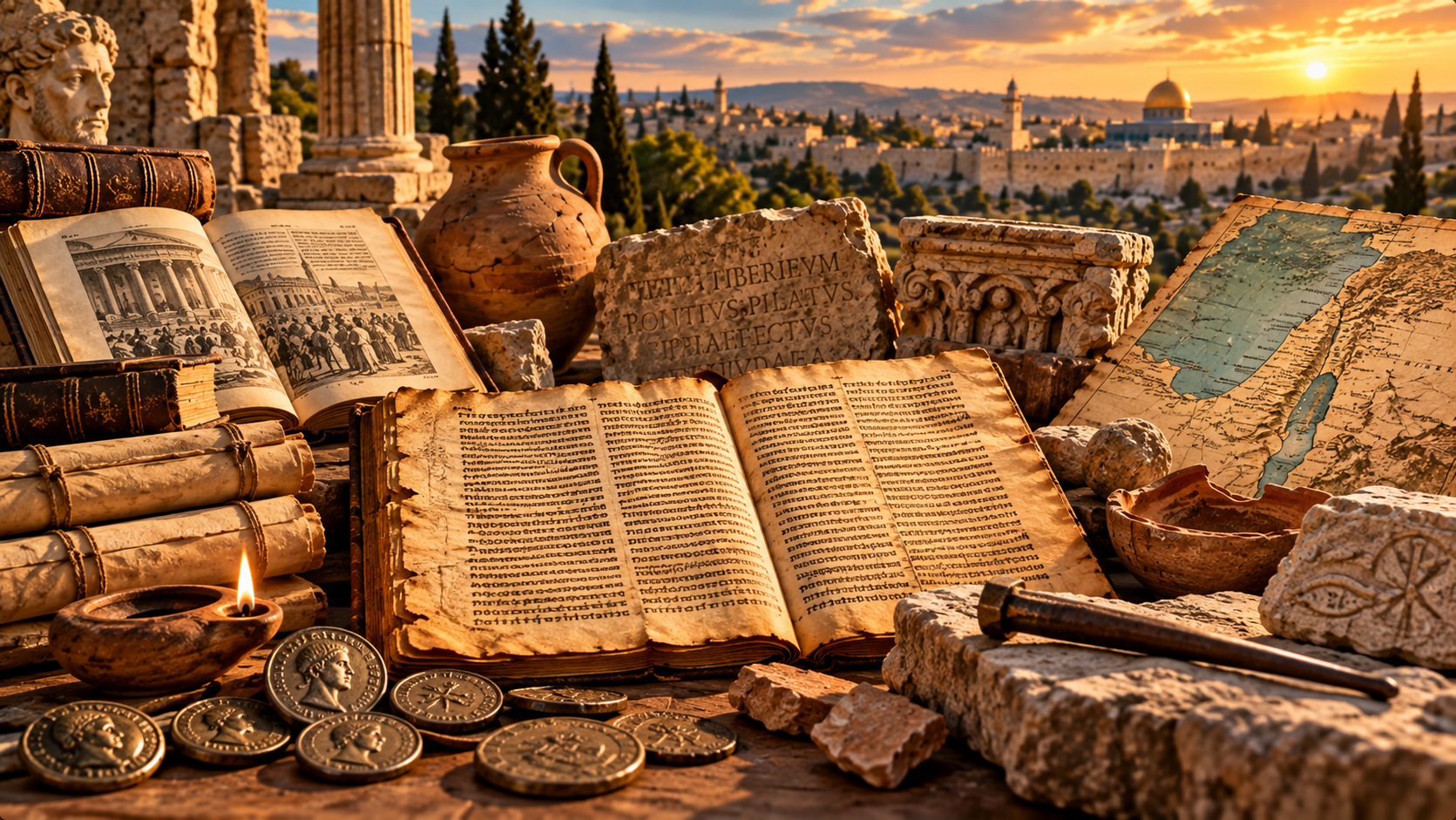
Historical testimony, manuscripts, archaeology, geography, and other evidence can be considered together rather than in isolation.
Why It Matters
Christians sometimes feel that they must find one argument that proves everything.
We do not.
God has not left us with only one reason to believe.
The Christian faith comes to us through Scripture, through the testimony of those who knew Jesus and His earliest followers, through events rooted in a real historical world, and through the proclamation that Jesus Christ died and rose again.
Paul reminded the Corinthians of the Gospel he had preached to them: Christ died for our sins, was buried, was raised, and appeared to witnesses (1 Corinthians 15:1-8). His presentation itself brings several claims together.
As we investigate Christianity, the same principle will guide us. We will not ask one piece of evidence to carry the entire case.
We will ask where the evidence points when it is allowed to speak together.
Questions & Challenges
A cumulative case must still be handled carefully.
Ten weak claims do not automatically become one strong claim simply because we place them in a list. Nor should we count the same evidence several times and pretend that we have discovered something new.
Each part of the case deserves honest examination.
We should also remember that some pieces of evidence are connected. One source may depend upon another. One historical conclusion may depend upon an earlier conclusion. We should not pretend that every item stands completely alone.
None of this makes a cumulative case useless. It simply means that we should build it carefully.
There is another common mistake. Sometimes one disputed point is treated as though the entire Christian case rises or falls with it.
Suppose someone questions one archaeological identification, one detail in a Gospel account, or one argument concerning the empty tomb. That question should be answered fairly. But it does not make all the other evidence disappear.
In the same way, Christians should not act as though finding one impressive piece of evidence settles every question.
The purpose of this investigation is to look at the whole picture.
Considering the Evidence
The Christian case is not a house balanced on one narrow post.
It is a picture formed from many parts.
We will examine the Gospels and the people behind them. We will compare their accounts. We will look at archaeology, geography, ancient history, and writers outside the New Testament. We will consider the preservation of Scripture. Then we will turn our attention to the events surrounding the death and Resurrection of Jesus.
Some evidence will answer one question. Other evidence will answer another.
As the pieces accumulate, we can ask whether they fit together naturally or whether they pull in different directions.
For Christians, this investigation is not an attempt to replace faith with evidence. It is an opportunity to see how much of our faith is tied to things that happened in the real world.
Jesus did not call His followers to believe in an idea detached from history. The apostles proclaimed what God had done through Jesus Christ.
Our task is to examine that proclamation carefully.
Now that we have established how we will approach the evidence, we can begin looking more closely at the witnesses themselves.
Continue exploring this question through related material already available on A Visit With Jesus.
Evidence
Evidence for the Resurrection
Examine historical evidence surrounding the Resurrection claim, including Jesus' death, the empty tomb, early Resurrection proclamation, reported appearances, and the beginnings of the Christian movement.
Explore archaeological discoveries, ancient inscriptions, manuscripts, artifacts, relics, reports, and video collections related to the historical world of the Bible.
Evidence
Jesus Outside the Bible
Explore ancient references to Jesus and early Christianity found outside the New Testament, including Jewish and Roman writers and other extra-biblical sources.
Manuscript
New Testament Papyri
Explore early New Testament papyrus manuscripts, beginning with P1 through P50, with dates, biblical contents, institutions, reference numbers, and image information.
In Summary
Few historical conclusions depend upon one decisive piece of evidence. Christianity presents a cumulative case involving testimony, documents, archaeology, historical setting, fulfilled expectations, the origin of Christian belief, and especially the resurrection of Jesus.