We believe many things about the past even though we were not there to see them. We know that nations rose and fell, wars were fought, rulers lived and died, and ordinary people experienced events that changed the world.
How do we know?
We look at the evidence they left behind.
The same is true when we investigate the life of Jesus and the beginnings of the Christian faith. We cannot return to first-century Judea and watch the events unfold. But we can examine what was written, how close those writings were to the events, whether other sources support them, and whether archaeology and history fit the world they describe.
Christianity makes claims about things that happened in history. Jesus lived. He taught publicly. He was crucified. His followers proclaimed that He rose from the dead. If these things happened, we should be willing to examine the evidence for them.
The Question
How can we responsibly investigate people and events that lived centuries ago, and what kinds of evidence allow us to reach reasonable conclusions about the past?
What We Know
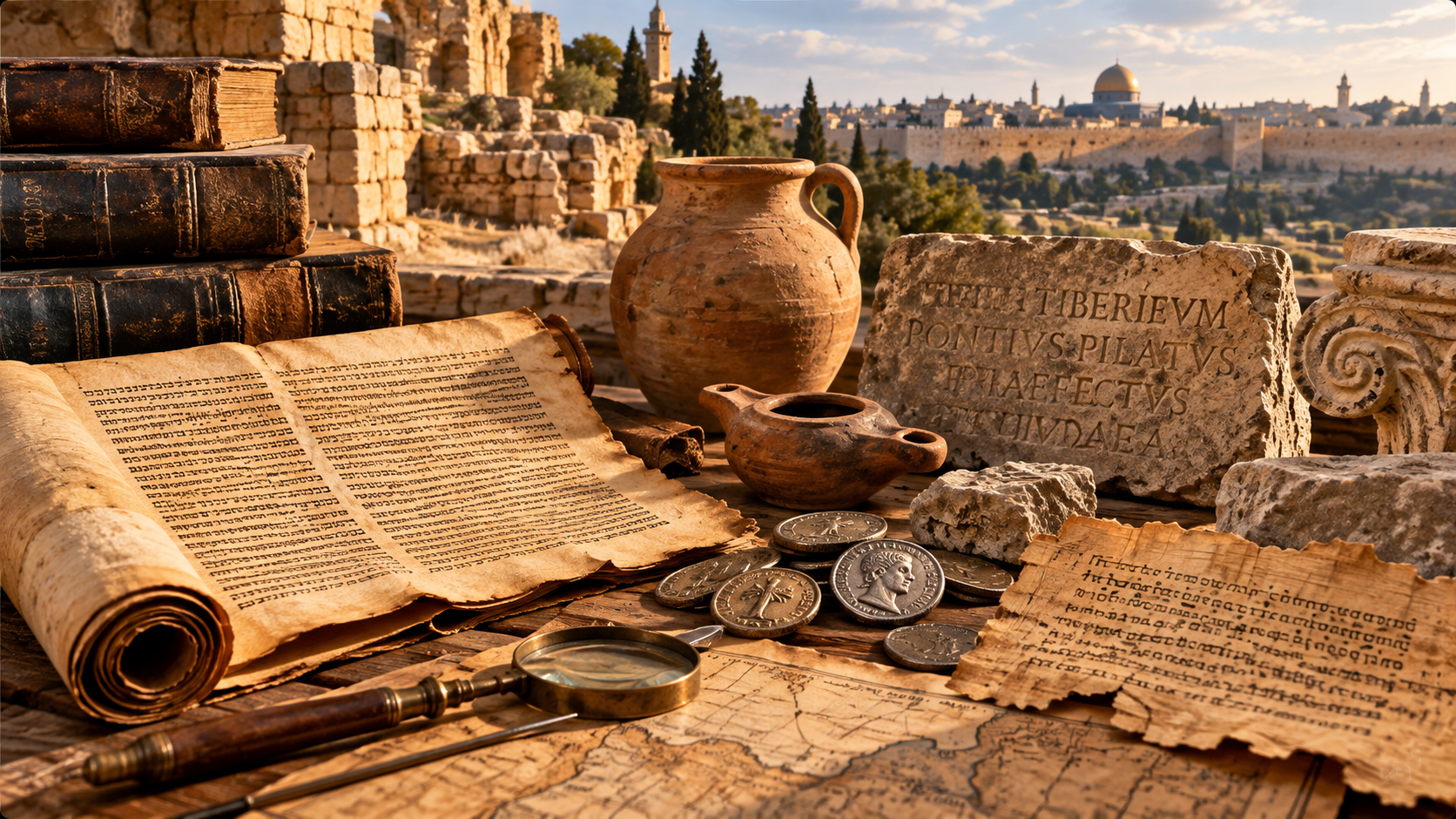
Much of what we know about the ancient world comes from evidence that survived.
Sometimes that evidence is written. We have letters, histories, government records, inscriptions, biographies, and other documents. Sometimes it is physical. Archaeologists uncover buildings, coins, tombs, roads, monuments, pottery, and objects used in everyday life.
No single kind of evidence answers every question. Instead, we compare what survives.
How close is the source to the event?
A source written near the time of an event may preserve information that would become harder to recover generations later. This is one reason the early writings of Christianity matter. Paul's letters, for example, take us into the first generation of the Christian movement.
Was the writer in a position to know?
We ask whether the writer witnessed the events, knew people who did, or had access to reliable information. Luke tells his readers that he investigated the events carefully and drew upon accounts handed down by those who had known them from the beginning (Luke 1:1-4).
Does other evidence support the account?
A written account becomes more interesting when names, places, customs, rulers, geography, and events can be compared with other sources. Archaeology is especially valuable here. It cannot tell us everything that happened, but it can help us determine whether a writer knew the world he claimed to describe.
Do different sources point in the same direction?
Sources do not have to use identical words to support one another. In fact, independent accounts often describe the same event differently. What matters is whether their testimony can be brought together into a reasonable picture of what happened.
Does the explanation fit all the evidence?
Finally, we ask what explanation makes the best sense of what we have found. An explanation that accounts for only one piece of evidence may not be enough. We want to know whether it also makes sense of the rest.
None of this gives us a time machine. History rarely offers that kind of certainty. But neither does investigating the past amount to guesswork. Evidence can give us very good reasons for believing that something happened.
Historical investigation brings together written testimony, archaeology, geography, artifacts, and other surviving evidence from the past.
Why It Matters
Christianity is rooted in history in a way that matters deeply to our faith.
The Gospel is not simply a collection of wise teachings about how we should live. Christians believe that God acted in history. Jesus was born into this world. He taught among real people in real places. He was crucified under Roman authority. Most importantly, Christians believe that He rose from the dead.
Paul understood how much depended upon that last claim. He wrote that if Christ had not been raised, Christian preaching and faith would be empty, and we would still be in our sins (1 Corinthians 15:14-17).
That is a remarkable statement. Christianity does not ask us to believe that historical truth is unimportant. The New Testament itself places the Resurrection at the center of the faith.
For that reason, examining the evidence is not an enemy of faith. It can be one way of understanding why our faith rests upon events Christians believe really happened.
Questions & Challenges
There are good reasons to be careful when studying the past.
People can remember things differently. Writers can emphasize different parts of an event. They may write for different audiences or for particular purposes. Documents can be copied incorrectly. Stories can change as they are repeated.
These possibilities should not frighten us. They are reasons to examine the evidence carefully.
We should also avoid a different mistake: assuming that a source cannot be historically useful simply because its writer believed strongly in what he wrote.
The writers of the New Testament were believers. They wanted others to believe in Jesus. John says this plainly: his Gospel was written so that his readers might believe that Jesus is the Christ, the Son of God (John 20:31).
His purpose is not hidden.
The important question is whether what he wrote is true.
Having a reason to tell a story does not make the story false. We still ask whether the writer was in a position to know, whether his account fits the historical setting, whether other evidence supports it, and whether the account makes sense of what followed.
Considering the Evidence
We do not need to choose between faith and evidence.
Christians believe that God entered human history in the person of Jesus Christ. If that is true, then it is reasonable to look for the marks those events left behind.
That is what we will do in this investigation.
We will examine the Gospel witnesses. We will look at archaeology and sources outside the New Testament. We will consider how the biblical text was preserved. We will examine the remarkably early belief that Jesus had risen from the dead. We will look at the empty tomb and the reported appearances of the risen Christ. We will also consider other explanations that have been offered.
We will not ask you to accept a conclusion simply because we say it is true.
We invite you to consider the evidence.
And as we do, we will return again and again to the question at the heart of this investigation:
Who is Jesus, and what really happened after He was crucified?
Continue exploring this question through related material already available on A Visit With Jesus.
History
History & Culture
Explore biblical history, ancient Israel, customs and daily life, historians, the world of Jesus, early Christianity, persecution, timelines, empires, and historical video collections.
Explore archaeological discoveries, ancient inscriptions, manuscripts, artifacts, relics, reports, and video collections related to the historical world of the Bible.
Evidence
Jesus Outside the Bible
Explore ancient references to Jesus and early Christianity found outside the New Testament, including Jewish and Roman writers and other extra-biblical sources.
In Summary
Historical events cannot be repeated in a laboratory, but they can be investigated. We begin by considering how documents, eyewitness testimony, archaeology, corroboration, historical context, and competing explanations can help us determine what most reasonably happened in the past.