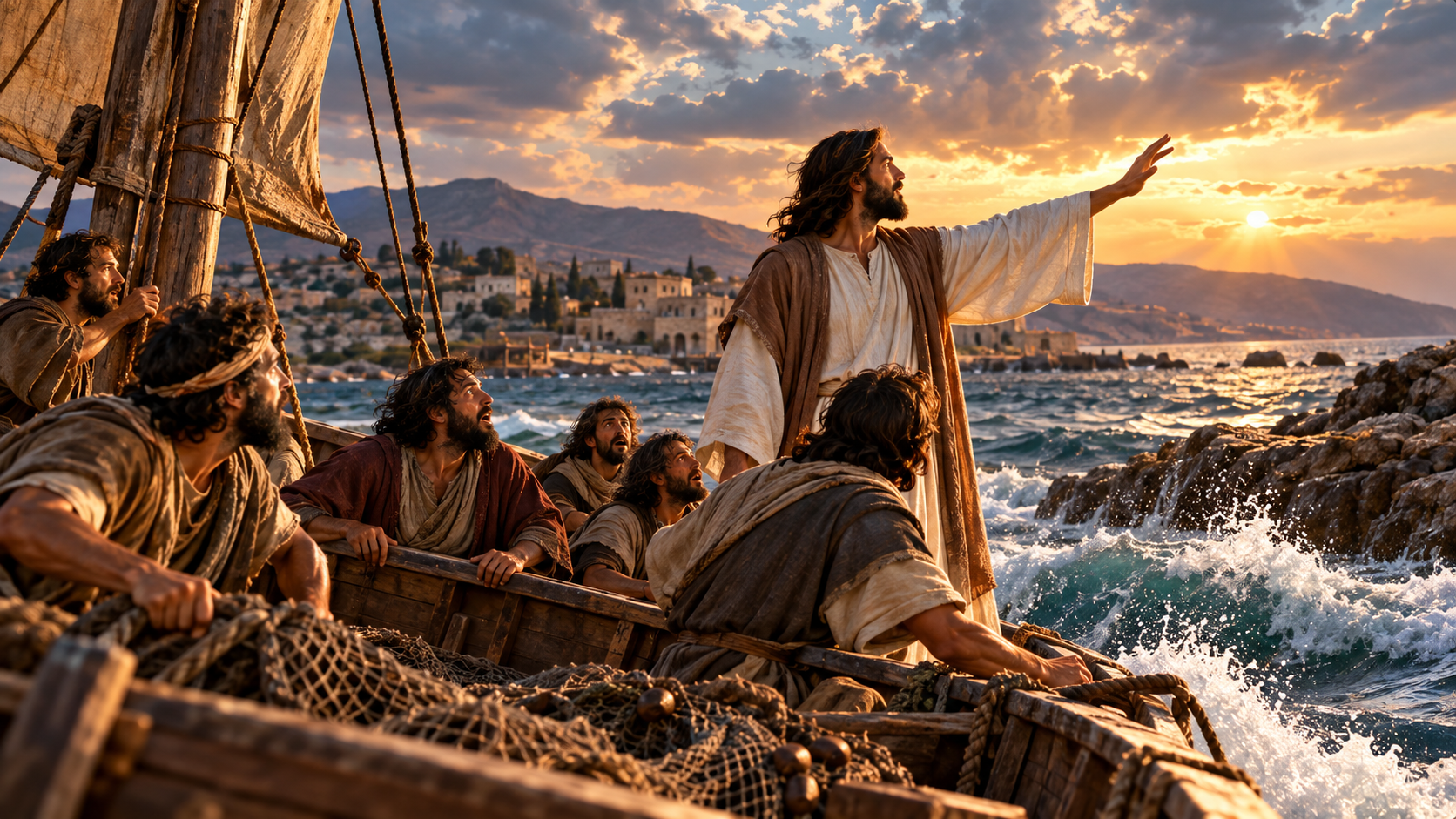
Can Miracles Be Considered as Historical Explanations?
Christians believe that God can act in the world He created. The Bible is filled with accounts of such acts, from the Exodus to the miracles of Jesus and, above all, His Resurrection.
For some people, this creates a problem before the evidence is even considered. They are willing to investigate ordinary events in the life of Jesus, but they believe that a miracle must be ruled out from the beginning.
That raises an important question.
If we decide beforehand that God cannot act in history, could any amount of evidence ever lead us to a miracle?
AVWJ does not suggest that every unusual event should be called a miracle. Christians have good reason to be careful about such claims. But neither should we decide that something could not have happened simply because it would require the action of God.
When we investigate the Resurrection, the question should not be, "Are miracles ordinary?" Clearly they are not. The question is whether the evidence gives us good reason to believe that something extraordinary actually happened.
The Question
Should a miraculous explanation be rejected before the evidence is considered, or can the possibility of God's action be included when evaluating an extraordinary historical claim?
What We Know
Our everyday experience teaches us that the world normally behaves in regular and predictable ways.
Dead people do not ordinarily return to life. Christians know this as well as anyone else. In fact, the Resurrection would have little meaning if rising from the dead were an ordinary event.
A miracle is remarkable precisely because it is not what normally happens.
The regular order of nature matters
Christian belief in miracles does not require us to deny the regular workings of the natural world. We expect fire to burn, rain to fall, wounds to hurt, and death to be final in the ordinary course of human life.
The Bible itself assumes this ordinary order. When Jesus healed the sick, gave sight to the blind, calmed a storm, or raised the dead, people were astonished because these were not ordinary events.
The Christian claim is not that nature has no order. It is that the God who created that order is not imprisoned by it.
An extraordinary claim deserves careful examination
The fact that an event would be extraordinary gives us a reason to examine the evidence carefully. It does not give us a reason to refuse to examine it at all.
If someone today claimed that a person had returned from the dead, we would rightly ask many questions. Was the person really dead? Who saw what happened? Could there have been a mistake? Could someone be lying? Is there physical evidence? Are there other explanations?
Those are sensible questions.
They are also the kinds of questions we will ask about Jesus.
The possibility of God matters
There is a deeper issue behind every discussion of miracles.
Does God exist?
If there is no God, then a resurrection brought about by God is not a possible explanation. But if God exists and created life, then the idea that He could restore life cannot simply be dismissed as impossible.
This does not prove that Jesus rose from the dead. It means only that we should not settle the question before looking at the evidence.
The Resurrection is a claim about something that happened
The first Christians did not merely say that Jesus continued to inspire them after His death. They proclaimed that God had raised Him from the dead.
Peter preached, "This Jesus hath God raised up, whereof we all are witnesses" (Acts 2:32). Paul wrote that Christ died, was buried, was raised, and appeared to His followers (1 Corinthians 15:3-8).
Those are claims about events.
They may be accepted or rejected. They may be investigated. But they should not be changed into a different kind of claim simply because the event described is extraordinary.
Why It Matters
The question of miracles matters because the Christian faith reaches its center at the Resurrection.
If we allow only ordinary causes before the investigation begins, then the Resurrection can never be considered as an explanation. No evidence could ever be enough because the answer would already have been decided.
But Christians believe that God is real and that He has acted in history. The Gospel declares that the same God who created life raised Jesus from the dead.
That does not mean we should believe without evidence. It means we should be willing to follow the evidence wherever it leads.
Paul did not treat the Resurrection as an optional symbol. He wrote that if Christ had not been raised, Christian faith would be empty (1 Corinthians 15:14-17).
Something that important deserves an honest investigation.
Claims of miraculous events raise an important historical question: should such reports be excluded before the evidence itself is considered?
Questions & Challenges
One of the most influential objections to miracles was made by the eighteenth-century philosopher David Hume. In simple terms, Hume argued that our repeated experience of the regular course of nature weighs heavily against reports of miracles. Testimony for an extraordinary event must therefore meet a very demanding standard.
There is something sensible in that warning. We should not believe every miracle story we hear. People can be mistaken. Stories can grow in the telling. Fraud is possible. An unusual event may have an ordinary explanation that was not understood at the time.
But there is an important difference between being cautious and deciding the answer in advance.
Suppose we begin with the rule that a miracle can never be the best explanation of historical evidence. We could then examine the empty tomb, the appearances reported by Jesus' followers, the conversion of Paul, and the beginning of the Christian movement. Yet no matter what we found, resurrection would remain forbidden as an explanation.
That would not show that the Resurrection had been disproved. It would show only that it had been excluded before the investigation began.
There is another danger on the Christian side. We must not call something a miracle simply because we want it to be one. Christian faith gives us no reason to accept weak evidence or careless claims.
The better approach is to examine the evidence carefully, consider reasonable alternatives, and then ask what explanation best accounts for what we find.
Considering the Evidence
Christians do not believe that Jesus rose from the dead because resurrection is something that normally happens.
We believe precisely the opposite.
Jesus truly died. If He was later alive, something extraordinary happened.
The Christian explanation is that God raised Him from the dead.
That explanation should not receive special treatment simply because it is Christian. It must face the evidence. But neither should it be disqualified simply because it involves God.
As we continue this investigation, we will ask what the earliest sources tell us. We will examine the people who made the claims. We will consider the empty tomb and the reported appearances. We will look at other explanations that have been proposed.
Then the reader can ask the question that matters:
Which explanation best accounts for what happened?
Before we can answer that question, however, we need to understand how different explanations should be compared. That is where we turn next.
Continue exploring this question through related material already available on A Visit With Jesus.
Further Study
Bible Narratives
Explore Bible narratives with historical, cultural, archaeological, and contextual information intended to illuminate the events described in Scripture.
An AVWJ narrative treatment of Jesus raising Lazarus, with historical background, burial context, theological meaning, and its connection with the events leading to the Crucifixion.
Background
Jesus & His World
Explore the life and ministry of Jesus, the people and places around Him, His first-century setting, His crucifixion and Resurrection, and evidence concerning His place in history.
In Summary
The resurrection is an extraordinary claim because it involves the action of God. Before considering the evidence, we must ask whether miraculous events should automatically be ruled out or whether the evidence should be allowed to lead us toward the best explanation.