a visit with jesus

 Jesus in Context

Law and Justice

Roman Rule and the Authority to Execute

Law and Justice

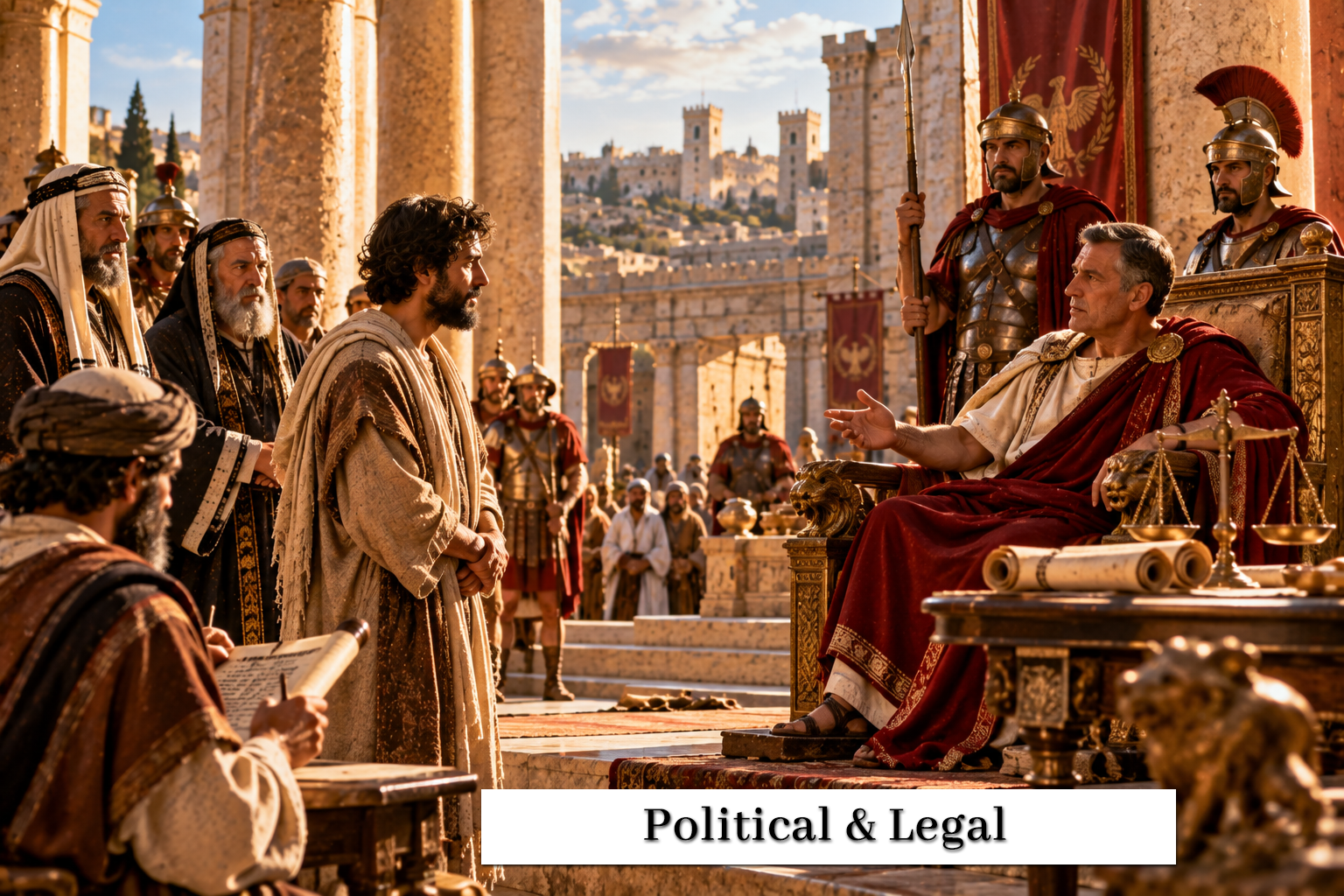
The transfer to Pilate reflects the layered legal world of Roman Judea: Jewish authorities retained substantial internal jurisdiction, while Roman power controlled the execution that would lead to crucifixion.
Scripture: John 18:29; John 18:30; John 18:31

Political/Legal Context

King of the Jews: The Political Charge Before Pilate

Political/Legal Context

Pilate's question 'Are you the King of the Jews?' reframes the case in terms Rome could recognize: a kingship claim could imply rival political authority under imperial rule.

Scripture: John 18:33; John 18:35

Political/Legal Context

My Kingdom Is Not From This World

Political/Legal Context

Jesus' statement that his kingdom is 'not of this world' speaks primarily of its source: his reign does not arise from the world's political order, as shown by the refusal of his servants to fight for his release.

Scripture: John 18:36

Language and Idiom

Kingship and Truth Before Pilate

Language and Idiom

Pilate's interrogation moves from kingship to Jesus' mission of bearing witness to truth, culminating in Pilate's famous but tonally ambiguous question, 'What is truth?'

Scripture: John 18:37; John 18:38

Festivals and Holy Days

The Passover Release and Barabbas

Festivals and Holy Days

All four Gospels describe a festival release custom in which the crowd chooses Barabbas rather than Jesus; John calls Barabbas a lestes, a term that can denote a robber or violent insurgent.

Scripture: John 18:39; John 18:40

Political/Legal Context

Roman Scourging Before Crucifixion

Political/Legal Context

Pilate has Jesus scourged even after declaring him innocent; Roman scourging was a brutal corporal punishment and must not be confused with the Jewish disciplinary limit of forty lashes.

Scripture: John 19:1

Honor and Shame

Crown of Thorns, Purple Robe, and Mock Kingship

Honor and Shame

The crown, purple robe, royal greeting, and blows form a coordinated parody of kingship in which Roman soldiers turn the charge against Jesus into public humiliation.

Scripture: John 19:2; John 19:3; John 19:5

Honor and Shame

Behold the Man

Honor and Shame

Pilate presents the scourged Jesus with the words 'Behold the man,' while continuing to say he finds no legal fault in him; the display places humiliation and innocence side by side.

Scripture: John 19:5

Law and Justice

The Son of God Charge and Pilate's Fear

Law and Justice

When Pilate's opponents invoke their law and say Jesus made himself the Son of God, the case shifts again from Roman kingship language to a religious charge that increases Pilate's fear.

Scripture: John 19:7; John 19:9

Political/Legal Context

You Could Have No Authority Except From Above

Political/Legal Context

Pilate boasts of authority to release or crucify, but Jesus answers that even the governor's real coercive authority is derivative—given 'from above'—while still recognizing differing human responsibility.

Scripture: John 19:10; John 19:11

Political/Legal Context

Caesar's Friend and Political Pressure on Pilate

Political/Legal Context

The warning that releasing Jesus would make Pilate 'not Caesar's friend' converts the dispute into a threat against the governor's political loyalty and career.

Scripture: John 19:12

Architecture and Housing

The Judgment Seat, the Pavement, and Gabbatha

Architecture and Housing

Pilate's final public judgment occurs at a bema in a place John calls the Pavement and gives the Semitic name Gabbatha, placing the decision within recognizable Roman judicial space.

Scripture: John 19:13

Page 25 of 40