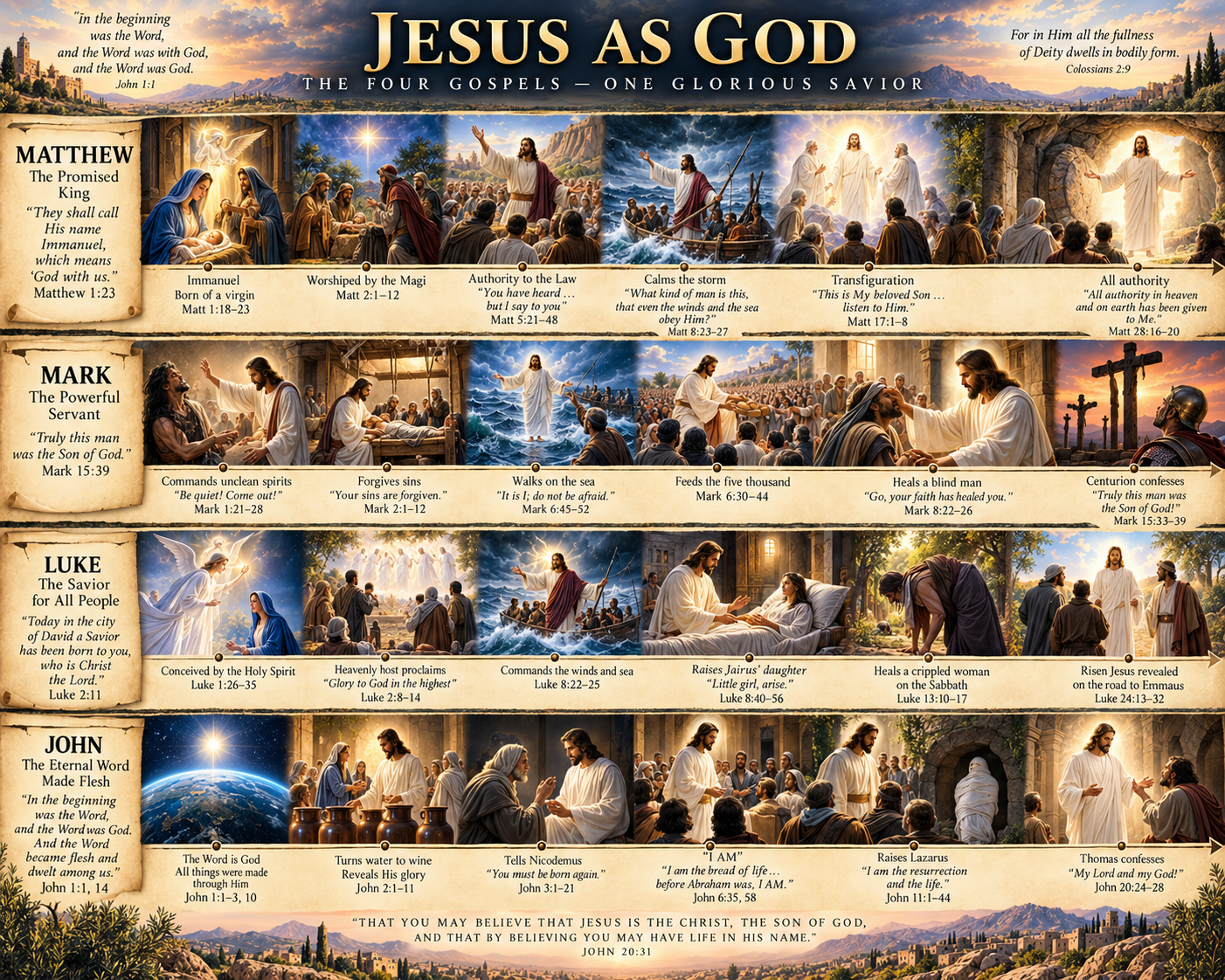
Jesus as God
The Gospels never record Jesus saying the exact sentence, “I am God.” Yet they repeatedly portray Him saying and doing things Scripture associates with God, accepting divine titles and testimony, exercising divine prerogatives, and fulfilling Old Testament passages concerning YHWH. Explore the cumulative evidence across all four Gospels.
Click timeline image to enlarge
Showing 25-35 of 35 evidence records.
The Son of Man Is Revealed in Final Judgment
Luke 17:24-30
What Jesus said or did: Jesus compares the revelation of the Son of Man with the catastrophic divine judgments in the days of Noah and Lot.
Why this points to His divinity: Luke does not simply rename every Day-of-the-LORD text, but the convergence of Son-of-Man revelation and divine judgment is strongly Christological.
Read the full evidence
The Son of Man Seeks and Saves the Lost
Luke 19:1-10
What Jesus said or did: Jesus declares that the Son of Man came to seek and save the lost.
Why this points to His divinity: Zacchaeus receives Jesus joyfully and responds with repentance and restitution.
Read the full evidence
Jerusalem Fails to Recognize God's Visitation in Jesus
Luke 19:37-44
What Jesus said or did: Jesus weeps over Jerusalem and predicts judgment because the city did not recognize the time of its visitation.
Why this points to His divinity: The disciples praise God, while Jerusalem as a city fails to recognize the visitation.
Read the full evidence
God Sends His Beloved Son and Heir
Luke 20:9-19
What Jesus said or did: In the vineyard parable the owner sends servants and finally his beloved son and heir, whom the tenants kill.
Why this points to His divinity: Son language alone is not a synonym for deity, but the unique salvation-historical status assigned to Jesus is strongly Christological.
Read the full evidence
David Calls the Messiah His Lord
Luke 20:41-44
What Jesus said or did: Jesus cites Psalm 110 and asks how the Messiah can simply be David's son when David calls him Lord.
Why this points to His divinity: It preserves distinction between God and Messiah while placing Jesus in an extraordinary heavenly position beside God.
Read the full evidence
The Son of Man Comes in Power and Great Glory
Luke 21:25-28
What Jesus said or did: Jesus predicts the Son of Man coming in a cloud with power and great glory and tells his followers their redemption is drawing near.
Why this points to His divinity: The combination of cloud-coming, great glory, judgment, and redemption makes this strong evidence of heavenly divine authority.
Read the full evidence
Jesus Establishes the New Covenant in His Blood
Luke 22:19-20
What Jesus said or did: Jesus identifies the cup as the new covenant in his blood, poured out for his disciples.
Why this points to His divinity: This is profoundly Christological but not by itself a direct proof of deity, so it remains Supporting.
Read the full evidence
The Son of Man Sits at God's Right Hand
Luke 22:67-71
What Jesus said or did: Jesus tells the council that the Son of Man will be seated at the right hand of God's power; when asked if he is the Son of God, his answer is treated as decisive testimony.
Why this points to His divinity: Personal distinction is fully preserved while Jesus claims a status within God's heavenly rule far beyond ordinary human kingship.
Read the full evidence
Jesus Grants the Criminal Entrance into Paradise
Luke 23:39-43
What Jesus said or did: A dying criminal asks Jesus to remember him in his kingdom; Jesus authoritatively promises that the man will be with him in Paradise that very day.
Why this points to His divinity: The criminal entrusts himself to Jesus' coming kingship.
Read the full evidence
The Risen Jesus Fulfills the Scriptures
Luke 24:1-12; Luke 24:36-49
What Jesus said or did: Jesus is announced as risen, appears bodily to his disciples, and explains that Moses, the Prophets, and Psalms anticipated his suffering, resurrection, and worldwide proclamation.
Why this points to His divinity: Luke presents Jesus as having been raised rather than explicitly saying here that Jesus raised himself; therefore no 'Raises the Dead' prerogative is assigned.
Read the full evidence
Jesus Ascends to Heaven and Is Worshiped
Luke 24:50-53
What Jesus said or did: Jesus blesses his disciples, is carried into heaven, and the disciples worship him before returning to Jerusalem with great joy.
Why this points to His divinity: The disciples worship Jesus and return to Jerusalem with great joy, continually blessing God.
Read the full evidence