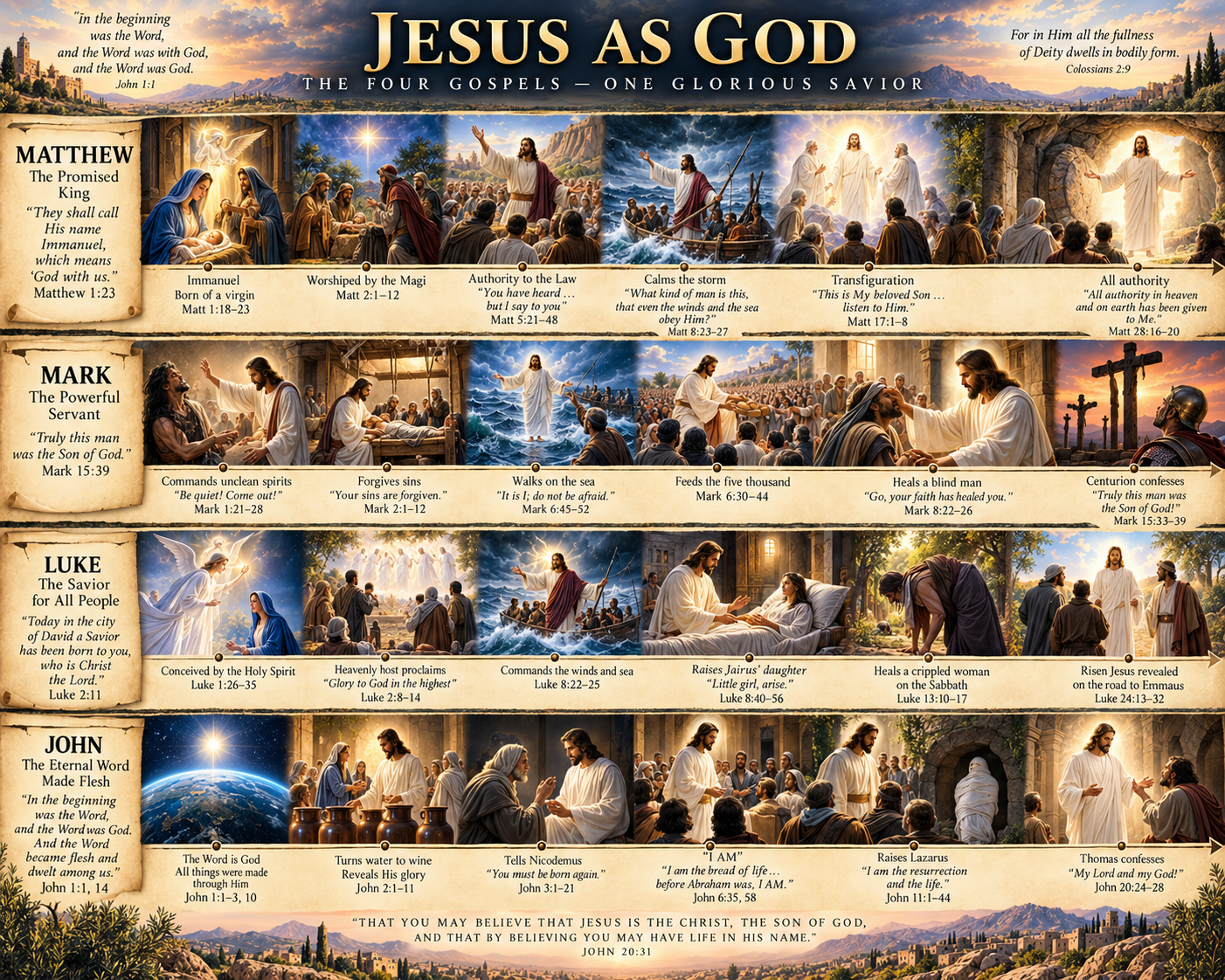
Jesus as God
The Gospels never record Jesus saying the exact sentence, “I am God.” Yet they repeatedly portray Him saying and doing things Scripture associates with God, accepting divine titles and testimony, exercising divine prerogatives, and fulfilling Old Testament passages concerning YHWH. Explore the cumulative evidence across all four Gospels.
Click timeline image to enlarge
Showing 25-36 of 51 evidence records.
Jesus Is the Good Shepherd of God's Sheep
John 10:1-16
What Jesus said or did: Jesus identifies himself as the good shepherd who knows his sheep, gives them abundant life, and lays down his life for them.
Why this points to His divinity: The claim is strong because Jesus fulfills a role Ezekiel explicitly assigns to YHWH himself while also fulfilling messianic expectation.
Read the full evidence
Jesus Has Authority to Take Up His Life Again
John 10:17-18
What Jesus said or did: Jesus says he has authority to lay down his life and authority to take it up again.
Why this points to His divinity: The saying gives Jesus an extraordinary authority over his own death and resurrection without erasing his obedient relationship to the Father.
Read the full evidence
No One Can Snatch Jesus' Sheep from His Hand
John 10:27-30
What Jesus said or did: Jesus gives his sheep eternal life, says no one can snatch them from his hand or the Father's hand, and concludes, 'I and the Father are one.'
Why this points to His divinity: The unity claim is grounded in shared saving action and sovereign security. The Father and Son remain personally distinct while acting with divine unity.
Read the full evidence
I and the Father Are One
John 10:30-33
What Jesus said or did: Jesus declares, 'I and the Father are one,' and his opponents say they intend to stone him because, being a man, he makes himself God.
Why this points to His divinity: The passage explicitly places the question of Jesus' deity within the narrative and connects it to his unity with the Father.
Read the full evidence
The Father Is in Jesus and Jesus Is in the Father
John 10:34-39
What Jesus said or did: After citing Psalm 82, Jesus calls himself the Son of God and tells his hearers to recognize that the Father is in him and he is in the Father.
Why this points to His divinity: The mutual-indwelling claim intensifies rather than dissolves the unique relationship expressed in John 10:30.
Read the full evidence
Jesus Is the Resurrection and the Life
John 11:21-27
What Jesus said or did: Jesus tells Martha, 'I am the resurrection and the life,' and makes belief in himself the condition of life beyond death.
Why this points to His divinity: The claim gathers John 5 and 6 into a concise declaration that final life is located in Jesus himself.
Read the full evidence
Jesus Calls Lazarus from the Grave
John 11:38-44
What Jesus said or did: After praying to the Father, Jesus directly calls the four-days-dead Lazarus from the tomb, and Lazarus comes out alive.
Why this points to His divinity: The sign enacts Jesus' immediately preceding claim to be the resurrection and the life.
Read the full evidence
Israel's Promised King Comes in Jesus
John 12:12-16
What Jesus said or did: The crowd welcomes Jesus as the one coming in the Lord's name and as Israel's King; John interprets the event through Zechariah's promised king.
Why this points to His divinity: The passage supports the larger Johannine portrait of Jesus as the saving King without functioning as an independent proof of deity.
Read the full evidence
The Lifted-Up Jesus Draws All People to Himself
John 12:27-32
What Jesus said or did: Jesus declares that the world's judgment has arrived, that its ruler will be cast out, and that when lifted up he will draw all people to himself.
Why this points to His divinity: The cross becomes the event through which Jesus exercises saving and judicial authority on a universal scale.
Read the full evidence
Isaiah Saw the Glory of Jesus
John 12:37-41
What Jesus said or did: After quoting Isaiah 53 and Isaiah 6, John says Isaiah spoke these things because he saw Jesus' glory and spoke about him.
Why this points to His divinity: This is one of John's strongest Old Testament divine-identity connections because it explicitly interprets a YHWH theophany Christologically.
Read the full evidence
Whoever Sees Jesus Sees the One Who Sent Him
John 12:44-50
What Jesus said or did: Jesus says that believing in him is believing in the One who sent him and that seeing him is seeing the One who sent him.
Why this points to His divinity: The statement anticipates John 14:9 and strengthens the Gospel's theme that the invisible God is uniquely made visible in Jesus.
Read the full evidence
Jesus Foretells Events So His Disciples Will Believe I Am
John 13:13-19
What Jesus said or did: Jesus accepts the disciples' address of him as Teacher and Lord and says he predicts the betrayal so that afterward they may believe that 'I am.'
Why this points to His divinity: The correspondence contributes strongly to John's cumulative divine-name theme, while the phrase itself is not treated mechanically as proof.
Read the full evidence