Cosmological Constant
The cosmological constant is connected with the accelerated expansion of the universe. Its observed value is very small compared with values that might be expected from some theories of particle physics.
Examine this evidence
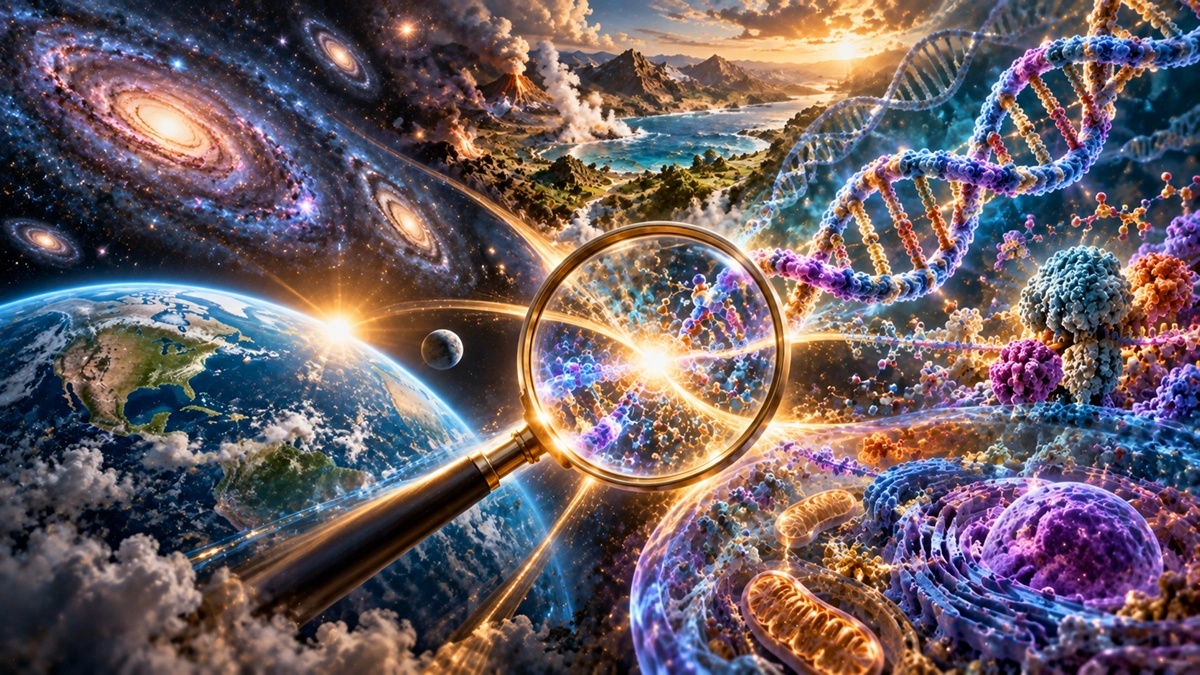
The first seven investigations looked at the evidence. This final investigation asks what that evidence means.
We have considered the fine-tuning of the universe, the conditions required for a habitable world, the origin of life, biological information, molecular machines, evolutionary mechanisms, and recurring patterns of organization in living systems.
No single observation needs to carry the entire case. The question is whether these different lines of evidence, considered together, point toward intelligence and purpose.
Intelligent Design proposes that some features of nature are better explained by intelligence than by unguided processes alone. How can we decide whether that conclusion is justified?
We already make design inferences in ordinary life. We can often distinguish a naturally shaped stone from an ancient tool. Archaeologists recognize artifacts. Investigators distinguish some accidents from deliberate acts. Scientists searching for extraterrestrial intelligence ask whether a signal could have been produced intentionally.
These judgments are not based simply on complexity. Snowflakes and crystals can be complex without being designed. The important question is whether an observed pattern has characteristics that are better explained by purposeful activity than by the natural processes known to be operating.
Intelligent Design asks whether similar reasoning can be applied to nature itself.
One way to approach the question is called inference to the best explanation. We compare possible causes and ask which one best accounts for what we observe. We can consider explanatory power and scope, causal adequacy, evidential support, fit with what is already known, and whether an explanation makes useful predictions. This does not produce mathematical proof. It is a reasoned judgment about which explanation best accounts for the available evidence.
We will examine how design is recognized and how competing explanations can be compared.
We will consider concepts such as functional information, specified complexity, irreducible complexity, causal adequacy, and inference to the best explanation.
We will also bring together the evidence examined throughout this series. The universe contains physical conditions that permit life. A habitable planet requires many interacting conditions. The first living systems required information, energy, chemistry, replication, and cellular organization. Living cells contain information-processing systems, molecular machines, transport systems, quality-control systems, and networks of coordinated activity.
At the same time, evolution is real and observable. Mutation, natural selection, gene duplication, regulatory change, co-option, and other mechanisms can produce biological change. Any serious investigation of design must take those capabilities into account.
The question is therefore not whether natural processes can accomplish anything. They clearly can. The question is whether they provide an adequate explanation for everything that needs to be explained.
We will also examine the major objections to Intelligent Design. Is it merely an argument from ignorance or a God-of-the-gaps argument? Can a design inference be tested? Does it make useful predictions? Can evolutionary processes account for apparently designed features? Are we justified in reasoning from the effects we observe to an intelligent cause?
Evidence does not interpret itself. People may agree about an observation while disagreeing about what best explains it.
This matters because the question of design reaches beyond any single protein, organism, or physical constant. If intelligence has played a role in the history of life or in establishing the conditions that make life possible, then nature is not entirely the product of unguided causes.
That would change the larger question. Instead of asking only how natural processes operate, we would also have reason to ask whether purpose lies behind them.
Design and natural processes are not necessarily opposites. A designed system can operate through regular processes. An engineer can design a machine that then functions according to physical laws without further intervention. In the same way, evidence for evolutionary change does not by itself demonstrate either design or the absence of design.
The deeper question is whether the whole pattern is adequately explained without intelligence.
This investigation draws upon 12 related evidence records. A few are highlighted below. The complete evidence library is available for readers who want to examine the research in greater depth.
The cosmological constant is connected with the accelerated expansion of the universe. Its observed value is very small compared with values that might be expected from some theories of particle physics.
Examine this evidenceEarth's habitability results from many interacting systems rather than from one remarkable property. The larger question is how a suitable star, orbit, water, atmosphere, chemistry, planetary structure, climate, and geological history work together over time.
Examine this evidenceThe sequence of nucleotides in genetic molecules affects their structure and function. Origin-of-life research therefore includes the question of how useful sequence-dependent information first emerged and became heritable.
Examine this evidenceThe evidence can be understood in different ways. Compare the 5 principal explanations considered in this investigation, including their strengths, limitations, and unresolved questions.
Compare the explanationsA serious investigation should consider the challenges to a design inference. Examine 6 objections, responses, and questions that remain.
Examine the objectionsThe supporting research draws upon scientific papers, reviews, philosophical analysis, and Intelligent Design sources. Source citations are presented with the detailed evidence, explanations, and objections.
View the research sourcesThe case for Intelligent Design should not rest simply on what science has not yet explained. Scientific knowledge changes. A mystery today may have a natural explanation tomorrow.
The stronger design argument is positive. Intelligent agents are known to produce information, codes, machines, coordinated systems, control networks, error-correction systems, and arrangements of parts directed toward functional goals.
When similar characteristics appear in living systems, it is reasonable to ask whether intelligence belongs among the possible explanations.
The cumulative case is especially important. Fine-tuning alone may be disputed. Biological information alone may be disputed. A molecular machine alone may be given an evolutionary history. But our investigation has uncovered several different kinds of evidence. They repeatedly raise questions about information, coordination, function, organization, and the conditions necessary for life.
For A Visit With Jesus, that convergence matters. We believe the cumulative evidence gives serious reason to consider intelligence and purpose as part of the explanation of life and the universe.
That conclusion does not require us to deny natural processes. Nor does it require us to claim that every unanswered scientific question is evidence of design. It asks instead whether intelligence has explanatory power where the characteristics of intelligence appear to be present.
Intelligent Design is not a mathematical proof of a Designer. Nor does it depend upon proving that natural processes never produce complexity or biological change.
The case is cumulative.
We have seen a universe whose physical conditions permit life. We have seen that habitability depends upon many interacting conditions. We have examined the difficult transition from chemistry to the first living systems. We have encountered DNA and the translation system, molecular machines, cellular transport, proofreading, repair, feedback, signaling, robustness, and highly coordinated networks.
We have also examined evolutionary mechanisms. They have real explanatory power. They can modify organisms, produce adaptations, duplicate and alter genes, change regulation, and make use of existing biological components in new ways.
But recognizing what these mechanisms can do does not settle every question about origins. We must still ask where the information, integrated systems, and life-permitting conditions ultimately came from and whether unguided processes provide the best explanation for the whole body of evidence.
A Visit With Jesus believes that the evidence gives good reason to take intelligent causation seriously. The repeated appearance of information-rich, functionally organized, highly coordinated systems is consistent with what intelligence is known to produce. When this is considered together with cosmic fine-tuning, habitability, and the requirements for life itself, the inference to design becomes part of a cumulative case.
Intelligent Design by itself does not identify the Designer. It does not prove that the Designer is the God of the Bible, establish the truth of Scripture, or demonstrate that Jesus is the Son of God. Those conclusions require additional evidence.
But that limitation should not obscure what the design inference may tell us. If nature gives us genuine reason to suspect mind, intention, and purpose behind what we observe, then an important question follows: Who is the Designer?
For Christians, that question has an answer. Scripture declares that creation is the work of God and that all things were made through Jesus Christ. A Visit With Jesus therefore does not end its investigation with Intelligent Design. We continue by asking whether the God toward whom nature points has revealed Himself in history, in Scripture, and ultimately in Jesus.
© 2026 AVisitWithJesus
"For God so loved the world, that he gave his only begotten Son,
that whosoever believeth in him should not perish, but have everlasting life."