Feedback Control
Living systems use feedback mechanisms in which information about the state of a system influences processes that regulate that state.
Examine this evidence
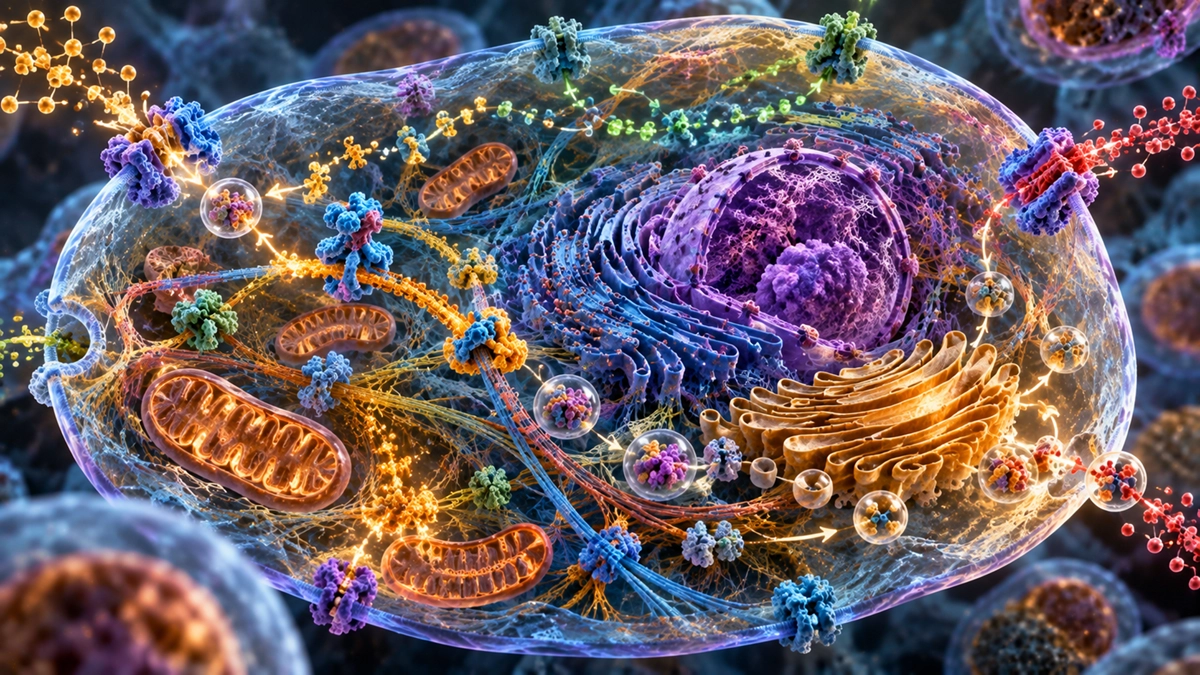
Living things do much more than carry out chemical reactions. They sense changes, regulate processes, correct errors, transmit information, compensate for disturbances, and coordinate many interacting activities.
Many of these systems display organizational patterns that are also familiar in human engineering. The resemblance is real enough that scientists routinely use concepts from control theory, information theory, network science, and engineering to investigate biological systems.
Living systems use feedback control, homeostasis, redundancy, error correction, information processing, modular organization, hierarchical regulation, and integrated networks. These features contribute to reliable function even though organisms operate in changing environments and are built from components that can fail.
Engineering concepts can help us understand these systems, but resemblance to engineering does not by itself establish how biological organization originated. We therefore need to examine both the organization itself and the different explanations proposed for it.
We will examine feedback control, homeostasis, robustness, redundancy, error detection and correction, biological information processing, modular organization, hierarchical control, and the integration of multiple regulatory networks.
We will also examine trade-offs, constraints, and failure modes. These are important because living systems are not uniformly optimal. Finally, we will ask why engineering principles apply so productively to biology and whether engineering-like organization provides evidence concerning biological origins.
The same broad organizational principles appear repeatedly throughout living systems. Feedback maintains important conditions. Error correction protects genetic information. Redundancy can preserve function after disruption. Modular and hierarchical organization help coordinate complex biological activities.
Understanding why these patterns recur can tell us something important about the capabilities of natural selection, self-organization, inherited biological architecture, historical constraint, and purposeful design.
This investigation draws upon 12 related evidence records. A few are highlighted below. The complete evidence library is available for readers who want to examine the research in greater depth.
Living systems use feedback mechanisms in which information about the state of a system influences processes that regulate that state.
Examine this evidenceOrganisms maintain many internal conditions within functional ranges despite changes in their surroundings and their own activities.
Examine this evidenceBiological systems often continue functioning despite environmental variation, molecular noise, genetic changes, and damage.
Examine this evidenceThe evidence can be understood in different ways. Compare the 5 principal explanations considered in this investigation, including their strengths, limitations, and unresolved questions.
Compare the explanationsA serious investigation should consider the challenges to a design inference. Examine 6 objections, responses, and questions that remain.
Examine the objectionsThe supporting research draws upon scientific papers, reviews, philosophical analysis, and Intelligent Design sources. Source citations are presented with the detailed evidence, explanations, and objections.
View the research sourcesIntelligent Design draws attention to the information-rich, coordinated, and engineering-like organization of living systems. Purposeful human activity is one known source of systems containing feedback, error correction, modularity, information processing, and integrated control.
However, biological systems also have evolutionary histories, and natural selection, self-organization, historical inheritance, constraint, and convergence can contribute to organized biological function. The investigation therefore asks whether particular features of living systems are adequately explained by these processes or whether some features provide reason to consider purposeful organization.
Living systems unquestionably display sophisticated organization. Feedback control, homeostasis, robustness, redundancy, error correction, information processing, modularity, hierarchical regulation, and network integration are genuine biological phenomena rather than merely engineering metaphors.
At the same time, engineering resemblance alone does not determine origin. Natural selection can preserve useful variations. Self-organizing processes can generate biological patterns. Existing structures constrain and guide later change. Historical events can influence which evolutionary pathways become available, and similar functional problems can favor similar organizational solutions.
Intelligent Design proposes that some combinations of information-rich and highly coordinated organization may be better explained by purposeful arrangement. Critics argue that evolutionary mechanisms and historical processes can produce such organization without intelligent causation.
The important question is therefore not simply whether living systems resemble engineering. They often do. The question is how particular systems arose and whether the detailed evidence is adequately accounted for by demonstrated natural mechanisms and historical pathways, supports an inference to purposeful organization, or leaves important questions unresolved.
© 2026 AVisitWithJesus
"For God so loved the world, that he gave his only begotten Son,
that whosoever believeth in him should not perish, but have everlasting life."