Mutation and Variation
Mutations and other genetic changes continually introduce variation into populations. These changes provide raw material upon which selection, drift, and other evolutionary processes can act.
Examine this evidence
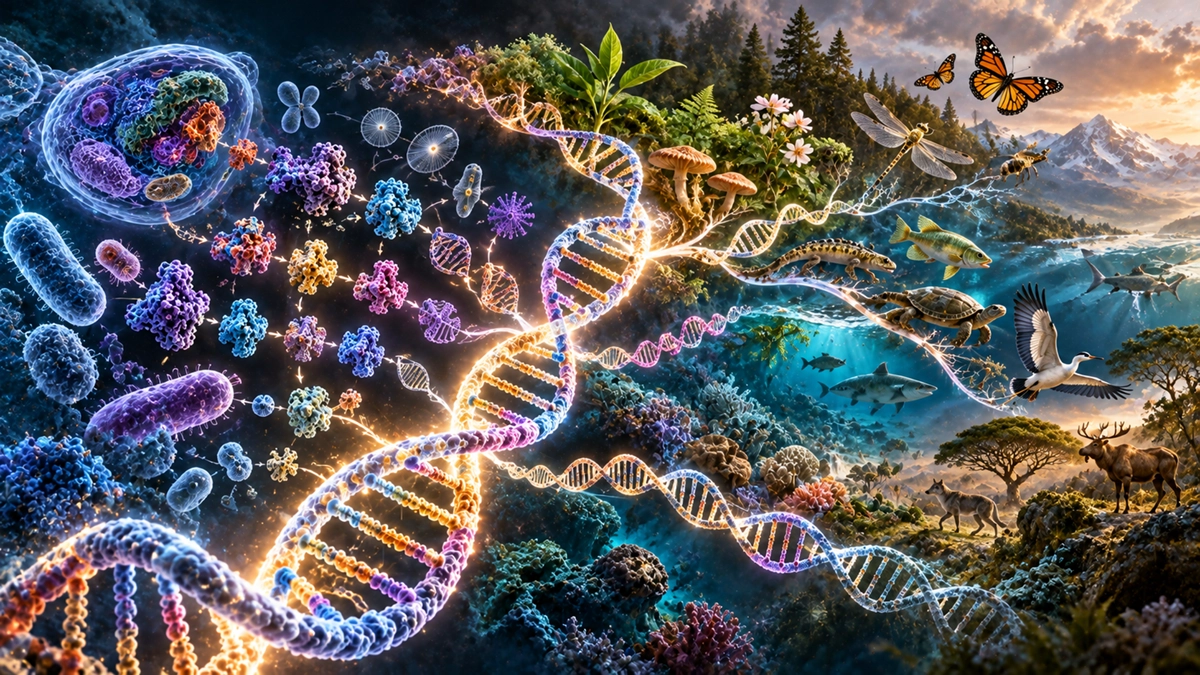
Living things change over time. Mutations occur. Natural selection favors some variations over others. Genes can be duplicated, rearranged, lost, or changed. Populations can divide and eventually become different species.
These are observed parts of biology.
The larger question is how much these processes can accomplish.
Evolution involves more than the familiar phrase "random mutation and natural selection." Scientists also study genetic drift, gene duplication, recombination, changes in gene regulation, the origin of new genes, changes in protein function, developmental processes, and the movement of genes between organisms.
We want to understand these mechanisms accurately before asking where their explanatory reach may lie. We must also distinguish different kinds of biological innovation. The origin of a new gene, a new function, a new anatomical feature, a major developmental change, and the later success of a new biological form are related questions, but they are not the same question.
We will examine mutation, natural selection, experimental evolution, gene duplication, the origin of new genes, changes in protein function, gene regulation, speciation, developmental change, convergence, and major biological innovation.
We will pay special attention to examples in which researchers can identify the actual genetic changes involved. We will also ask how evidence for observed change connects to proposed explanations for major historical innovations.
It is not enough to say that evolution happens. Nor is it enough to say that evolution cannot explain something because we do not yet know how it happened.
Observed evolutionary mechanisms can produce meaningful genetic, functional, regulatory, and phenotypic changes. The larger question is how those demonstrated processes relate to the origin of major structures, systems, and forms of biological organization in the history of life.
This investigation draws upon 12 related evidence records. A few are highlighted below. The complete evidence library is available for readers who want to examine the research in greater depth.
Mutations and other genetic changes continually introduce variation into populations. These changes provide raw material upon which selection, drift, and other evolutionary processes can act.
Examine this evidenceNatural selection changes populations when inherited variations affect survival or reproduction. It can produce substantial adaptation to particular environments.
Examine this evidenceLaboratory evolution experiments allow researchers to observe populations over many generations and identify genetic changes associated with adaptation and new traits.
Examine this evidenceThe evidence can be understood in different ways. Compare the 5 principal explanations considered in this investigation, including their strengths, limitations, and unresolved questions.
Compare the explanationsA serious investigation should consider the challenges to a design inference. Examine 6 objections, responses, and questions that remain.
Examine the objectionsThe supporting research draws upon scientific papers, reviews, philosophical analysis, and Intelligent Design sources. Source citations are presented with the detailed evidence, explanations, and objections.
View the research sourcesIntelligent Design does not require us to deny ordinary evolutionary change. Mutation, selection, gene duplication, new gene formation, changes in protein function, regulatory change, speciation, and other evolutionary processes can be investigated empirically.
The important question is whether known mechanisms and the available historical evidence adequately account for particular major biological innovations, or whether some features are better explained by purposeful organization. That question should be examined case by case rather than answered in advance.
The evidence examined in this investigation establishes substantial evolutionary change and several mechanisms capable of producing genuine biological novelty. It also shows why biological innovation should not be treated as a single process. Different kinds of novelty involve different genetic, functional, developmental, and historical questions.
The investigation therefore does not end merely by asking whether evolution occurs. It asks how well demonstrated mechanisms and the available historical evidence account for particular major innovations. That provides a more useful basis for considering the claims of Intelligent Design than assuming either unlimited evolutionary power or universal evolutionary inadequacy at the outset.
© 2026 AVisitWithJesus
"For God so loved the world, that he gave his only begotten Son,
that whosoever believeth in him should not perish, but have everlasting life."