Molecular Machines in the Cell
Cells contain organized molecular systems that perform mechanical and chemical tasks such as rotation, transport, synthesis, movement, and controlled assembly.
Examine this evidence
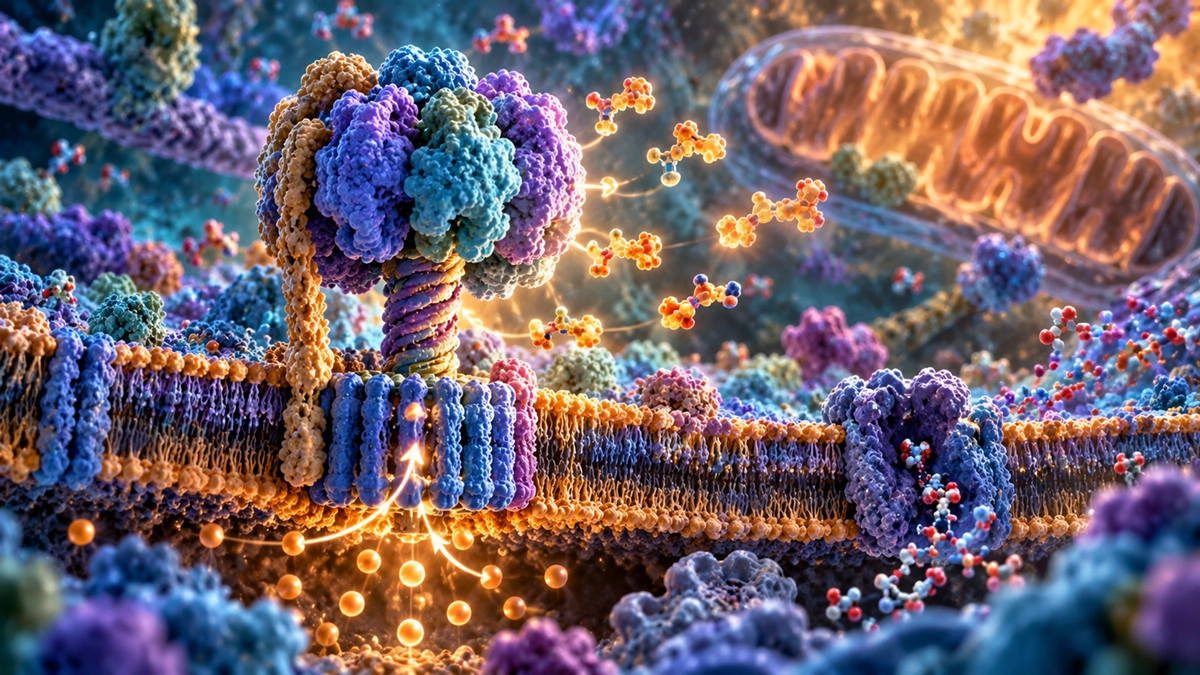
A living cell is filled with tiny working systems. Some produce energy. Some build proteins. Some transport materials from one place to another. Others help proteins fold correctly, remove damaged molecules, or allow cells to move.
Scientists often describe many of these systems as molecular machines because multiple parts work together to perform particular jobs. These machines do not operate alone. They function within larger networks of energy production, information processing, transport, regulation, and maintenance.
Calling something a machine does not prove that it was designed. We first need to understand what the system does, what parts it needs, how those parts work together, and how the system is assembled and maintained.
Modern molecular biology gives us remarkable detail about many of these systems. The historical question is different: How did the machinery and the relationships among its parts arise?
We will examine the bacterial flagellum, ATP synthase, intracellular transport motors, the ribosome, molecular chaperones, the proteasome, and the larger networks in which cellular machinery operates.
We will then examine irreducible complexity and proposed evolutionary mechanisms such as gene duplication, divergence, co-option, recruitment, recombination, and changes of function. Finally, we will ask what evidence supports proposed step-by-step pathways for the origin of molecular machinery.
Some biological systems stop performing their normal function when an important part is removed. That tells us something important about how the system works today. It does not, by itself, tell us how the system arose in the past.
Likewise, showing that biological components can be duplicated, modified, or reused does not by itself reconstruct the complete history of a particular molecular machine. Historical explanations require evidence connecting known mechanisms with proposed pathways.
This investigation draws upon 12 related evidence records. A few are highlighted below. The complete evidence library is available for readers who want to examine the research in greater depth.
Cells contain organized molecular systems that perform mechanical and chemical tasks such as rotation, transport, synthesis, movement, and controlled assembly.
Examine this evidenceThe bacterial flagellum is an ion-powered rotary molecular machine that enables many bacteria to swim through their environment.
Examine this evidenceThe bacterial flagellum is constructed through a highly ordered process in which gene expression and physical assembly are coordinated.
Examine this evidenceThe evidence can be understood in different ways. Compare the 5 principal explanations considered in this investigation, including their strengths, limitations, and unresolved questions.
Compare the explanationsA serious investigation should consider the challenges to a design inference. Examine 6 objections, responses, and questions that remain.
Examine the objectionsThe supporting research draws upon scientific papers, reviews, philosophical analysis, and Intelligent Design sources. Source citations are presented with the detailed evidence, explanations, and objections.
View the research sourcesIntelligent Design argues that the coordinated organization of some biological systems may point beyond undirected evolutionary processes alone.
Evolutionary researchers propose that complex systems can develop through modification and reuse of existing components, sometimes with earlier structures performing functions different from those they perform today.
We will examine the observed machinery, the proposed historical pathways, and what remains uncertain. The goal is to understand what the evidence shows and allow the reader to consider which explanation best accounts for it.
Molecular machines are not merely illustrations or figures of speech. Modern biology has revealed real molecular systems that rotate, transport cargo, translate information, fold proteins, destroy damaged molecules, and convert energy into useful cellular work.
Known evolutionary processes can duplicate, modify, recruit, and reorganize biological components. Comparative evidence can also reveal relationships among existing systems and support proposed histories. At the same time, the earliest stages in the origin of many ancient molecular machines cannot be observed directly and must be reconstructed from evidence that remains today.
The central question therefore remains one of explanation. How well do proposed evolutionary pathways account for the origin of the coordinated machinery and integrated systems we observe? Intelligent Design asks whether purposeful organization should also be considered when weighing that evidence. The reader should examine the evidence, the proposed pathways, and the remaining uncertainties before reaching a conclusion.
© 2026 AVisitWithJesus
"For God so loved the world, that he gave his only begotten Son,
that whosoever believeth in him should not perish, but have everlasting life."