DNA and the Storage of Biological Information
DNA is the principal hereditary material of cellular life. Its sequence of four nucleotide bases stores information that can be copied, inherited, and used by cells.
Examine this evidence
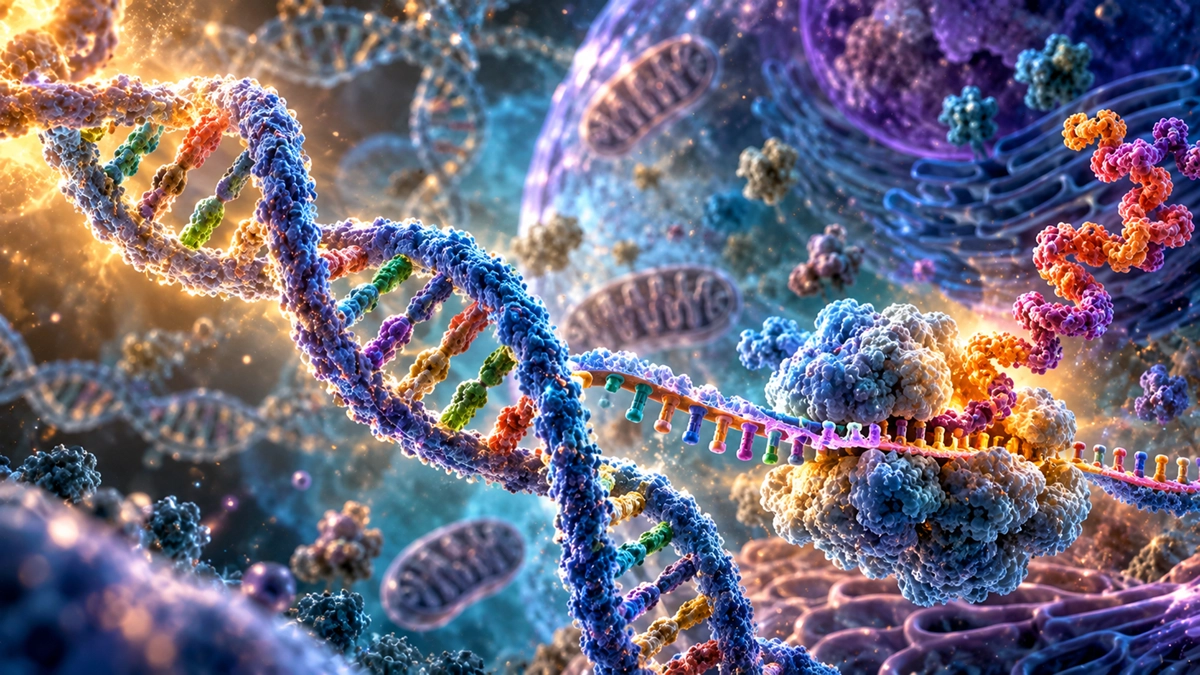
Every cell depends upon information. DNA stores enormous amounts of it. Cells copy that information, read it, and use it to make the proteins needed for life.
But DNA does not work alone. An elaborate system of RNA molecules, enzymes, and molecular machinery is needed to use the information stored in DNA.
We often hear that DNA contains a "code." That comparison can be helpful, but we need to understand exactly what it means.
Groups of DNA and RNA letters correspond to particular amino acids. Cells use that relationship when building proteins. Other DNA sequences help control when and where genes are used.
We will examine how this remarkable information system actually works before asking how it arose.
We will look at DNA, RNA, genes, the genetic code, transcription, protein production, ribosomes, transfer RNA, proofreading, DNA repair, gene regulation, and the molecular machinery that connects genetic instructions with the proteins they specify.
We will also examine the leading ideas about how the genetic code and its supporting machinery may have developed.
A cell cannot survive simply by having the right chemicals. Those chemicals must be organized and used in the right ways.
The information stored in DNA and the machinery that reads it are therefore central to understanding life.
This investigation draws upon 12 related evidence records. A few are highlighted below. The complete evidence library is available for readers who want to examine the research in greater depth.
DNA is the principal hereditary material of cellular life. Its sequence of four nucleotide bases stores information that can be copied, inherited, and used by cells.
Examine this evidenceThe biological importance of DNA depends upon particular sequences performing useful functions. Some sequences specify molecular products, while others help regulate when and where those products are produced.
Examine this evidenceThe genetic code is the system by which three-nucleotide sequences in messenger RNA correspond to amino acids used in protein synthesis. It connects information stored in nucleic acids with the chemically different world of proteins.
Examine this evidenceThe evidence can be understood in different ways. Compare the 5 principal explanations considered in this investigation, including their strengths, limitations, and unresolved questions.
Compare the explanationsA serious investigation should consider the challenges to a design inference. Examine 6 objections, responses, and questions that remain.
Examine the objectionsThe supporting research draws upon scientific papers, reviews, philosophical analysis, and Intelligent Design sources. Source citations are presented with the detailed evidence, explanations, and objections.
View the research sourcesWe know from everyday experience that intelligent beings can create coded information. Does that make intelligence the best explanation for biological information?
Or can chemistry and evolution account for its origin? We will examine what is known before drawing a conclusion.
Biological information is one of the most remarkable features of life. DNA does not merely contain chemically interesting molecules. The sequence of its nucleotides participates in a system in which information is stored, copied, transcribed, translated, regulated, corrected, and used to produce functional results.
None of this means that every comparison between DNA and human language or computer software should be taken literally. Nor does the word "code" by itself establish intelligent design. The case must rest upon the biological system itself rather than upon the terminology we use to describe it.
We also know that biological information can change. Mutations occur. Genes duplicate. Existing sequences acquire new functions. Natural selection can preserve useful variations. The genetic code itself shows evidence of history, and researchers have developed serious models involving stereochemical relationships, coevolution, selection, error minimization, historical contingency, and self-organization.
These findings are important. They help explain how an existing biological information system can change and develop. Some proposals go farther and attempt to explain how simpler forms of coding and translation might have emerged before the modern system existed.
Yet the central origin question remains. Before natural selection could accumulate improvements, there had to be some means of preserving heritable differences. Before modern proteins could perform their enormous range of cellular functions, there had to be a means of translating nucleotide sequences into amino-acid sequences. And before the modern translation system existed, some pathway had to establish dependable relationships among information-bearing molecules, molecular recognition, catalysts, and functional products.
This is not simply one missing step. Modern biological information operates as an integrated system. DNA, RNA, the genetic code, transfer RNAs, aminoacyl-tRNA synthetases, ribosomes, regulatory systems, and error-control mechanisms work together. Researchers can study possible histories for individual components, but explaining how coding, translation, replication, and function became sufficiently coordinated to support an evolving living system remains a profound question.
For Intelligent Design, the significance of biological information therefore does not rest upon what science has failed to discover. It rests upon what life actually contains. We observe sequence-dependent information, coding relationships, molecular recognition, coordinated information processing, and systems in which many components contribute to a common functional result.
Natural processes unquestionably operate within these systems, and future research may explain much more about their history. Such discoveries should be welcomed. A design inference should never depend upon preventing science from discovering natural mechanisms.
At the same time, purposeful organization is familiar to us as an effect of intelligence. When we encounter systems in which information is stored, interpreted, and used to accomplish functional ends, it is reasonable to ask whether intelligence provides a better explanation of those characteristics than undirected processes alone.
From the Christian perspective, this evidence fits naturally within a larger understanding of creation. Scripture presents life as purposeful rather than accidental. The biological evidence does not replace that revelation, nor does it prove every theological conclusion from molecular biology. But the extraordinary information-processing architecture of life is consistent with what Christians would expect if living things ultimately owe their existence to a purposeful Creator.
Our investigation therefore does not end with the simplistic argument that DNA is a code and codes require a coder. The evidence is richer than that. Life depends upon an integrated system that stores information, interprets it, acts upon it, preserves it, and passes it forward. Naturalistic models offer important proposals concerning how portions of this system could have developed, and those proposals deserve continued investigation. Yet the origin of the coding and translation system itself remains a central question.
For the believer, biological information provides substantial reason to see purpose rather than mere accident in the organization of life. The deeper science looks into the cell, the more clearly we encounter not simply chemistry, but chemistry organized into an extraordinary information-processing system capable of building, maintaining, reproducing, and modifying living things.
© 2026 AVisitWithJesus
"For God so loved the world, that he gave his only begotten Son,
that whosoever believeth in him should not perish, but have everlasting life."