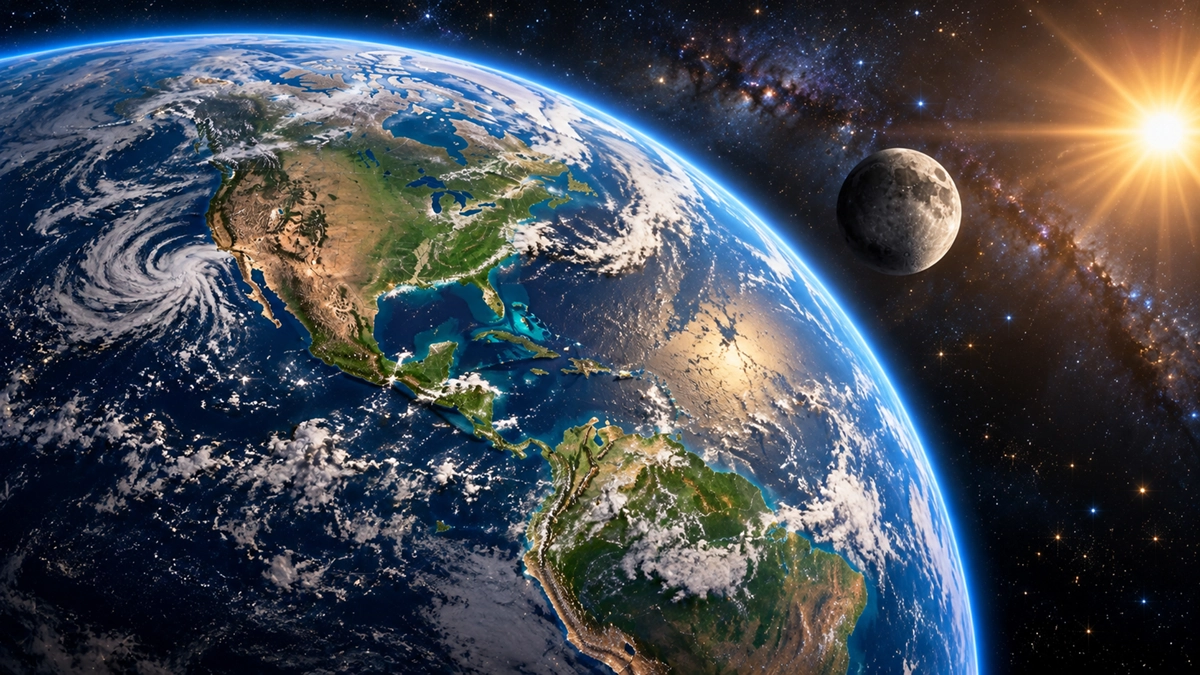
A universe capable of supporting life is only the beginning. Life also needs somewhere to live.
Earth provides such a place. It has remained home to life for billions of years while its atmosphere, oceans, climate, continents, and living organisms have undergone enormous changes.
What makes this possible?
The answer is not a single feature. Earth orbits a long-lived star at a distance where liquid surface water can exist. It has an atmosphere, oceans, a rocky surface, continuing geological activity, and the chemical materials used by living organisms. These features interact with one another through systems that have changed throughout Earth's history.
This makes Earth an especially interesting subject for investigation. We can ask not simply why Earth is habitable today, but how it became habitable and how it has remained so over immense periods of time.
The Investigative Question
What makes Earth such a suitable home for complex life?
Overview
Planetary habitability is more complicated than simply placing a planet at the right distance from its star.
A planet may orbit within a star's habitable zone and still lack surface water. It may lose its atmosphere. Its climate may become too hot or too cold. Its star may produce conditions hostile to long-term surface life.
For this reason, scientists increasingly study habitability as a problem involving many interacting systems.
Earth gives us the only known example of an inhabited planet. It therefore provides an important starting point. But we must be careful not to assume that every characteristic of Earth is required for every possible form of life.
Our investigation will distinguish between conditions known to be important for terrestrial life, conditions that appear helpful for long-term habitability, and features whose necessity remains uncertain.
What We Investigate
We will examine Earth's habitability in several connected areas.
A suitable star and orbit. Earth receives energy from a long-lived star and occupies a region where surface liquid water can exist. We will also consider Earth's orbit, rotation, and axial tilt.
Water and atmosphere. Earth possesses extensive oceans and an atmosphere that provides pressure, influences temperature, and participates in the planet's climate system.
Long-term climate. Carbon moves among the atmosphere, oceans, living organisms, rocks, and Earth's interior. These processes have important effects upon climate over geological time.
The right kind of planet. Earth's mass, gravity, rocky composition, magnetic field, and continuing geological activity all influence the environment in which life exists.
The Earth-Moon system. The Moon affects tides and Earth's rotation and has influenced the planet throughout its history. We will also examine how much of that influence is actually required for habitability.
Materials for life. Earth contains the chemical elements and compounds used by every known organism.
Finally, we will put these subjects together and ask what happens when habitability is considered as an interacting planetary system rather than as a list of isolated conditions.
Why It Matters
Finding a planet at the right distance from its star does not necessarily mean that we have found another Earth.
Habitability has a history. Planets form, cool, lose and acquire atmospheres, experience impacts, undergo geological change, interact with their stars, and sometimes change beyond recognition.
Earth itself demonstrates this. The planet we inhabit today is not identical to the early Earth. Its atmosphere, climate, continents, oceans, and biosphere have changed dramatically.
The important question is therefore not merely whether a planet can become habitable for a moment. For complex surface life especially, we must also ask whether suitable conditions can be maintained over long periods of time.
This turns habitability into a systems question. A change in one part of a planet can affect many others.
Understanding those relationships helps us ask a better question: How unusual is a planetary system capable of establishing and maintaining the conditions necessary for complex life?
Explore the Evidence
This investigation draws upon 12 related evidence records.
A few are highlighted below. The complete evidence library is available for readers who want to examine the research in greater depth.
Habitable Zone
Earth orbits the Sun within a region where conditions can allow liquid water to remain on a planet's surface. This habitable zone is important, but distance from a star is only the beginning of the habitability question.
Earth receives its light and energy from a long-lived main-sequence star whose properties have allowed habitable conditions to persist for billions of years.
The evidence can be understood in different ways. Compare the 5 principal explanations considered in this investigation, including their strengths, limitations, and unresolved questions.
The supporting research draws upon scientific papers, reviews, philosophical analysis, and Intelligent Design sources. Source citations are presented with the detailed evidence, explanations, and objections.
Earth's habitability is relevant to Intelligent Design because it involves a collection of conditions and interacting systems that together make complex life possible.
That does not mean that every familiar feature of Earth should automatically be called evidence of design.
Some claims require qualification. A large Moon may be helpful without being absolutely necessary. A magnetic field has important effects without simply functioning as an impenetrable shield against atmospheric loss. Other kinds of planets may maintain habitable environments in ways different from Earth.
These qualifications strengthen the investigation because they help separate genuine evidence from exaggerated claims.
The more important design question concerns the complete system. Earth possesses water, useful chemistry, an atmosphere, a suitable energy source, long-term climate processes, and geological systems that have operated together while life has persisted for billions of years.
Natural processes describe much of how these systems operate. The Intelligent Design question is different: does the existence and coordination of such a life-supporting planetary system reasonably suggest purpose?
That question should be considered alongside other possibilities, including planetary evolution, selection effects, the enormous number of planets in the universe, and conditions for life that may differ from those found on Earth.
Conclusion
Earth is a remarkable inhabited world, but our investigation gives us reason to describe that fact carefully.
No single characteristic establishes the case. Being inside the Sun's habitable zone is not enough. Neither is having water, an atmosphere, a Moon, a magnetic field, or plate tectonics considered by itself.
Habitability emerges from a planetary system.
Earth has a long-lived energy source. Liquid water has persisted at its surface. Its atmosphere and climate have remained compatible with life through enormous changes. Geological and chemical cycles connect its surface with its interior. The materials required by living organisms are available. These conditions have continued long enough for a complex biosphere to develop.
At the same time, important uncertainties remain. We do not yet know how many different kinds of planets could support life. We do not know how frequently long-term habitable environments develop. We do not know which Earth characteristics are indispensable and which merely represent one successful way of producing an inhabited world.
Future discoveries may answer some of these questions. Finding other habitable or inhabited planets would give us something we presently lack: additional examples with which to compare Earth.
For now, Earth remains the only inhabited world known to us.
For the Christian, a world capable of sustaining life fits naturally within the biblical understanding of a purposeful creation. Intelligent Design approaches the subject from the evidence found in nature itself. It asks whether the combination and coordination of life-supporting conditions is reasonably understood as the result of purpose rather than merely assumed to be so.
Earth does not answer that question through one remarkable feature. The question emerges from the whole system.