Cosmological Constant
The cosmological constant is connected with the accelerated expansion of the universe. Its observed value is very small compared with values that might be expected from some theories of particle physics.
Examine this evidence
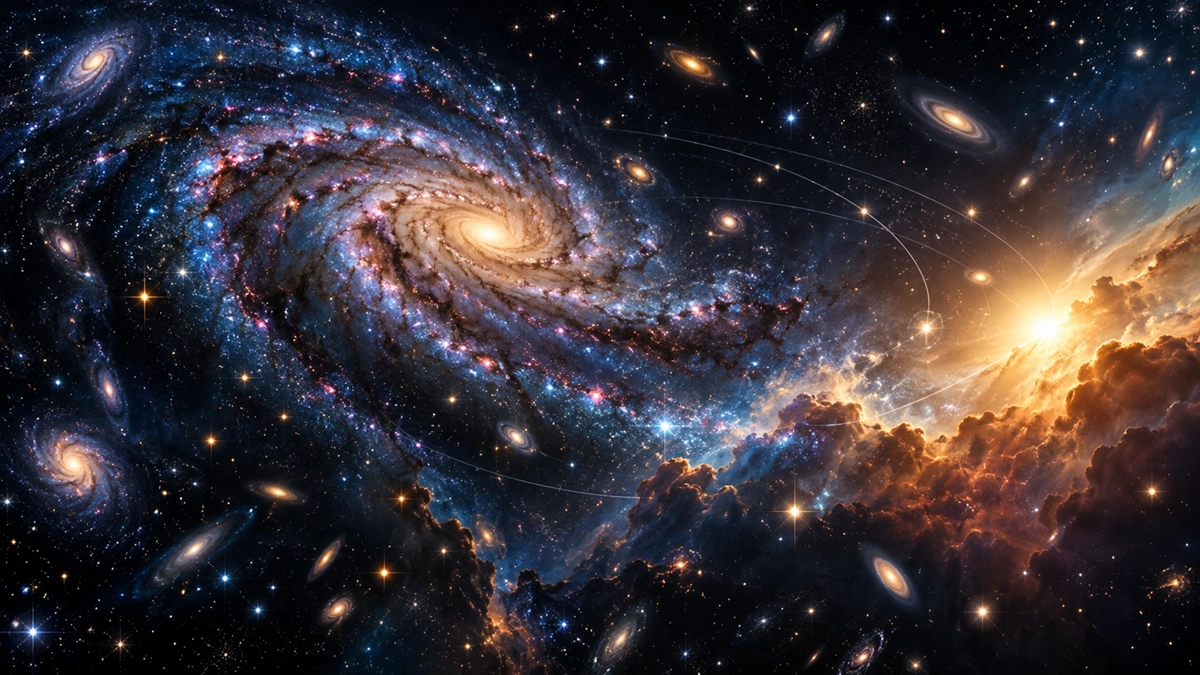
Our universe did not have to look exactly as it does. Physics describes fundamental forces, particle properties, and cosmic conditions whose values help determine what kind of universe can exist.
Change some of these conditions and the consequences can be enormous. Galaxies may not form. Stars may not survive long enough. Stable atoms may become impossible. The elements needed for complex chemistry may never be produced.
This has led scientists, philosophers, and others to ask whether our universe is in some sense fine-tuned for life.
That question deserves careful investigation. Fine-tuning does not necessarily mean that every physical constant must have exactly the value we observe. In many cases, other values are possible. The deeper question is whether the many requirements for a life-supporting universe can all be satisfied together.
The fine-tuning question reaches from the largest scale of the universe to the smallest particles of matter.
At the cosmic level, we find an expanding universe capable of forming galaxies and long-lived stars. Its early conditions included tiny density variations from which those structures eventually developed.
At the level of fundamental physics, gravity, electromagnetism, nuclear interactions, and particle properties work together in ways that permit stable matter.
Inside stars, nuclear reactions produce carbon, oxygen, and other elements needed for complex chemistry.
None of these observations by itself proves that the universe was designed. Some have known physical explanations. Others remain active areas of research. Some proposed examples of fine-tuning are also less restrictive than they have sometimes been portrayed.
Our purpose is therefore not simply to collect remarkable numbers. We want to ask what is actually known, what physics can presently explain, what remains uncertain, and what explanations have been proposed.
We will examine several groups of evidence.
Cosmic conditions. We will consider the cosmological constant, the early expansion of the universe, its unusually low initial entropy, primordial density fluctuations, and the excess of matter over antimatter.
Forces and stable matter. We will examine gravity, electromagnetism, nuclear physics, the relationship between protons and neutrons, and the conditions that allow stable atoms to exist.
Stars and the elements of life. We will investigate the production of carbon through the triple-alpha process and the remarkable nuclear properties associated with the Hoyle state. We will also consider the production of both carbon and oxygen inside stars.
For each subject we will distinguish observation from interpretation. We will ask what happens when physical parameters are changed, what alternative physical possibilities have been studied, and how confidently the resulting limits can be stated.
A universe may contain laws of physics and still fail to produce anything remotely like the world around us.
Complex life requires a long chain of possibilities. Matter must survive. Stable atoms must exist. Stars must form and remain active long enough to manufacture heavier elements. Galaxies and planetary systems must be possible. Chemistry must have suitable building materials.
The interesting question is therefore not merely whether one number looks unusual. It is whether the complete physical system occupies a region in which these many requirements can work together.
That makes fine-tuning a cumulative investigation. A change that still permits one requirement may prevent another. A universe capable of making stable nuclei, for example, must still be capable of producing those nuclei in useful quantities and building stars in which further elements can be made.
This investigation draws upon 12 related evidence records. A few are highlighted below. The complete evidence library is available for readers who want to examine the research in greater depth.
The cosmological constant is connected with the accelerated expansion of the universe. Its observed value is very small compared with values that might be expected from some theories of particle physics.
Examine this evidenceThe early universe was remarkably smooth. In a universe governed by gravity, that smooth beginning represents an unusually ordered state from which stars, galaxies, and usable energy could later develop.
Examine this evidenceThe neutron is only slightly heavier than the proton, but that small difference has major consequences for the stability of hydrogen and the elements produced in the early universe.
Examine this evidenceThe evidence can be understood in different ways. Compare the 5 principal explanations considered in this investigation, including their strengths, limitations, and unresolved questions.
Compare the explanationsA serious investigation should consider the challenges to a design inference. Examine 6 objections, responses, and questions that remain.
Examine the objectionsThe supporting research draws upon scientific papers, reviews, philosophical analysis, and Intelligent Design sources. Source citations are presented with the detailed evidence, explanations, and objections.
View the research sourcesIntelligent Design asks whether some features of nature are better explained by purposeful arrangement than by unguided processes alone.
The fine-tuning of the universe is relevant to that question because purposeful selection is one possible explanation for a collection of physical conditions that permit complex structures and life.
But design is not the only explanation that has been proposed. A deeper physical theory might show that some apparently adjustable features are actually necessary. A sufficiently varied multiverse could allow many different combinations of conditions, with observers naturally appearing only where life is possible. Some features may simply remain unexplained until physics advances further.
For that reason, the case for design should not rest upon saying, "Science cannot explain this, therefore it was designed." One important question is whether the complete pattern of evidence is what we would reasonably expect if the universe were purposefully ordered.
The universe contains a remarkable collection of conditions that allow complex structures and life to exist. Some of these conditions are tightly constrained. Others permit wider ranges than popular descriptions of fine-tuning sometimes suggest. In many cases, several physical parameters must be considered together.
Physics has also provided important explanations. Inflationary cosmology addresses several properties of the early universe. Nuclear physics explains how stars manufacture elements. Researchers have modeled universes with different constants and discovered that some alternative combinations could still produce stars, planets, or useful nuclei.
Those discoveries do not make the larger question disappear. They help us state it more carefully.
Why does nature possess laws and parameters that allow any life-supporting region of possibilities at all? Why do the requirements for matter, stars, elements, chemistry, and cosmic structure fit together?
Several answers have been proposed. They include deeper physical necessity, chance, anthropic selection within a multiverse, and purposeful design. The evidence does not force us to pretend that every question has already been settled.
For the Christian, the idea of an ordered and purposeful creation is already familiar from Scripture. Intelligent Design approaches the question differently. It asks what may reasonably be inferred from the features of nature themselves.
The individual pieces of evidence in this investigation allow us to examine that question more closely.
© 2026 AVisitWithJesus
"For God so loved the world, that he gave his only begotten Son,
that whosoever believeth in him should not perish, but have everlasting life."