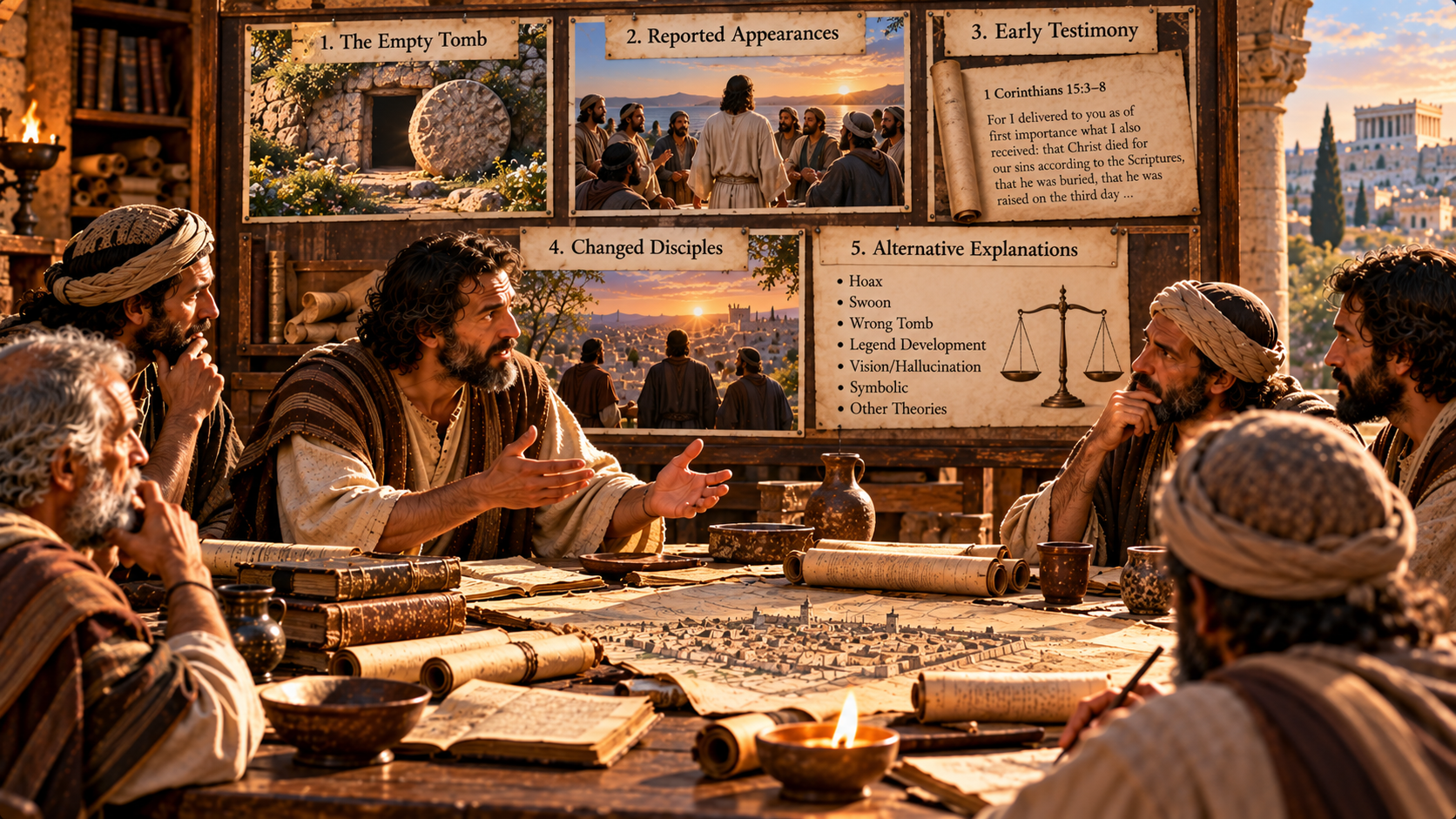
Could Something Else Explain the Resurrection Evidence?
Christians believe that God raised Jesus from the dead.
But if we are investigating that claim seriously, we should ask whether something else could explain the evidence.
Perhaps Jesus never actually died. Perhaps His body was moved. Perhaps the disciples went to the wrong tomb. Perhaps grief or religious experiences convinced His followers that they had seen Him. Perhaps the story grew as it was told. Perhaps someone deliberately invented it.
These possibilities should not be dismissed simply because Christians disagree with them.
Each deserves the same basic question:
What does this explanation account for, and what does it leave unexplained?
No single fact should be forced to carry the entire case. We have spent the previous investigations looking at several pieces of evidence separately. We can now begin asking how proposed explanations fit those pieces when they are considered together.
The Question
Could theft, relocation of the body, survival of crucifixion, mistaken identity, visionary experiences, legendary development, or a combination of natural explanations account for the evidence?
What We Know
Several alternative explanations have been proposed during the long history of discussion about the Resurrection.
Perhaps Jesus did not really die
This is sometimes called the swoon theory.
On this view, Jesus survived crucifixion, later revived, and was then seen alive by His followers.
The proposal has one obvious advantage: if Jesus survived, there would be no need to explain how a dead man returned to life.
But it creates other difficulties.
Roman crucifixion was designed to kill. The Gospel accounts portray Jesus as severely scourged and crucified before His body was released for burial. Modern medical writers disagree about the precise physical mechanism by which crucifixion caused death, but survival after the completed Roman execution described in the sources is not the usual historical explanation.
Even if Jesus somehow survived, we would still have to ask whether a badly injured survivor would naturally lead His followers to proclaim that God had conquered death and raised Him into a transformed life.
Perhaps the body was moved or stolen
If Jesus was buried and the tomb was later empty, a moved body is an obvious possibility to consider.
Someone might have transferred the body to another location. Grave robbers might have taken it. The disciples themselves might have removed it.
Such proposals can offer an explanation for an empty tomb.
But an empty tomb is only one part of the evidence.
A moved body by itself does not explain why Peter, James, Paul, and others became convinced that Jesus had appeared to them alive.
The proposal therefore needs an additional explanation for the appearance experiences.
Perhaps they went to the wrong tomb
Another proposal is that the women mistakenly visited a different tomb and found it empty.
That could explain an initial report that the body was missing.
But Mark connects women who observed Jesus' burial with the later visit to the tomb. If that tradition reflects what happened, a simple mistake of location becomes less natural.
The wrong-tomb proposal also does not by itself explain the appearance traditions.
And if Jesus remained buried in a known location, we must ask why the mistake was not corrected as the Resurrection message spread in Jerusalem.
Perhaps the appearances were visions or grief experiences
This is a more substantial proposal.
People who have lost someone they love sometimes report vivid experiences in which they sense, see, or hear the deceased person.
Religious visions are also known in human experience.
Such experiences could help explain why an individual sincerely believed that Jesus had appeared.
Paul's experience is especially important in this discussion because his encounter came later and because his own letters give little narrative description of what he experienced.
But questions remain.
Were the experiences of Peter, James, Paul, and the groups all the same kind of event? How should the group appearance traditions be understood? How does a visionary explanation relate to the empty-tomb tradition and to the early Jewish understanding of resurrection as something more than a departed person appearing in a vision?
A psychological or visionary explanation may address an important part of the evidence. Whether it accounts for the whole picture is a further question.
Perhaps the Resurrection story grew through legend
Stories can grow in the telling.
The Gospel appearance accounts contain details that are not present in Paul's earlier summary. Luke and John, for example, strongly emphasize physical features of the risen Jesus.
It is reasonable to ask whether some details developed as Christians told and retold the story.
But our earlier investigation found that the basic Resurrection proclamation is much older than the completed Gospel narratives.
Paul had already received and passed on a tradition that Jesus died, was buried, was raised, and appeared. He personally knew Peter and James.
Legendary development might help explain some later details. It has greater difficulty explaining the origin of Resurrection belief itself if that belief was already present near the beginning of Christianity.
Perhaps the disciples invented the story
Deliberate invention would explain why a false claim was being proclaimed.
But it must be compared with what we examined in our investigation of motive and sincerity.
Paul's own letters describe substantial suffering connected with his Christian mission. Acts records opposition to the earliest apostles. Early sources associate leading figures such as Peter, Paul, and James with persecution or violent death.
Suffering does not prove that their beliefs were true.
But there is a difference between suffering for something mistaken and knowingly suffering for something one invented.
A deliberate-fraud explanation therefore has to account for the conduct of the people closest to the proclamation.
Perhaps several natural explanations worked together
Not every explanation has to solve the entire problem by itself.
Someone might propose that the body was moved, that one or more followers had grief-related experiences, and that later storytelling developed those experiences into the fuller narratives preserved in the Gospels.
This kind of combined explanation deserves consideration because history is often complicated.
But adding explanations also creates a new question.
Does the combination arise naturally from the evidence, or are separate possibilities being added mainly because no one of them accounts for enough?
Why It Matters
Alternative explanations matter because Christians should not ask only whether the Resurrection can fit the evidence.
We should also ask how other explanations fit it.
A theory may explain one fact very well while leaving several others untouched.
A moved body could explain an empty tomb. A grief experience could help explain an individual appearance. Legendary development could explain differences or later details. Deliberate invention could explain a story that someone knew was false.
But the historical question concerns the evidence together.
Jesus was crucified. His followers very early proclaimed that He had been raised. Traditions of burial and an empty tomb became central to the Gospel accounts. Individuals and groups were said to have experienced appearances. Peter, James, and Paul became prominent proclaimers of the risen Jesus.
The task is not merely to find a possible explanation for each isolated piece.
It is to ask what overall account makes sense of the picture that emerges when the pieces are placed together.
Questions & Challenges
There is a danger in discussing alternatives only to make them look foolish.
That would not be a fair investigation.
Some proposals are more widely defended today than others. The idea that Jesus simply recovered from crucifixion is much less common in contemporary historical discussion than explanations involving religious experience, memory, grief, or legendary development.
There is also no single "hallucination theory."
Different scholars propose different psychological and historical models. Some emphasize individual visions. Others emphasize bereavement experiences, religious expectation, memory, group influence, or combinations of factors.
Likewise, saying that a story developed does not necessarily mean that someone deliberately lied. Memories can change without conscious dishonesty, and traditions can acquire new details as communities preserve and interpret them.
Christians should therefore avoid answering serious alternatives with caricatures.
At the same time, proposing that something could have happened is not enough.
Historical explanations should be compared by asking how much evidence they explain, how many additional assumptions they require, whether they fit what is known about the people and setting, and whether they create new problems larger than the ones they solve.
The same standard should be applied to the Resurrection explanation itself.
Alternative explanations can be compared by asking how well each accounts for the same collection of historical claims and evidence.
Considering the Evidence
We have now reached the point where the evidence begins to converge.
No alternative explanation is without some ability to address part of the story.
Survival would account for Jesus later being alive. A moved body could account for an empty tomb. Visions or grief experiences could account for sincere appearance claims. Legendary development could account for some differences and later narrative detail. Deliberate invention could account for false testimony if there were good reason to think the witnesses knowingly created it.
But each proposal must also face the evidence it does not immediately explain.
That is why the investigation cannot end merely by naming possibilities.
Nor should Christians claim that every imaginable natural explanation has been disproved with mathematical certainty. Historical reasoning rarely works that way.
Instead, we return to the method with which we began.
Which explanation accounts for the greatest range of evidence without forcing us to ignore important facts or continually add unrelated assumptions?
Christians believe the answer is that Jesus truly died and that God raised Him from the dead.
We have not asked the reader simply to accept that conclusion at the beginning. We have examined the documents, the historical setting, the witnesses, the transmission of the text, the early Resurrection proclamation, the tomb, the appearances, and now the alternatives.
Continue exploring this question through related material already available on A Visit With Jesus.
Further Study
Objections & Alternative Explanations
Examine proposed alternatives to the Resurrection, including theft, relocation of the body, survival of crucifixion, the wrong tomb, visions, legendary development, Gospel differences, and non-bodily interpretations.
Examine historical evidence surrounding the Resurrection claim, including Jesus' death, the empty tomb, early Resurrection proclamation, reported appearances, and the beginnings of the Christian movement.
Evidence
Resurrection Gospel Accounts
Compare the Resurrection accounts in Matthew, Mark, Luke, and John, including their differing details and their shared testimony.
In Summary
Many alternatives to resurrection have been proposed. Rather than dismissing them, we examine whether theft, relocation, survival, visionary experiences, legendary development, or combinations of these explanations adequately account for the evidence as a whole.