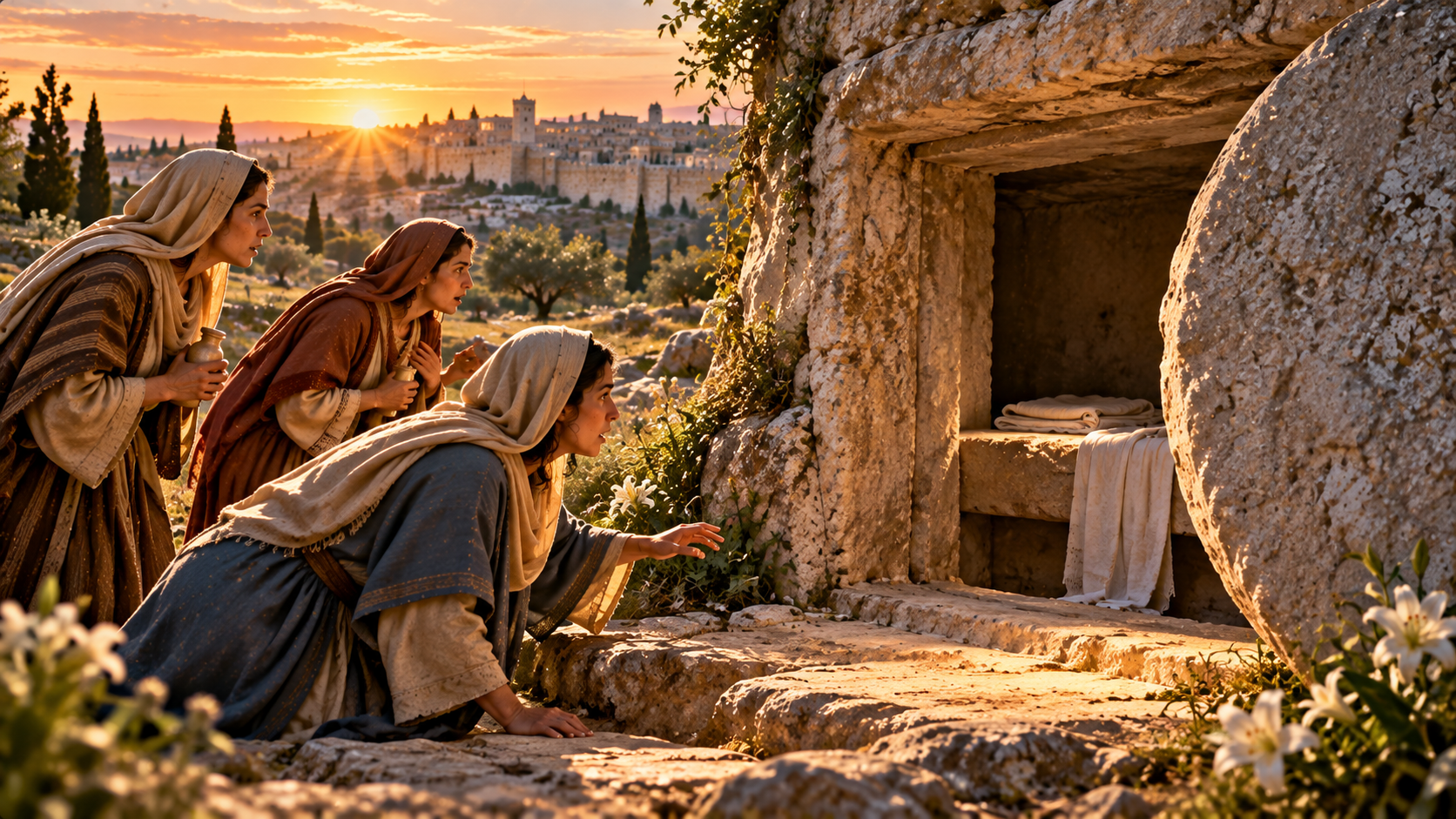
All four Gospels bring the story of Jesus' death to a tomb.
They say that His body was taken down from the cross, wrapped for burial, and placed in a tomb associated with Joseph of Arimathea.
Then comes the claim that changed everything.
When followers of Jesus returned after the Sabbath, His body was no longer there.
Christians believe the tomb was empty because God had raised Jesus from the dead.
But before considering that explanation, we should ask a more basic historical question.
Is there good reason to believe that Jesus was actually buried and that His tomb was later found without His body?
An empty tomb would not, by itself, prove a Resurrection. A missing body could invite other explanations.
But if the tomb was not empty, one important part of the earliest Christian proclamation would require a very different explanation.
The Question
What evidence supports the Gospel claim that Jesus was buried and that His tomb was subsequently found empty?
What We Know
The evidence begins with the burial of Jesus.
The Gospels identify Joseph of Arimathea
Mark, our earliest surviving Gospel, says that Joseph of Arimathea, a respected member of the council, asked Pilate for the body of Jesus. Pilate first confirmed that Jesus had died. Joseph then wrapped the body in linen and placed it in a rock-cut tomb (Mark 15:42-47).
Matthew, Luke, and John also preserve the burial tradition, although they describe Joseph somewhat differently.
The accounts agree on the central point: Jesus received a burial connected with Joseph of Arimathea rather than simply disappearing from the story after the crucifixion.
The burial fits what is known about Jewish concerns for the dead
Jewish law placed importance on burying the dead rather than leaving a body exposed overnight (Deuteronomy 21:22-23).
Ancient Jewish sources show that burial remained an important concern even for people who had been executed.
Roman crucifixion could be brutal and humiliating, and bodies were not always released for burial. But evidence from Judea shows that burial of crucified Jews could occur.
The remains of the crucified man commonly called Yehohanan provide physical evidence that at least one crucified Jewish man in first-century Jerusalem was subsequently placed in a tomb.
None of this proves Joseph's role in Jesus' burial. It does show that burial after crucifixion was possible within the world described by the Gospels.
The women connect the burial with the empty tomb
In Mark, women who had followed Jesus see where His body was placed. After the Sabbath, Mary Magdalene, Mary the mother of James, and Salome go to the tomb and find the stone moved and the body gone (Mark 15:47-16:8).
The other Gospels also place women at the discovery of the empty tomb, with differences in names, details, and what happens afterward.
The role of the women is historically interesting. In some ancient settings, women had less public standing than men, and this has led many Christian writers to argue that no one inventing the story would have chosen women as the first witnesses.
That argument should not be pressed too far.
Women could give testimony in the ancient world, and a storyteller might have reasons for including them. Their presence is worth considering, but it is not a simple proof that the account must be historical.
Paul knows the sequence of death, burial, and Resurrection
Paul does not narrate the women finding the tomb.
But in 1 Corinthians 15:3-5 he passes on the sequence that Christ died, was buried, was raised on the third day, and appeared.
John Granger Cook has argued that the ancient meaning of resurrection was bodily enough that Paul could not have conceived of Jesus as raised while His corpse remained in the tomb.
That does not mean Paul independently tells the empty-tomb story found in the Gospels.
It does mean that Paul's Resurrection proclamation is naturally understood as involving the body that had been buried.
The Gospel accounts are not identical
The four accounts differ about which women came, what they encountered, and how the events unfolded.
Those differences deserve the same honest treatment we gave them earlier.
They do not allow us simply to combine every sentence into one effortless narrative.
But all four accounts agree on the central claim that followers of Jesus encountered His tomb after the burial and found that His body was no longer there.
Why It Matters
The empty tomb matters because Christian Resurrection belief was bodily.
The first Christians were not merely saying that Jesus' teachings lived on or that His spirit had gone to heaven.
They proclaimed that the Jesus who died had been raised.
If His body still lay in a known tomb, that would create an obvious problem for such a proclamation.
On the other hand, an empty tomb alone would not tell us why the body was gone.
The body might have been moved. Someone might have taken it. The burial location might have been misunderstood. Other explanations can be proposed.
So the empty tomb should not be treated as a shortcut that proves the Resurrection.
Its importance is that it forms one part of a larger historical picture that must be explained together with the experiences and convictions of Jesus' followers.
Questions & Challenges
The empty tomb remains a subject of historical debate.
Some scholars accept the burial by Joseph and the discovery of the empty tomb as historically probable. Others question whether Jesus received the kind of burial described in the Gospels or whether the empty-tomb narratives can be established historically.
Recent archaeological and historical work continues to examine the plausibility of Jesus receiving burial in a rock-cut tomb. Jewish burial customs make burial of an executed person understandable, but the particular circumstances surrounding Jesus cannot be reconstructed with certainty from archaeology alone.
There are also possible explanations for an empty tomb other than Resurrection.
A body could theoretically have been moved after an initial burial. Someone could have gone to the wrong location. A story about an empty tomb could have developed as the Resurrection message was told.
Each proposal must be compared with the evidence rather than dismissed merely because it conflicts with Christian belief.
We should also avoid claiming that Paul explicitly says, "The tomb was empty." He does not.
Paul says that Jesus died, was buried, was raised, and appeared. Whether that language necessarily presupposes an empty tomb is a historical and linguistic argument, not an additional sentence found in Paul.
These cautions do not make the empty-tomb evidence unimportant.
They help us state the question accurately.
Considering the Evidence
Several pieces of evidence belong together.
The Gospel tradition gives Jesus a specific burial associated with Joseph of Arimathea. Mark connects women who saw the burial place with women who later found the tomb empty. All four Gospels preserve an empty-tomb tradition, despite differences in their accounts.
Paul, writing earlier than the completed Gospels, already knows a sequence of death, burial, Resurrection, and appearances.
Jewish burial concerns and archaeological evidence show that burial of a crucified Jew in first-century Judea was possible. They do not prove the details of Jesus' burial, but they make the basic setting historically understandable.
None of this requires us to say that the empty tomb has been proved beyond every possible question.
Nor would an empty tomb by itself prove that God raised Jesus.
But the claim belongs very early and very deeply within the Christian Resurrection tradition and deserves to be included in any serious investigation.
And an empty tomb creates another question.
Why did the followers of Jesus become convinced that He was alive?
The earliest Christian tradition does not merely say that the tomb was empty. It says that Jesus appeared to people afterward.
That is our next investigation:
Did people really see Jesus alive after His death?
The reported discovery of the empty tomb is one of the central claims to be examined when considering what happened after the crucifixion of Jesus.
Continue exploring this question through related material already available on A Visit With Jesus.
Evidence
Evidence for the Resurrection
Examine historical evidence surrounding the Resurrection claim, including Jesus' death, the empty tomb, early Resurrection proclamation, reported appearances, and the beginnings of the Christian movement.
Compare the Resurrection accounts in Matthew, Mark, Luke, and John, including their differing details and their shared testimony.
Timeline
Resurrection Timeline
A reasoned chronology of the burial, empty tomb, Resurrection appearances, forty-day period, and Ascension assembled from the Gospel accounts, Acts, and 1 Corinthians.
In Summary
The Gospels report that Jesus was buried and that His tomb was found empty on the first day of the week. We examine the burial accounts, the discovery of the tomb, and the principal explanations proposed for the missing body.