How Early Was the Claim That Jesus Rose from the Dead?
Sometimes a story changes as it is told from one generation to another.
Details are added. Memories fade. An ordinary person may gradually become larger than life.
Could something like that explain the Resurrection?
Perhaps Jesus died, His followers remembered Him with devotion, and only much later Christians began saying that He had risen from the dead.
That explanation would deserve serious consideration if the Resurrection first appeared late in Christian history.
But our earliest Christian evidence points in a very different direction.
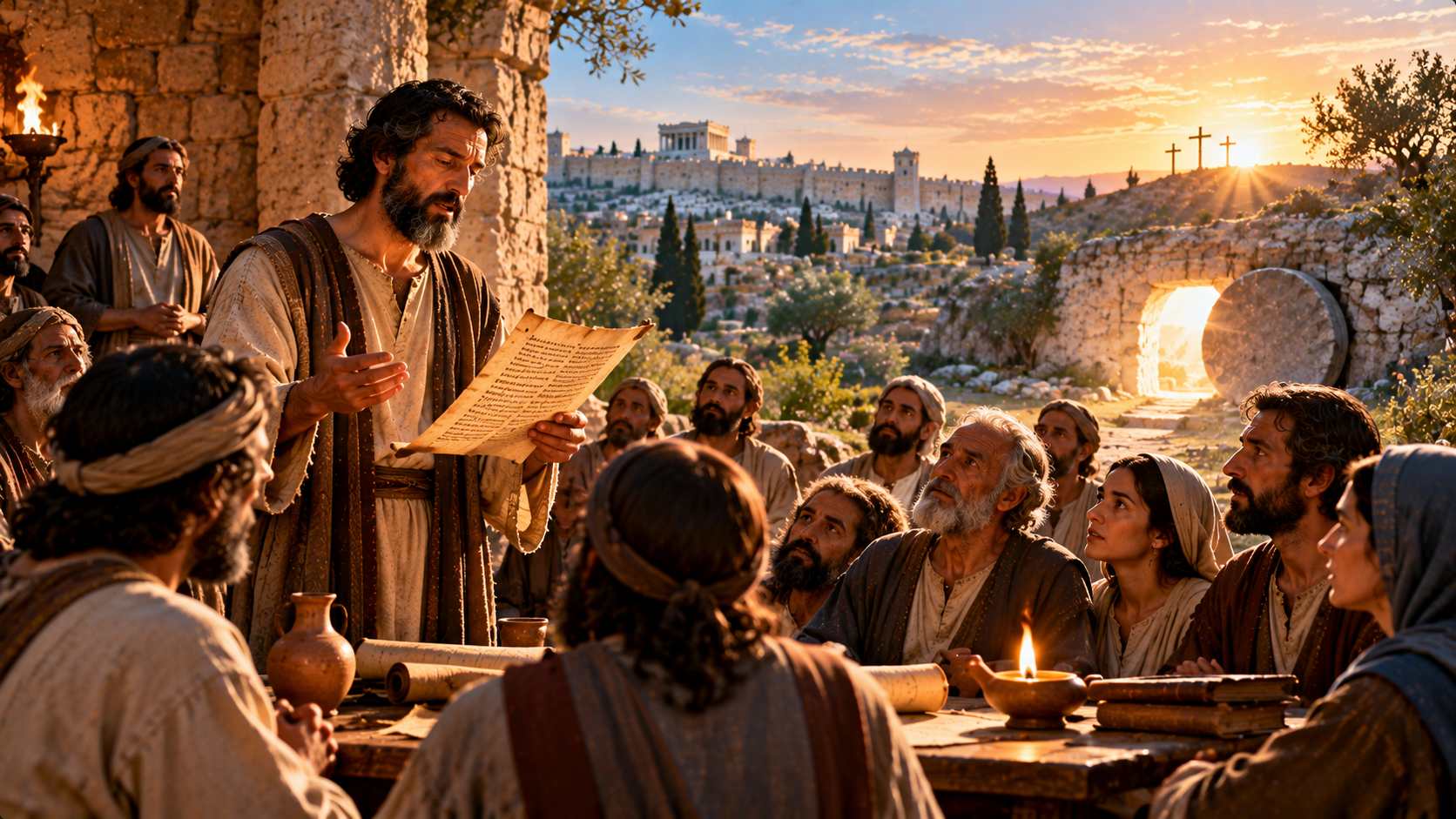
Long before the Gospels had all reached their final written form, Paul was already passing on a message that he himself had received: Christ died, was buried, was raised, and appeared to witnesses.
This means that belief in the Resurrection was not added to Christianity centuries later.
It was already at the heart of the Christian message near the beginning.
The Question
How close to Jesus' death can the proclamation that He had risen from the dead be traced?
What We Know
Our most important evidence comes from Paul's first letter to the Corinthians.
Paul passes on something he had already received
In 1 Corinthians 15:3-8, Paul reminds the church at Corinth of the message he had previously taught them.
He introduces it by saying that he had "received" this material and had "delivered" it to them.
The summary that follows says that Christ died for our sins according to the Scriptures, was buried, was raised on the third day, and appeared to Cephas, then to the Twelve. Paul continues with appearances to more than five hundred people, to James, to all the apostles, and finally to Paul himself.
Scholars commonly recognize at least part of this passage as material that Paul received rather than first composed for the Corinthians.
That matters because 1 Corinthians itself was written only a few decades after the crucifixion, and the tradition Paul quotes is earlier still.
How early was it?
We cannot put an exact date on the first formulation of every line in 1 Corinthians 15:3-8.
Scholars disagree about precisely where the earlier traditional material ends and Paul's own comments begin. They also differ about exactly when and where Paul first received it.
But the important point is not dependent upon choosing one exact year.
Paul became a Christian early in the history of the Church. Within a few years he visited Jerusalem and spent fifteen days with Peter. He also met James, the brother of Jesus (Galatians 1:18-19).
Both Peter and James appear by name in the Resurrection tradition preserved in 1 Corinthians 15.
Whether Paul received the complete form of the tradition during that Jerusalem visit or at some other early point, the material takes us back very near the beginnings of the Christian movement.
Paul knew the Jerusalem leaders
This is especially important.
Paul was not developing his Resurrection message for decades without contact with the people who had known Jesus.
He tells us that he met Peter and James. Later he again met James, Peter, and John, whom he describes as recognized leaders of the Jerusalem church (Galatians 2:1-10).
Paul says that although their missions differed, they recognized the same Gospel he proclaimed.
In 1 Corinthians 15:11, after discussing the Resurrection witnesses, Paul makes the point very simply: whether it was he or the other apostles preaching, this was the message they proclaimed and the Corinthians believed.
The Resurrection was central, not secondary
Paul does not treat the Resurrection as an optional addition to Christianity.
He tells the Corinthians that if Christ has not been raised, Christian preaching is empty and their faith is empty (1 Corinthians 15:14).
That statement is revealing.
By the time of one of our earliest surviving Christian letters, the Resurrection was already so central that Paul said Christianity stood or fell with it.
The timing of the earliest resurrection proclamation matters when considering whether belief arose near the reported events or only much later.
Why It Matters
The early date of Resurrection belief helps us answer one particular explanation of Christian origins.
It is difficult to explain the Resurrection as a story that first appeared after generations of Christians had forgotten what actually happened to Jesus.
Paul's letters take us much closer to the beginning.
He knew Peter and James personally. He knew other leaders of the Jerusalem church. He passed on Resurrection material that he said he had himself received.
That does not prove that Jesus rose from the dead.
It establishes something more limited but very important:
The first Christian generation was already proclaiming that He had.
Any explanation of Christianity must therefore account for an early Resurrection belief, not merely a legend that appeared in a much later century.
Questions & Challenges
The early tradition in 1 Corinthians 15 is sometimes asked to prove more than it can.
Dating the Resurrection proclamation early does not establish that the proclamation was true.
A belief can arise quickly and still be mistaken.
Nor can we say with certainty that Paul received every word of 1 Corinthians 15:3-7 during his fifteen-day visit with Peter.
That is a reasonable possibility discussed by scholars, but Paul does not tell us, "Peter taught me this exact formula during that visit."
We should not turn a plausible reconstruction into a fact stated by the text.
The appearance to more than five hundred also raises questions. Paul gives no names, location, or description of the occasion. His statement that many were still alive shows that he regarded the group as belonging to recent memory, but the passage does not provide enough information for us to investigate those individuals today.
There is also scholarly discussion about how much of verses 3-8 belonged to the earlier tradition Paul received and how much reflects Paul's own expansion of it.
None of these questions removes the central point.
The death, burial, Resurrection, and appearances of Jesus were already being proclaimed very early in Christianity.
Considering the Evidence
The Resurrection was not a late decoration placed upon an earlier Christianity that had known nothing about it.
Our earliest surviving Christian author already treats it as the center of the faith.
Paul says that he received and passed on a tradition concerning Jesus' death, burial, Resurrection, and appearances. He personally knew Peter and James, two men named in that tradition. He later met again with leading figures in Jerusalem and says that they recognized the Gospel he preached.
We should not claim more than this evidence shows.
An early belief is not automatically a true belief.
But the timing matters.
Any explanation of the rise of Christianity must account for followers of Jesus proclaiming His Resurrection within the first Christian generation and very near the beginning of the movement.
That brings us to the events themselves.
The early proclamation says that Jesus died, was buried, was raised, and appeared.
One of the most discussed pieces of that historical picture is His burial place.
Was the tomb in which Jesus was placed later found empty?
Continue exploring this question through related material already available on A Visit With Jesus.
Evidence
Resurrection and the Early Church
Explore the central place of the Resurrection in apostolic preaching and the repeated claim of the apostles that they were witnesses to what God had done in Jesus Christ.
Examine historical evidence surrounding the Resurrection claim, including Jesus' death, the empty tomb, early Resurrection proclamation, reported appearances, and the beginnings of the Christian movement.
Evidence
Resurrection Appearances
Explore New Testament reports that individuals and groups encountered Jesus alive after His death, including Mary Magdalene, Peter, the apostles, James, and Paul.
In Summary
The resurrection was not a doctrine that first appeared centuries after Jesus. We examine Paul's letters, early Christian tradition, and the first generation of the Church to determine how early the proclamation that Jesus had risen can be traced.