Do We Have an Accurate Record of What the Gospels Originally Said?
The Gospel writers lived nearly two thousand years ago.
The pieces of parchment or papyrus on which they first wrote no longer survive.
So how can we know what they said?
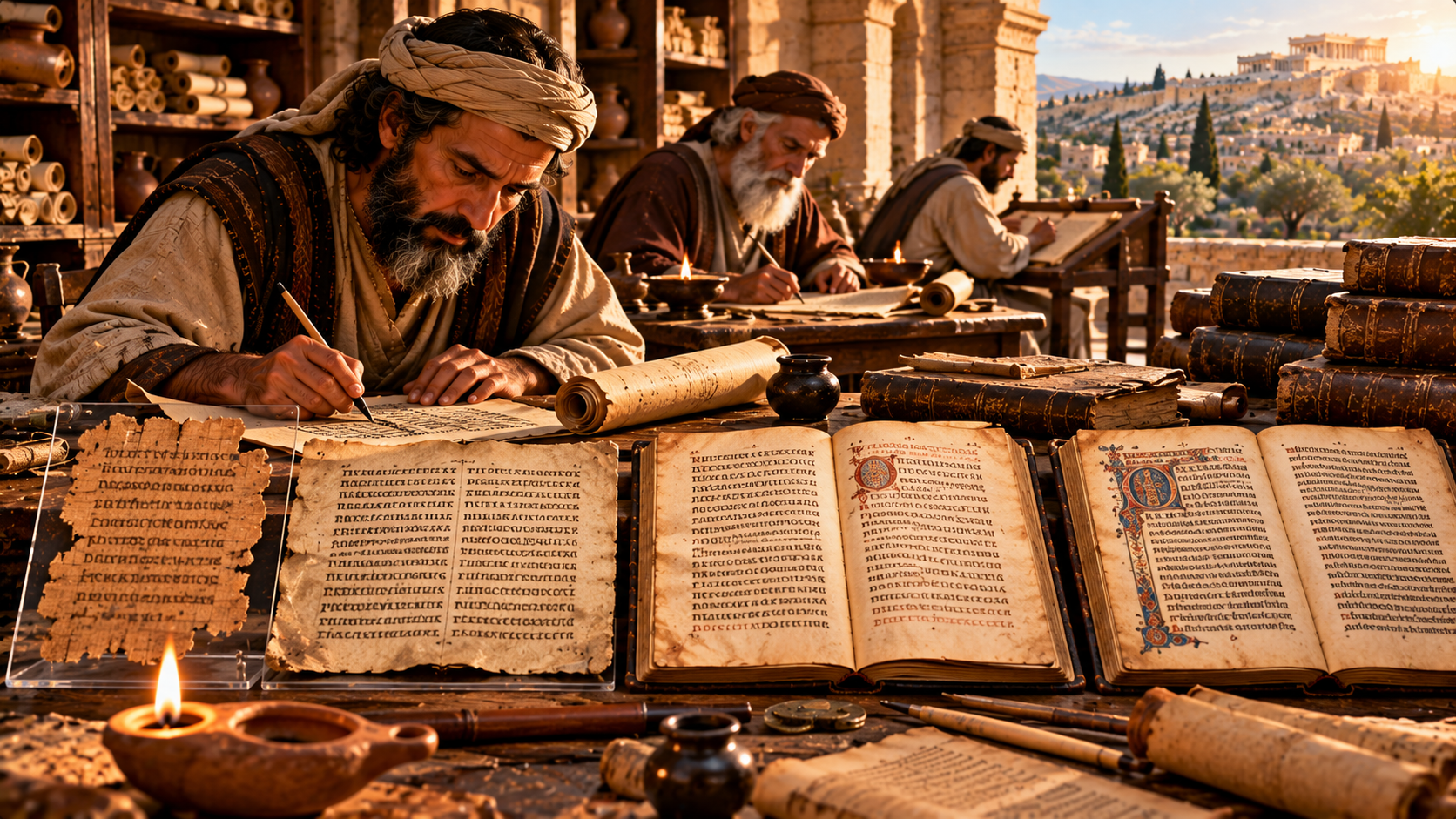
The answer lies in the manuscripts that were copied from earlier manuscripts and then copied again as Christianity spread across the ancient world.
Those copies are not all identical. Scribes sometimes misspelled a word, skipped a line, repeated something, changed word order, or made another alteration while copying by hand.
Christians should not be troubled by admitting this. The differences are visible, they can be studied, and modern Bible translations often tell readers about important ones in their footnotes.
The real question is not whether differences exist.
The question is whether the surviving evidence allows us to determine, with confidence, what the New Testament writers originally wrote.
The Question
After centuries of copying by hand, how confidently can we determine what the New Testament authors originally wrote?
What We Know
The study of ancient manuscripts allows scholars to compare surviving copies and work backward toward the earliest recoverable text.
The original manuscripts no longer survive
We do not possess the sheet on which Matthew first wrote his Gospel or the original copy of Paul's letter to the Romans.
That is not unusual for ancient literature.
What we possess are manuscripts copied from earlier manuscripts. Some contain large portions of the New Testament. Others preserve only part of a book or even a small fragment.
The earliest surviving New Testament papyri come from the centuries close to the beginning of the manuscript tradition, while important nearly complete biblical codices survive from the fourth century.
There are many surviving manuscripts
Thousands of Greek New Testament manuscripts are known today, along with early translations into other languages and quotations preserved in the writings of early Christians.
This large amount of evidence does not mean that every manuscript says exactly the same thing.
In fact, having many copies means that we can see many places where copying differences occurred.
But it also means that scholars have many witnesses to compare.
Copying differences are real
Before printing, books were copied by hand.
A scribe could accidentally omit a word, write the same word twice, confuse similar-looking words, change spelling, or skip from one similar line to another.
Sometimes a scribe appears to have tried to make a difficult sentence clearer or to bring wording into closer agreement with another familiar passage.
As manuscripts were copied over many centuries, these differences became part of the manuscript tradition.
Most are small. Some are more important. Scholars examine them rather than pretending they are not there.
The copies can be compared
Suppose twenty handwritten copies preserve a sentence and nineteen contain one wording while one accidentally leaves out a line.
Comparison immediately gives us information that the single damaged copy could not provide by itself.
Real New Testament manuscript study is much more complicated than that example. The oldest reading is not always simply the one found in the greatest number of manuscripts. Scholars consider the age and relationships of manuscripts, the geographical spread of readings, the habits of scribes, and which reading best explains how the others may have arisen.
The important point for the ordinary reader is simple: differences among manuscripts are not invisible. They can be compared and investigated.
Some passages remain especially well known
Two passages often discussed are Mark 16:9-20 and John 7:53-8:11, the account of the woman caught in adultery.
The longer ending of Mark is absent from important early witnesses, while other manuscripts preserve it and the history of Mark's ending is complex.
The account of the woman caught in adultery is also absent from important early manuscripts of John and appears in different locations in parts of the later manuscript tradition.
That is why many modern Bibles place these passages in brackets or include explanatory notes.
This is not evidence being hidden from Christians.
It is evidence being shown to them.
Why It Matters
Christians believe that Scripture matters because its message comes to us through words.
We therefore have good reason to care about what the biblical writers actually wrote.
The existence of manuscript differences does not mean that the New Testament disappeared and had to be recreated from guesswork.
Instead, the surviving manuscript tradition allows scholars to identify the places where copies differ and to compare the evidence for the competing readings.
Modern critical editions of the Greek New Testament openly record many of these differences so that translators and scholars can evaluate them.
For the believer, there is something reassuring about this openness.
We do not have to claim that every scribe copied every page perfectly.
Our confidence can rest upon examining the manuscript evidence that actually survives.
Questions & Challenges
The large number of New Testament manuscripts is sometimes presented too simply.
Christians may hear that because thousands of manuscripts survive, the text must automatically be certain.
That is not quite how the evidence works.
Thousands of manuscripts also produce thousands of places where readings can be compared. Many differences are spelling changes, word order, omissions, repetitions, or other small variations. Other differences require more careful judgment.
The number of manuscripts is valuable because it gives scholars a large body of evidence. It is not a magic number that removes every textual question.
Another challenge concerns passages that have become beloved parts of Christian reading.
Mark 16:9-20 and John 7:53-8:11 are familiar examples. Christians may feel uncomfortable when a Bible footnote says that early manuscripts do not contain a passage.
But the footnote is actually evidence that the process is working.
Translators are telling the reader where the manuscript evidence raises a significant question.
There are also places where scholars continue to disagree about the earliest reading.
We should be willing to say so.
Christian faith does not require us to pretend that textual study has answered every question with equal certainty.
Considering the Evidence
The New Testament reached us through centuries of handwritten copying.
That process produced differences.
It also produced the manuscript evidence by which those differences can be discovered and studied.
Today scholars can examine Greek manuscripts from many periods, compare early translations, study quotations in ancient Christian writers, and trace relationships among different readings.
The Institute for New Testament Textual Research in Münster maintains the international catalog of Greek New Testament manuscripts and continues the work of documenting and comparing the textual tradition. Modern critical editions make this evidence available to scholars and translators.
There is no surviving original copy that can simply be placed beside our modern Bible for comparison.
Instead, the earliest recoverable text must be reconstructed from the surviving evidence.
That is a more complicated story than saying that every copy is identical.
It is also a much stronger position than pretending the copying differences do not exist.
The manuscript tradition is open to examination.
Having considered whether the Gospel text has been preserved, we can now turn from the documents to the people who first proclaimed their message.
Why did they say these things?
Were the first Christians simply inventing a story that served their interests?
That is our next investigation:
Did the first Christians have a reason to invent their claims?
The Gospel text was copied and preserved through generations of manuscripts, leaving surviving witnesses that can be compared with one another.
Continue exploring this question through related material already available on A Visit With Jesus.
Manuscript
New Testament Papyri
Explore early New Testament papyrus manuscripts, beginning with P1 through P50, with dates, biblical contents, institutions, reference numbers, and image information.
An early papyrus fragment of the Gospel of John containing portions of John 18:31-33 and 18:37-38.
History
History of the Bible
Follow the Bible from the origins of Israel's Scriptures through Jesus and the apostles, the New Testament writings, manuscript transmission, canon recognition, translation, printing, and modern Bible versions.
Archaeology
Bible Archaeology: History and Manuscripts
Explore the history of biblical archaeology together with AVWJ links to New Testament papyri and the Dead Sea Scrolls.
In Summary
No original handwritten copy of a New Testament book survives. Yet thousands of manuscripts and ancient witnesses allow scholars to compare copies and identify variations. We examine whether the original wording of the New Testament can be recovered reliably.