Jesus as God
The Gospels never record Jesus saying the exact sentence, “I am God.” Yet they repeatedly portray Him saying and doing things Scripture associates with God, accepting divine titles and testimony, exercising divine prerogatives, and fulfilling Old Testament passages concerning YHWH. Explore the cumulative evidence across all four Gospels.
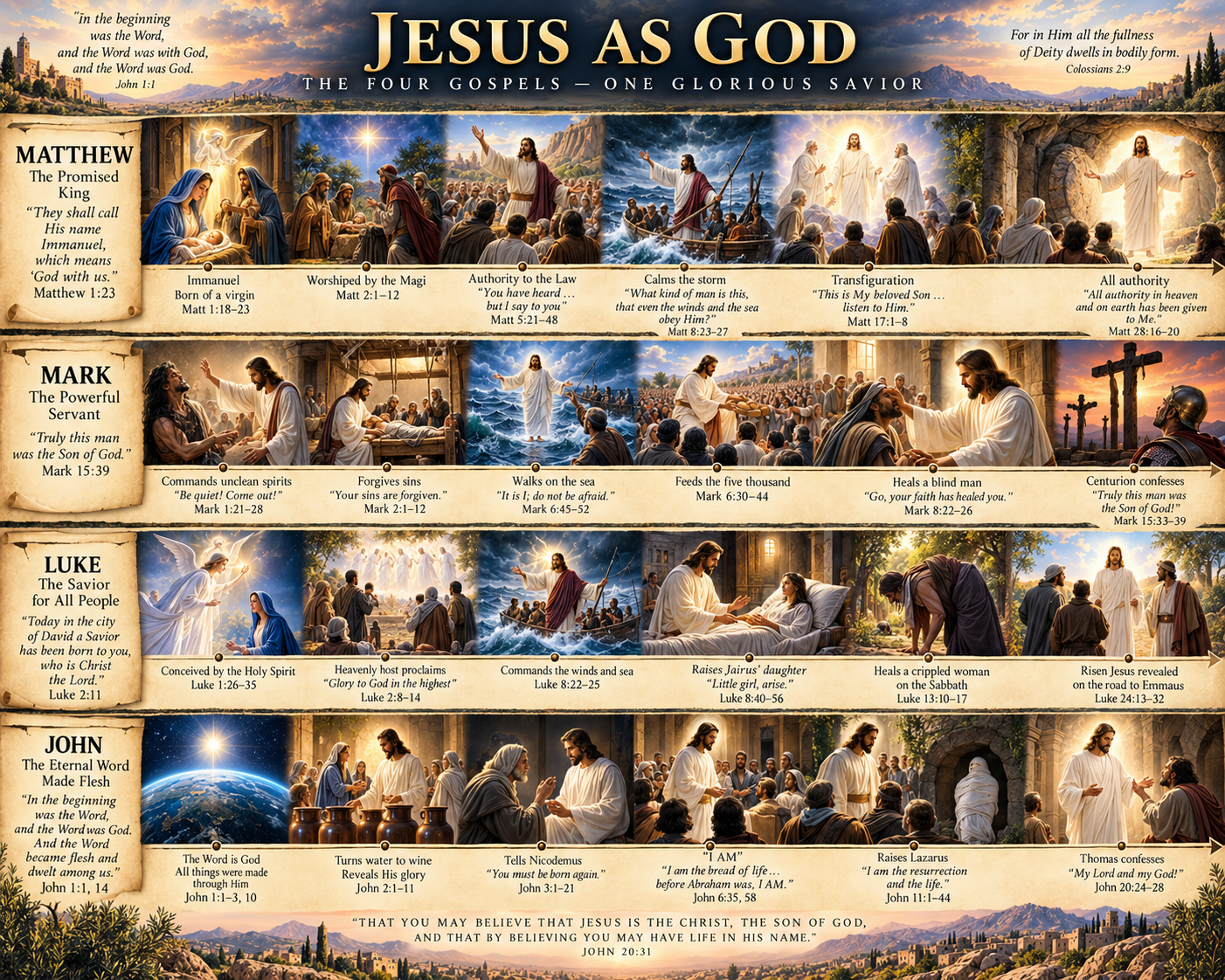
Click timeline image to enlarge
Showing 13-24 of 35 evidence records.
Jesus Commands the Wind and the Waves
Luke 8:22-25
What Jesus said or did: Jesus rebukes the wind and raging waves, producing a calm and prompting the disciples to ask who he is.
Why this points to His divinity: Prophets perform miracles, but Luke's scriptural pattern and the disciples' identity question make this strong cumulative evidence.
Read the full evidence
What God Has Done Is What Jesus Has Done
Luke 8:26-39
What Jesus said or did: Jesus tells the delivered man to declare how much God has done for him; Luke immediately says the man proclaimed how much Jesus had done for him.
Why this points to His divinity: The juxtaposition is not a philosophical formula of identity, but it is powerful narrative Christology and strong cumulative evidence.
Read the full evidence
Jesus Raises Jairus' Daughter
Luke 8:40-56
What Jesus said or did: After Jairus' daughter dies, Jesus takes her hand and directly commands, 'Child, arise'; Luke says her spirit returned.
Why this points to His divinity: The prophetic precedents mean the miracle alone does not prove deity, but Jesus' direct authority over death fits Luke's cumulative divine-identity portrait.
Read the full evidence
Jesus Revealed in Glory at the Transfiguration
Luke 9:28-36
What Jesus said or did: Jesus' appearance changes in radiant glory; Moses and Elijah speak of his coming exodus, and the Father identifies Jesus as his Son and commands the disciples to listen to him.
Why this points to His divinity: Created figures may reflect glory, so radiance alone is not proof. The complete theophanic scene and the Father's unique testimony make this strong evidence.
Read the full evidence
To Reject Jesus Is to Reject the One Who Sent Him
Luke 10:16
What Jesus said or did: Jesus says that rejecting him is rejecting the One who sent him.
Why this points to His divinity: The agency parallel makes this Supporting, while its significance grows when read beside Luke 10:21-22.
Read the full evidence
Only the Son Knows and Reveals the Father
Luke 10:21-22
What Jesus said or did: Jesus says all things have been handed to him by his Father, that Father and Son uniquely know one another, and that the Son reveals the Father to whomever he chooses.
Why this points to His divinity: This is among the strongest Synoptic statements of Jesus' unique divine sonship and revelatory authority.
Read the full evidence
Jesus Brings God's Kingdom by the Finger of God
Luke 11:14-20
What Jesus said or did: Jesus says his exorcisms by the finger of God demonstrate that God's kingdom has come upon his hearers.
Why this points to His divinity: Because Jesus explicitly acts by God's power, the passage is Supporting rather than a direct identity claim; nevertheless God's Exodus power is now breaking in through Jesus.
Read the full evidence
The Son of Man Acknowledges People Before God's Angels
Luke 12:8-9
What Jesus said or did: Jesus says earthly acknowledgment or denial of him determines acknowledgment or denial before the angels of God.
Why this points to His divinity: The Son of Man's judicial role and the decisive significance of response to Jesus make this strong evidence of heavenly authority.
Read the full evidence
Jesus Longs to Gather Jerusalem Under His Wings
Luke 13:34-35
What Jesus said or did: Jesus laments Jerusalem's history of killing prophets and says he has often desired to gather its children as a hen gathers her brood under her wings.
Why this points to His divinity: The saying strongly suggests Jesus occupying the divine gathering role. We discuss its pre-existence implication without assigning the stronger 'Claims Eternal Existence' prerogative, since Jesus does not explicitly state pre-human existence here.
Read the full evidence
Jesus Seeks God's Lost Sheep
Luke 15:1-7
What Jesus said or did: Jesus explains his reception of sinners through a shepherd who seeks his lost sheep and rejoices when it is found.
Why this points to His divinity: The Ezekiel background and Jesus' self-interpreting conduct make this strong cumulative YHWH-identification evidence.
Read the full evidence
The Samaritan Gives Glory to God at Jesus' Feet
Luke 17:11-19
What Jesus said or did: A healed Samaritan returns glorifying God, falls at Jesus' feet, thanks him, and is told by Jesus that his faith has saved or made him well.
Why this points to His divinity: The Samaritan falls at Jesus' feet and thanks him while glorifying God.
Read the full evidence
God's Kingdom Is Present in Jesus
Luke 17:20-25
What Jesus said or did: Jesus says the kingdom of God is already among his hearers and immediately speaks of the coming revelation and suffering of the Son of Man.
Why this points to His divinity: The connection is real but indirect, so this record remains Supporting.
Read the full evidence