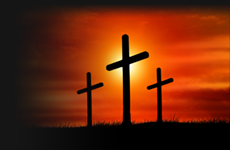
Jesus' Crucifixion In Art
The symbol of Christ on the cross has infiltrated culture in innumerable ways, and depictions have become ubiquitous. There is no other subject matter that better reflects the historical progression of artistic expression. This is fitting, as there is no other event that has had comparable effect on all aspects of human history.

"The Crucifixion with the Two Thieves"
Artist: Jan Snellinck
c. 1597-1638
Painting
On Good Friday, three crosses stood at Golgotha. Jesus was on the middle cross, willing to take our deserved punishment. On the other crosses were two thieves, sentenced to die for their crimes. Three crosses and three men. Two needed salvation that only one could provide. The Greek words used in the Gospels to describe them can be interpreted as robbers, criminals, thieves, rebels, revolutionaries, and malefactors. The Greek word used by Mark and Matthew includes the idea of “looting by violence,” and Luke’s word choice suggests someone who is an “evil-doer.” These two men were hardened, violent criminals whom Rome considered a threat to their control.
This oil on panel measures 22¼ x 18 3/8 in. (56.5 x 46.7 cm.)

"The Dead Christ Mourned"
Artist: Annibale Carracci
c. 1604
Painting
The Dead Christ Mourned (also known as Lamentation of Christ, Pietà with the Three Marys, or The Three Marys) is an oil painting on canvas of c. 1604 by Annibale Carracci. It was in the Orleans Collection before arriving in Great Britain in 1798. In 1913 it was donated to the National Gallery, London, which describes it as "perhaps the most poignant image in [its] collection of the pietà – the lamentation over the dead Christ following his crucifixion – and one of the greatest expressions of grief in Baroque art".
- page 36 of 37 -© 2026 AVisitWithJesus
"For God so loved the world, that he gave his only begotten Son,
that whosoever believeth in him should not perish, but have everlasting life."