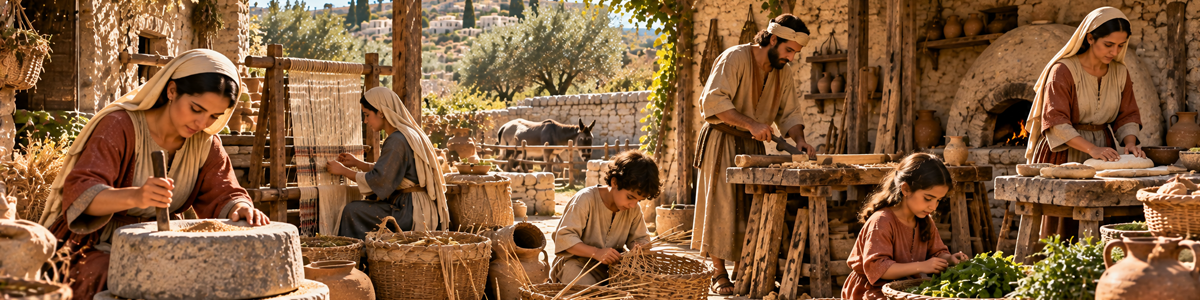
The homes of first-century Galilee and Judea were usually simple by modern standards. Yet they were busy places. Families slept there, prepared food, stored supplies, and carried out much of the work of daily life.
Understanding these homes helps us picture many scenes in the Gospels. Roofs, courtyards, lamps, doors, and household vessels were familiar parts of the world in which Jesus lived.
Overview
There was no single kind of first-century Jewish house. Homes differed according to location and the resources of the family. A modest village house looked very different from the home of a wealthy family in Jerusalem.
Many ordinary houses were built from local stone. Rooms could be arranged around a courtyard or other open working space. Families might add or change rooms as their needs changed.
The courtyard was especially useful. Much of the work that we would now do indoors could take place there. Food could be prepared and household chores performed in the open air.
Rooms did not always have one permanent purpose. The same space might be used differently during the day and at night. Furnishings were generally limited in ordinary homes.
The roof was also useful space. Flat roofs could be reached by steps or a ladder. They could be used for household activities when the weather allowed.
Water had to be obtained and stored. After sunset, small oil lamps provided light. Pottery vessels were used throughout the household for cooking and storage.
All of this made the home a working part of family life. It was not simply a building where people returned after the day's activities were finished.
What We Know
Archaeology gives us unusually direct evidence about ancient homes. Excavations reveal walls, floors, courtyards, storage areas, and other parts of domestic buildings.
Objects found in and around these houses tell us even more. Cooking vessels show where food was prepared. Lamps help us understand how people dealt with darkness after sunset.
Even so, we should be careful when reconstructing a particular home. Houses changed over time. Families also adapted their living spaces to their own needs.
The evidence therefore gives us a good picture of common features without requiring us to imagine that every first-century house looked alike.
Biblical Context
Homes appear throughout the Bible because so much ordinary life took place in them. Meals and family gatherings happened there. Hospitality also brought visitors into the household.
The Gospels often place Jesus inside homes. He heals Peter's mother-in-law in a house at Capernaum. He eats in the homes of people who invite Him.
Some Gospel accounts depend on features of ancient houses. In Mark 2:1–4, men bring a paralyzed man to Jesus through a roof. Jesus also speaks about lamps, doors, household vessels, and other familiar parts of domestic life.
These details were ordinary to His first listeners. Learning how ancient homes worked helps modern readers see those scenes more clearly.
Why It Matters
It is easy to picture a biblical house as a smaller version of a modern home. That can give us the wrong impression.
Ancient homes were working spaces. Rooms could serve several purposes. Courtyards and roofs could be useful parts of daily life.
Once we understand that setting, many Gospel scenes become easier to imagine. A crowded house feels different. A lamp in a dark room becomes more meaningful. Even the men opening a roof to reach Jesus become easier to picture.
The home gives us a window into the ordinary world behind the Gospel accounts.
The House Itself
The Galilean Village House
Most village homes in Galilee were practical buildings made for everyday family life. They provided shelter, but they were also working spaces. Rooms could open onto a courtyard where household activity took place. The exact size and arrangement differed from one home to another.
Building Materials and Construction
Most homes were built with materials available nearby. Stone was common in Galilee and Judea. Wood and earth were also important parts of construction. Ordinary houses were built for usefulness rather than display.
The Household Courtyard
A courtyard could be one of the busiest parts of a home. It provided open space for work that was difficult to do inside a small room. Family members could prepare food or carry out household chores there. The courtyard also connected different parts of the house.
Rooms and Living Spaces
Rooms in an ordinary first-century home were often used for more than one purpose. Families did not necessarily have separate rooms for every activity. A space used during the day might serve another purpose at night. This made the home flexible and practical.
Floors
The floors of ordinary homes were usually practical rather than decorative. Packed earth or simple surfaces were common. Stone could be useful in areas that received heavy wear. Expensive decorative floors belonged mainly to wealthier settings.
Doors, Windows and Roofs
Doors, Entrances and Locks
The entrance to a house separated the family's living space from the street outside. A main doorway could have a wooden door that could be secured. Inside the house, some rooms may have had much simpler coverings. Doors therefore provided both access and a measure of security.
Windows, Light and Ventilation
Windows in an ordinary village house were often small and practical. They admitted light and allowed air to move through the room. They were not necessarily designed to provide a wide view outside. Even during the day, some rooms could remain fairly dim.
The Flat Roof
The roof of a Galilean village house could provide useful space above the family's rooms. Light roofs were made with wooden supports and plant material covered with mud. Once dry, the surface could support light activity. Roofs also needed regular care, especially before and during the rainy season.
Stairs and Roof Access
If a roof was used, people needed a practical way to reach it. Some houses had simple stone steps leading upward from the courtyard. Ladders could also provide access in suitable settings. Roof access made the upper surface a useful extension of the household.
The Working Household
Cooking Areas and Ovens
Cooking was an important part of household work. Much of it could take place in a courtyard or another open working area. Small ovens and simple hearths provided heat for preparing food. Cooking therefore shaped both the daily routine and the physical space of the home.
Storage in the Home
Families needed places to keep food, tools, clothing, and other possessions. Storage jars and smaller containers helped organize household supplies. Some goods could also be kept in designated parts of a room. Good storage protected resources that might need to last for weeks or months.
Water in the Home
Water was essential, but most families could not simply turn a tap inside the house. Water had to come from a well, spring, cistern, or another local source. It then had to be carried and stored. This made water an important part of everyday household work.
Animals Around the Household
Animals were a familiar part of village life. Donkeys could carry loads, while sheep and goats were valuable for the household economy. Chickens and other small animals could also be found around settlements. Their presence meant that the world around a home was often much more closely connected with animals than modern urban life is.
Life Inside the Home
Household Furnishings
Ordinary homes contained fewer furnishings than most modern houses. Families needed places to sit, sleep, eat, and store their belongings, but much of this could be done with simple and movable objects. Wealthier households could afford more furniture and decoration.
Pottery and Household Vessels
Pottery was everywhere in first-century household life. Families used ceramic vessels for cooking and storage. Smaller vessels could be used for serving food and drink. Because broken pottery survives well, it is also one of archaeology's best sources of information about everyday life.
Stone Vessels
Jewish households in the Roman period sometimes used vessels made from soft chalkstone. These included cups, bowls, and larger containers. Their use is closely connected with Jewish concern for ritual purity. Archaeological discoveries show that stone vessels were used in Galilee as well as Judea.
Oil Lamps and Lighting
Once the sun went down, a household needed artificial light. Small oil lamps provided it. A lamp gave only a modest amount of light, so nighttime inside a house was much darker than modern people are accustomed to.
Sleeping Arrangements
Most ordinary families did not have separate bedrooms like those in a modern home. Rooms could serve several purposes during the day and then become sleeping areas at night. Bedding could be simple and portable. Family members therefore made flexible use of the space available to them.
The Rhythm of the Day
Daily life followed the natural rhythm of daylight. People rose early and made good use of the hours when they could see to work. Meals and household tasks fit into that pattern. After sunset, activity could continue, but the limited light of oil lamps changed the pace of life.
Sunrise, Sunset and Life After Dark
Sunrise and sunset were important markers in everyday life. Daylight opened the most useful period for work and travel. Sunset brought darkness quickly into a world with limited artificial light. It also had special importance in Jewish religious life.