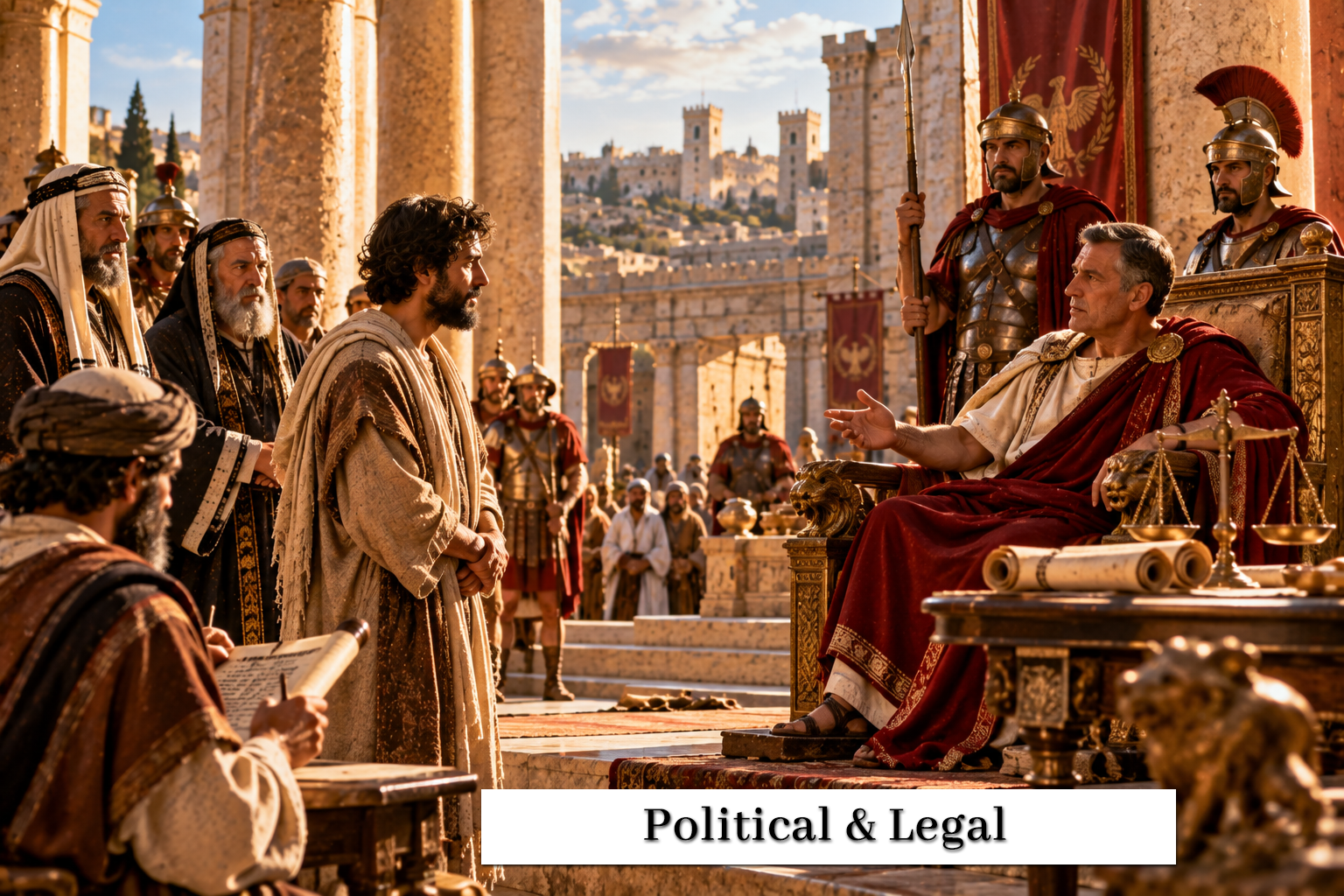
The council worries that if Jesus is left alone, everyone will believe in him and 'the Romans shall come and take away both our place and nation.' Their concern places the debate squarely within Roman imperial politics.
Jesus in Context
The Romans Will Take Away Our Place and Nation

The council's fear that Rome might take away 'our place and nation' reflects the precarious reality of Judea under imperial rule, where a popular messianic movement could provoke Roman intervention.
Introduction
Historical and Cultural Context
Judea existed under Roman supremacy, and Roman governors were responsible for maintaining order. Large crowds, royal claims, and popular movements could be interpreted as potential unrest. The Greek word translated 'place' can refer to a place or position; interpreters have variously understood it as the Temple, the leaders' position, or the national center more broadly. John does not explicitly settle that nuance.
The fear of losing the nation is historically intelligible in a system where Rome could and did use force against perceived rebellion.
Why It Matters
The statement helps explain why some leaders can regard Jesus as dangerous even while acknowledging his signs. Their reasoning is political and institutional as well as theological.
John's irony is severe: an attempt to preserve the nation by eliminating Jesus will not ultimately prevent the later Roman destruction of Jerusalem and the Temple.