
Wiki Details
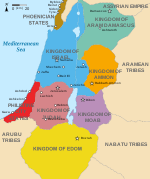
See Map
The Kingdom of Judah was an Israelite kingdom of the Southern Levant during the Iron Age. Centered in the highlands to the west of the Dead Sea, the kingdom's capital was Jerusalem. It was ruled by the Davidic line for four centuries. Jews are named after Judah, and primarily descend from people who lived in the region.
The Hebrew Bible depicts the Kingdom of Judah as one of the two successor states of the United Kingdom of Israel, a term denoting the united monarchy under biblical kings Saul, David, and Solomon and covering the territory of Judah and Israel. However, during the 1980s, some biblical scholars began to argue that the archaeological evidence for an extensive kingdom before the late 8th century BCE is too weak, and that the methodology used to obtain the evidence is flawed. In the 10th and early 9th centuries BCE, the territory of Judah might have been limitedly populated, comprising some fortified sites and many unfortified rural settlements. The Tel Dan Stele, discovered in 1993, shows that the kingdom existed in some form by the middle of the 9th century BCE, but it does not indicate the extent of its power. Recent excavations at Khirbet Qeiyafa, however, support the existence of a centrally organized and urbanized kingdom by the 10th century BCE, according to the excavators.
In the 7th century BCE, the kingdom's population increased greatly, prospering under Neo-Assyrian vassalage despite Hezekiah's revolt against the Assyrian king Sennacherib. Josiah took advantage of the political vacuum that resulted from Assyria's decline and the emergence of Saite Egyptian rule over the area to enact his religious reforms. The Deuteronomistic history, which recounts the history of the people of Israel from Joshua to Josiah and expresses a worldview based on the legal principles found in the Book of Deuteronomy, is assumed to have been written during this same time period and emphasizes the significance of upholding them.
With the final fall of the Neo-Assyrian Empire in 605 BCE, competition emerged between Saite Egypt and the Neo-Babylonian Empire over control of the Levant, ultimately resulting in Judah's rapid decline. The early 6th century BCE saw a wave of Egyptian-backed Judahite rebellions against Babylonian rule being crushed. In 587 BCE, Nebuchadnezzar II engaged in a siege of Jerusalem, ultimately destroying the city and ending the kingdom. A large number of Judeans were exiled to Babylonia, and the fallen kingdom was then annexed as a Babylonian province.
After the fall of Babylon to the Achaemenid Empire, the Achaemenid king Cyrus the Great permitted the Jewish exiles to return to their homeland and re-establish their communal and religious institutions under Persian overlordship. Although the restored community enjoyed a degree of autonomy, full Jewish political independence was not achieved again until nearly four centuries later, in the aftermath of the Maccabean Revolt, with the emergence of the Hasmonean kingdom of Judea.
General info from Wikipedia.org
