Agrippa II

Godliness
Biography
Agrippa II's full name, like that of his father, was Marcus Julius Agrippa. He was educated in Rome, and was a thoroughly Hellenized Jew. After his father died when Agrippa was still a teenager, Emperor Claudius gradually provided him with territorial political responsibilities, including the right to name the important post of high priest of Jerusalem. Agrippa also found favor with Nero, who increased his territories significantly.
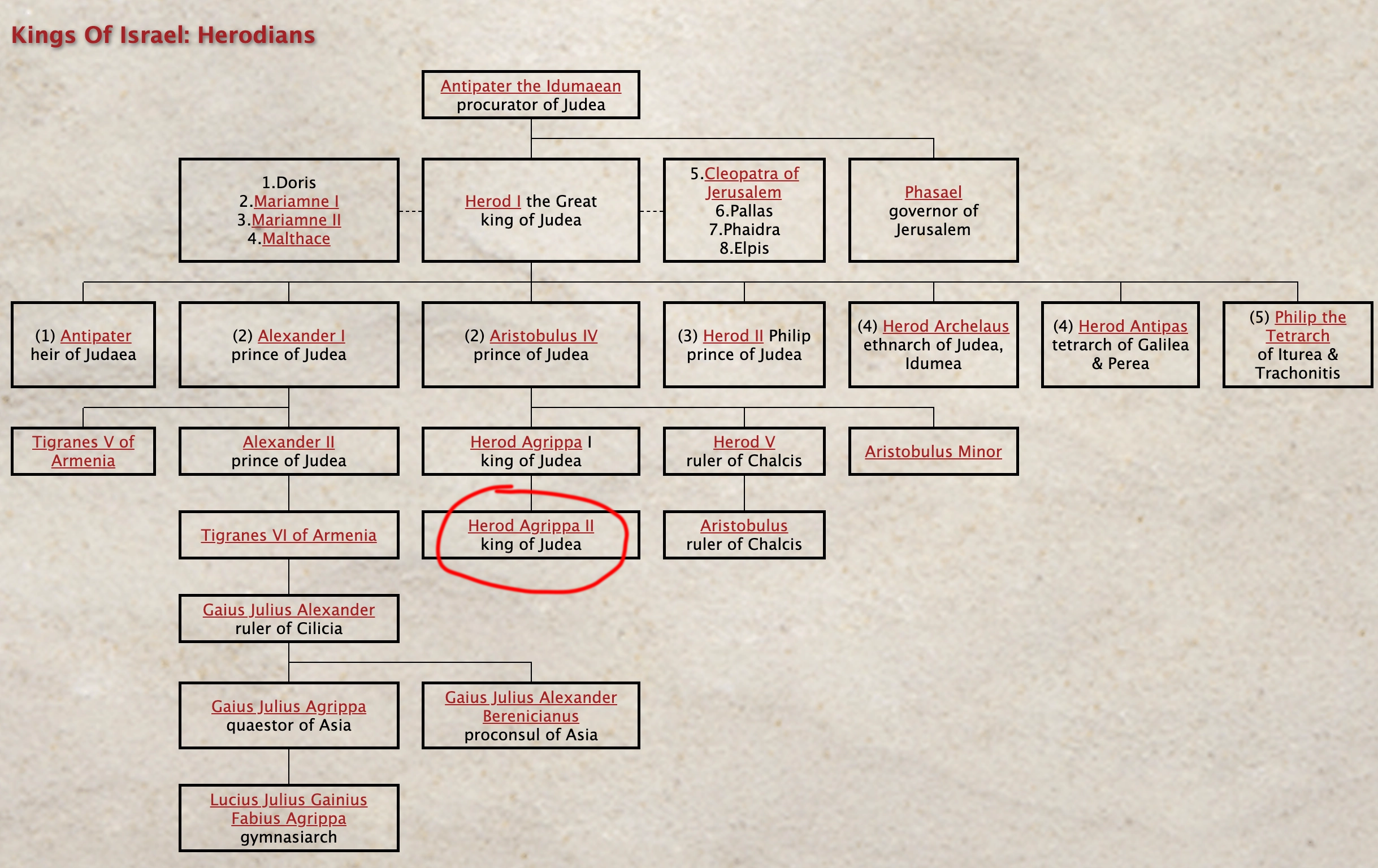
Agrippa II was the last in the royal line that began with Herod the Great. Agrippa's father, Aprippa I, had been a favorite of both Caligula and Claudius, and eventually came to rule a territory even larger than Herod I's. Unlike Herod I though, Agrippa I had been widely popular among the Jews, although he was considered an enemy of the Christians.
Agrippa II was educated in Rome at the court of Emperor Claudius. At the time of his father's death, he was only 17 years old and not prepared to lead. Therefore, Claudius kept him in Rome and sent Cuspius Fadus to be procurator of the Jewish kingdom.
Agrippa did show some evidence of Jewish patriotism, voicing his support for the Jewish cause to Claudius over an issue regarding the control of the vestments of the high priest He also lobbied on behalf of the Jews during a conflict with the Samaritans and Claudius decided in favor of the Jewish side.
After the death of Herod of Chalcis in 48, his small Syrian principality was given to Agrippa. This appointment carried with it the right of superintending the Temple in Jerusalem and appointing the high priest. In 53, Claudius appointed Agrippa governor of the much larger tetrarchy formerly belonging to Herod Philip II and Lysanias east of the Galilee. After the promotion Agrippa succeeded in marrying his sister Drusilla to Gaius Julius Azizus, King of Emesa. Drusila's husband was circumcised as a condition of his marriage, revealing that Agrippa still identified strongly with Jewish tradition. Agrippa's third sister, Berenice, joined Agrippa as his companion.
Agrippa was in good standing with the Nero, who added important new territories to Agrippa's jurisdiction including the cities of Tiberias and Taricheae in Galilee, and Julias in Peraea. Agrippa spent large sums in beautifying Cæsarea Philippi and renamed it "Neronias."
Around AD 59, Agrippa and Berenice heard the case of the Apostle Paul at Caesarea Maritima, along side the current Roman procurator, Porcius Festus. The scene is recorded in considerable detail in Acts 25-26. Agrippa's comment to Festus after Paul left indicated that the apostle had made a serious tactical error by appealing to Rome: "This man could have been set free if he had not appealed to Caesar." The point seems to be that Agrippa agreed with Festus that Paul had done nothing worthy of death.
Agrippa's partiality to Hellenistic culture rendered him unpopular among his more religious Jewish subjects. There were even rumors that he had established an incestuous relationship with his sister Berenice. He also offended Jews because in contrast to the coins of some earlier Jewish rulers of the Roman period, most of his coins bore the images of the reigning emperor or of pagan emblems. He was also thought to have abused the right to appoint and remove the high priests, with whom he often quarreled.
In 64 Emperor Nero appointed Gessius Florus as procurator of the Judaea Province. This led to civil unrest when Florus plundered the treasury of the Temple of Jerusalem under the guise of imperial taxes. Riots followed, and the rioters were crucified by the Romans. In an attempt to prevent violence from escalating, Agrippa assembled the populace and delivered a tearful speech to the crowd with Berenice by his side. However, things by this time had reached the point of no return. As the insurgents burned down the Herods' palaces, Agrippa and Berenice barely escaped with their lives to Galilee and joined the Roman cause.
During the revolt, Agrippa sent 2,000 foot soldiers, archers, and cavalry to support the Roman general Vespasian in putting down the rebellion. After Vespasian was made emperor in 69, Agrippa accompanied Vespasian's son Titus on some campaigns and was wounded at the siege of Gamala in the Golan Heights. After the capture of Jerusalem, he went to Rome where he was rewarded with the dignity of praetor and given additional territory.
According to the much later writings of Photius, Agrippa died, childless, at the age of 70, in the third year of the reign of Trajan, that is, 100. However, contemporary documents and statements of Josephus cast this date into doubt. The modern consensus holds that he died before 93/94. He was the last prince of the house of the Herods.