Agrippa I

Godliness
Historical Scripture
Biography
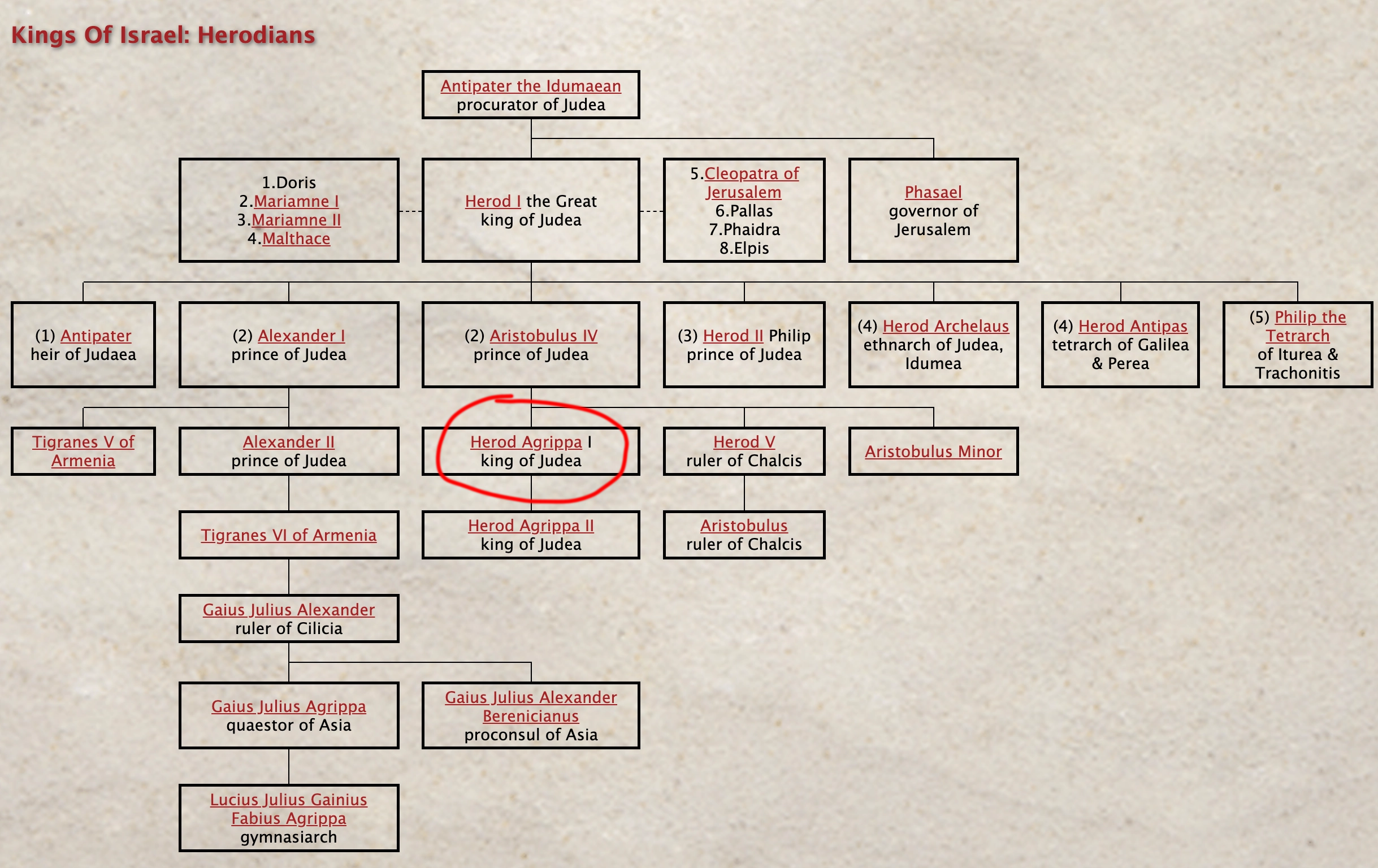
Agrippa I was the grandson of Herod the Great and son of Aristobulus IV and Berenice. His original name was Marcus Julius Agrippa, and he is the king named "Herod" in the Acts of the Apostles in the New Testament, (while his son Agrippa II is called "Agrippa.")
Agrippa was sent by Herod the Great to be educated in Rome, where he became a favorite in court circles. Emperor Tiberius developed a great affection for him, placing him near his son Drusus, who befriended him. When Drusus died, Agrippa left Rome because of money problems, but his fortunes improved with the intervention of his uncle, Herod Antipas, who had been appointed tetrarch of Galilee and Perea. Antipas had also married Agrippa's sister Herodias, who influenced Antipas to name Agrippa as overseer of markets in the new capital city of Tiberias. When the monetary support from Antipas ceased, Agrippa went to Antioch and then back to Rome. He was welcomed by Tiberius and became friends with a young Caligula.
When Agrippa was overheard to express a wish for the aged Tiberius' death and the advancement of Caligula, he was thrown into prison. After six months in prison, Caligula succeeded to the throne and release Agrippa. Caligula made Agrippa governor of the territories of Batanaea and Trachonitis (previously ruled by his cousin, Herod Philip I). He was then appointed to the tetrarchy of Lysanias, with the title of "king." In 39 AD. When Agrippa returned to Rome and secured the banishment of his uncle Antipas, the tetrarchy of Galilee and Perea was added to his realm.
After Caligula's death, Agrippa helped Claudius to succeed him. Agrippa soon became a major client-king for Rome, ruling over a territory as great even as his grandfather. Unlike Herod the Great, however, Agrippa seems to have been highly popular among the Jews. Although extravagant in his youth, he was careful to observe Jewish customs as king, and was able to perform several services for which he is recognized by Jewish sources with gratitude. Sources indicate that Agrippa honored the Jewish Law and personally carried his sacrificial basket of first-fruits to the Temple of Jerusalem and celebrated the Feast of Tabernacles with the common people.
After Passover in AD 44, Agrippa went to Caesarea and had games performed in honor of Claudius. In the midst of his elation, Josephus reports that Agrippa saw an owl perched over his head. During his imprisonment by Tiberius a similar omen had been interpreted as portending his speedy release, with the warning that should he behold the same sight again, he would die within five days. Josephus says that he was immediately smitten with violent heart pains and a pain in his abdomen, and died after five days.
The New Testament (Acts 12) gives a different account of these events, suggesting that Agrippa's opposition to the Christian movement and his acceptance of god-like adulation from the populace led to his death. About the time of the Passover in 44, James, son of Zebedee, was seized at Agrippa's orders and put to death by beheading. Agrippa also arrested Peter and imprisoned him, from which God's angel released Peter. After that Passover, while ion Caesarea, Agrippa received the people of Tyre and Sidon in the stadium and addressed them, while the audience cried out that his was "the voice of a god, not a man." But "the angel of the Lord smote him," and shortly afterwards he died, "eaten of worms."
A third and final conjecture as to the cause of Agrippa's demise regards the Romans and their concern for his growing popularity and poswer. was assassinated by the Romans, who objected to his growing power. When he began to repair the fortifications Jerusalem, he was told to stop by the emperor. as his actions were construed as prelude to rebellion. It is therefore felt that "his sudden death at the games in Cæsarea, was the product of Roman politics
Agrippa's only legitimate successor was his adolescent son, Agrippa II. Therefore, Emperor Claudius returned Iudaea Province to the rule of Roman procurators, as had been the case during the time of Jesus. Thus, Agrippa I was the last actual king of the Jews.