
Bible Location

Mediterranean Sea

Also known as: Great Sea in the Bible
A Visit With Jesus

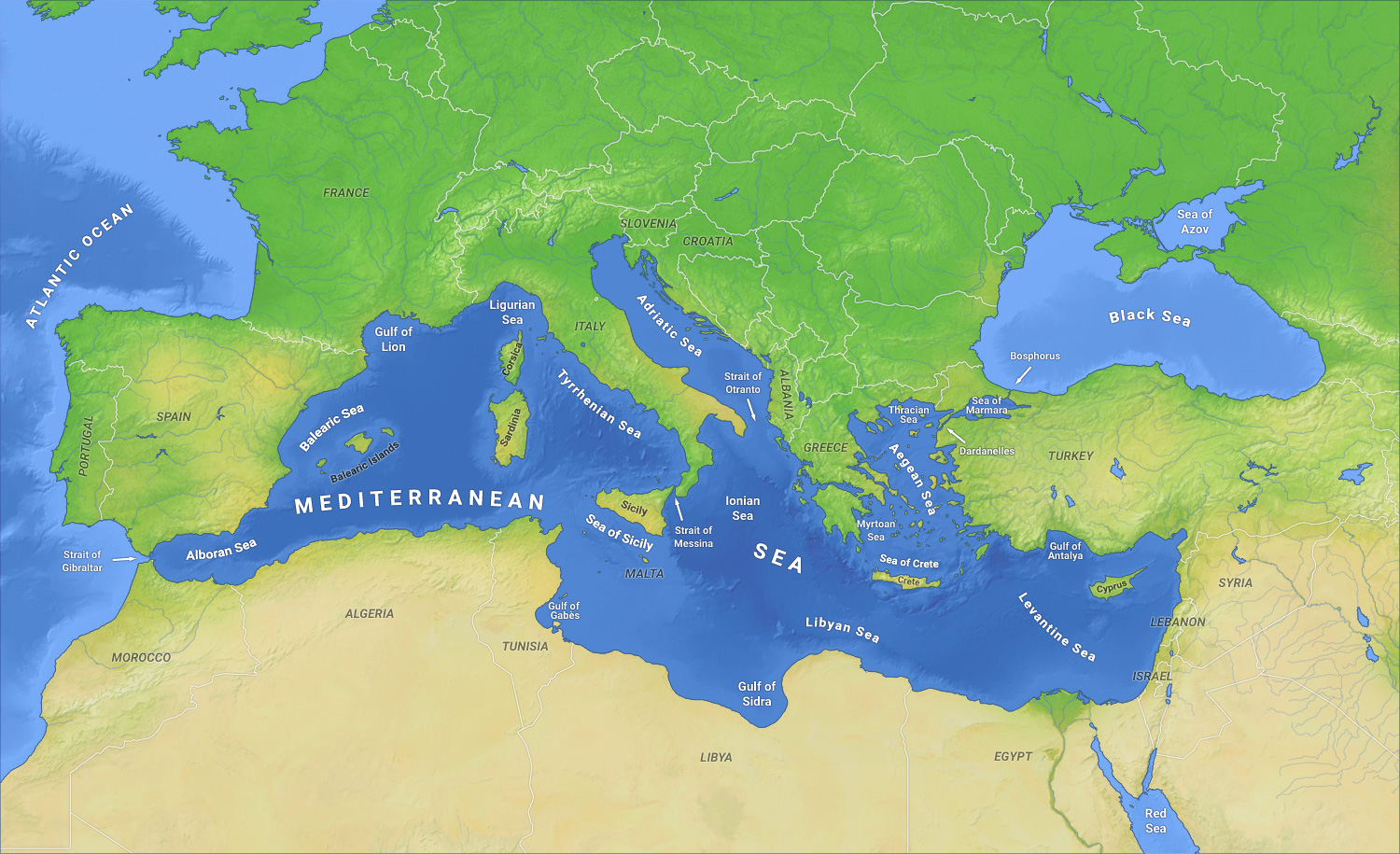
The Mediterranean Sea forms the western boundary of the biblical lands of Israel and the principal maritime connection between the Levant, Egypt, Asia Minor, Greece, Italy, and the wider ancient world.

The Old Testament commonly calls it the "Great Sea" or simply "the sea." It appears frequently in descriptions of territorial boundaries and in accounts involving Phoenician maritime activity.

In the New Testament, Mediterranean travel became particularly important to the spread of Christianity as Paul and other early Christians traveled among the cities and islands of the Roman world.

Mediterranean Sea

Biblical Significance

Numbers 34:6 identifies the Great Sea as the western boundary of the land allotted to Israel. Similar boundary descriptions occur elsewhere in the Old Testament.

Israel itself was not primarily a maritime power. The Phoenician cities of Tyre and Sidon were far more deeply involved in Mediterranean seafaring, and Solomon cooperated with Hiram of Tyre in maritime commercial ventures.

The New Testament world was much more closely interconnected by Mediterranean shipping. Acts records voyages involving Cyprus, Asia Minor, Greece, Crete, Malta, and Italy, culminating in Paul's journey by sea toward Rome.

Historical Background

The Mediterranean connected the civilizations surrounding its shores and supported extensive movement of people, raw materials, manufactured goods, military forces, and ideas.

During the Bronze and Iron Ages, Egyptians, Canaanites, Phoenicians, Greeks, and other peoples participated in maritime networks. Phoenician sailors became especially important in Mediterranean commerce and colonization during the first millennium BC.

By the Roman period, shipping routes linked the provinces of the empire on an enormous scale. Seasonal winds and winter storms strongly influenced travel, as dramatically illustrated by Paul's voyage in Acts 27.

Modern Identification

The biblical Great Sea is the modern Mediterranean Sea. The identification is certain.

Ancient writers generally understood geography from the perspective of the eastern Mediterranean world, so biblical references to "the sea" may sometimes mean the Mediterranean without explicitly naming it.

Scripture References

Related Resources

Sources

Bible: Numbers 34:6, Joshua 1:4, Joshua 9:1, Joshua 15:12, Ezekiel 47:20, Jonah 1, Acts 13-14, Acts 27-28; historical studies of Phoenician, Greek, and Roman Mediterranean navigation and commerce