
Bible Location

Phoenicia

A Visit With Jesus

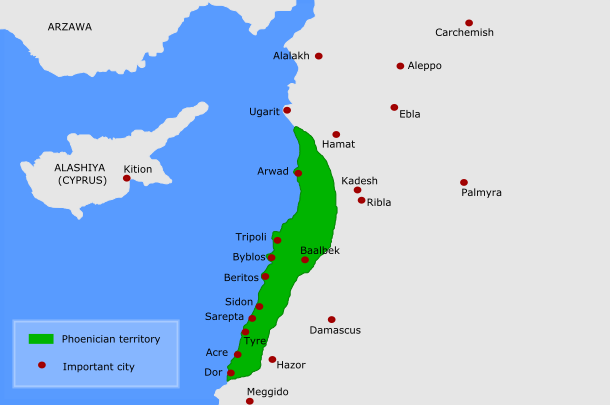
Phoenicia was a narrow coastal region along the eastern Mediterranean centered upon important cities including Tyre, Sidon, Byblos, and Arwad. The Phoenicians became renowned as merchants, sailors, craftsmen, and colonizers throughout the Mediterranean world.

The Bible records extensive interaction between Israel and the Phoenician cities, particularly Tyre and Sidon. Hiram of Tyre supplied materials and craftsmen for the building projects of David and Solomon, while the marriage of Ahab to the Sidonian princess Jezebel brought strong Phoenician religious influence into the northern kingdom.

In the New Testament, Jesus visited the region of Tyre and Sidon, and Phoenicia became part of the geographical expansion of early Christianity.

Phoenicia

Biblical Significance

David and Solomon maintained important relations with Hiram king of Tyre. Phoenician timber and craftsmen contributed to royal construction and especially to Solomon's Temple in Jerusalem.

The marriage of Ahab king of Israel to Jezebel, daughter of the king of the Sidonians, introduced strong royal patronage of Baal worship into Israel and forms an important background to the ministry of Elijah.

Jesus traveled into the district of Tyre and Sidon, where the Gospels describe His encounter with a Gentile woman who appealed for the healing of her daughter.

After the persecution following Stephen's death, believers traveled as far as Phoenicia preaching the message. Paul later passed through Phoenicia on his journeys.

Historical Background

Phoenicia consisted primarily of independent coastal city-states rather than a single unified kingdom. Tyre, Sidon, Byblos, and Arwad became major centers at different periods.

Phoenician merchants developed extensive maritime networks across the Mediterranean. Phoenician colonies and settlements reached Cyprus, North Africa, Sicily, Sardinia, Spain, and other regions.

The Phoenician alphabetic writing tradition profoundly influenced the development of Greek and later alphabetic scripts.

The cities came successively under Assyrian, Babylonian, Persian, Hellenistic, and Roman political domination while retaining substantial commercial importance.

Modern Identification

Ancient Phoenicia corresponds primarily to the Mediterranean coast of modern Lebanon together with adjoining coastal portions of modern Syria and northern Israel.

Its boundaries varied considerably, and the Phoenician cultural and commercial sphere extended far beyond this narrow homeland.

AVWJ should therefore present Phoenicia as a coastal historical region centered particularly upon Tyre and Sidon.

Scripture References

Related Resources

Sources

Bible: 2 Samuel 5:11, 1 Kings 5, 1 Kings 7:13-14, 1 Kings 16:31, Isaiah 23, Ezekiel 26-28, Matthew 15:21-28, Mark 7:24-31, Acts 11:19, Acts 15:3, Acts 21:2; Phoenician inscriptions; Assyrian records; classical sources and archaeological studies of Tyre, Sidon, Byblos, and Phoenician maritime culture