
Bible Location

Phrygia

Also known as: Phrygia Nation in Asia Minor
A Visit With Jesus

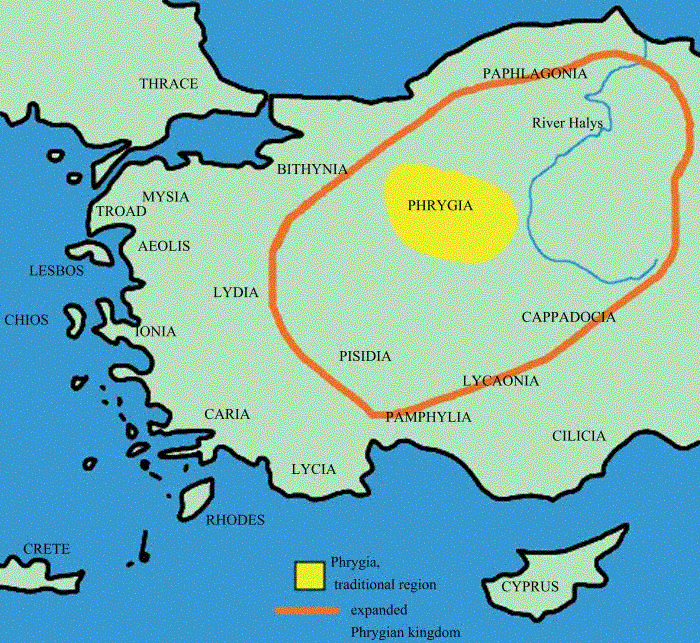
Phrygia was an ancient region of central and western Asia Minor. Its boundaries changed substantially through history, and by the Roman period the old Phrygian territory was divided among several Roman administrative provinces.

Phrygia appears several times in Acts. People from Phrygia were present in Jerusalem at Pentecost, and Paul traveled through the Phrygian region during his missionary journeys.

Several cities important to early Christianity lay within or near historically Phrygian territory.

Phrygia

Biblical Significance

Acts 2 lists residents of Phrygia among the Jewish pilgrims present in Jerusalem at Pentecost who heard the apostles proclaiming the works of God in their own languages.

During Paul's second missionary journey, Paul and his companions traveled through the region of Phrygia and Galatia before being directed toward Mysia and Troas.

Acts later records Paul traveling again through the Galatian region and Phrygia, strengthening the disciples.

Although the New Testament does not always define precise regional boundaries, Phrygia formed part of the important Anatolian setting in which Pauline Christianity expanded.

Historical Background

Phrygian civilization became especially prominent in central Anatolia during the early first millennium BC. Gordion became its best-known political center and is traditionally associated with King Midas.

Phrygia later came under Lydian, Persian, Hellenistic, and Roman control. Consequently, the term Phrygia survived as a cultural and geographical designation even when the territory no longer formed an independent political state.

During the Roman period, historically Phrygian lands were divided among provinces including Asia and Galatia, complicating attempts to assign New Testament references to fixed administrative borders.

Modern Identification

Ancient Phrygia occupied a substantial portion of west-central Anatolia in modern Turkey.

Its boundaries changed considerably through different historical periods. AVWJ should therefore display Phrygia as a historical region rather than as a precisely bounded Roman province or modern territory.

Scripture References

Related Resources

Sources

Bible: Acts 2:10, Acts 16:6, Acts 18:23; ancient Greek and Roman geographical sources; archaeological and historical studies of Gordion, Phrygia, Roman Asia, and Galatia