
Bible Location

Midian

A Visit With Jesus

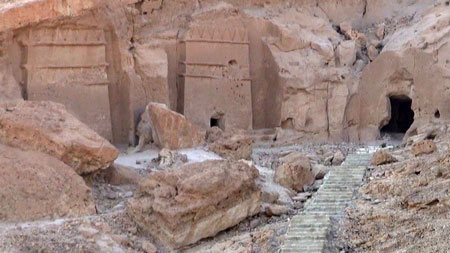
Midian was a territory and people associated principally with northwestern Arabia and the lands east of the Gulf of Aqaba. Biblical traditions trace the Midianites to Midian, a son of Abraham by Keturah.

Midian is especially important in the life of Moses. After fleeing Egypt, Moses settled in Midian, married Zipporah, and tended the flocks of his father-in-law. God later appeared to Moses at the burning bush while he was tending those flocks.

The geographical extent of Midian probably changed through time, and Midianite groups may have ranged over a considerable area.

Midian

Biblical Significance

Genesis identifies Midian as one of the sons of Abraham and Keturah. Midianite traders also appear in the story of Joseph, although Genesis uses the terms Midianite and Ishmaelite in closely related ways.

After killing an Egyptian, Moses fled from Pharaoh and settled in the land of Midian. There he married Zipporah, daughter of the priest of Midian, and became a shepherd.

While tending his father-in-law's flock, Moses came to the mountain of God and encountered the burning bush. God commissioned him to return to Egypt and lead Israel from slavery.

Later biblical narratives describe conflict between Israel and Midian, particularly during the wilderness period and during the time of Gideon.

Historical Background

Midianite populations appear to have occupied and traveled through the arid regions east and southeast of the Gulf of Aqaba. Their economy likely combined pastoralism, trade, and settlement around oases and routes crossing northwestern Arabia and southern Transjordan.

Archaeologists have identified a distinctive painted pottery tradition, often called Qurayyah Painted Ware or formerly Midianite pottery, distributed across northwestern Arabia and neighboring regions during the Late Bronze and early Iron Age periods.

The biblical descriptions themselves suggest that Midian was not necessarily a compact state with permanently fixed borders.

Modern Identification

The heartland of ancient Midian is generally placed in northwestern Arabia, particularly east of the Gulf of Aqaba, with influence and movement extending into southern Jordan and the Sinai region.

The precise boundaries cannot be reconstructed with certainty and probably varied over time.

Midian's location is relevant to discussions concerning Mount Sinai, but the fact that Moses lived in Midian does not by itself establish that Mount Sinai was located within Midianite territory.

Scripture References

Related Resources

Sources

Bible: Genesis 25:1-6, Genesis 37:25-36, Exodus 2:15-22, Exodus 3:1, Exodus 18, Numbers 22, Numbers 25, Numbers 31, Judges 6-8; archaeological studies of northwestern Arabia and Qurayyah Painted Ware; historical geography of Midian