
Bible Location

Kingdom of Judah

Also known as: Judah
A Visit With Jesus

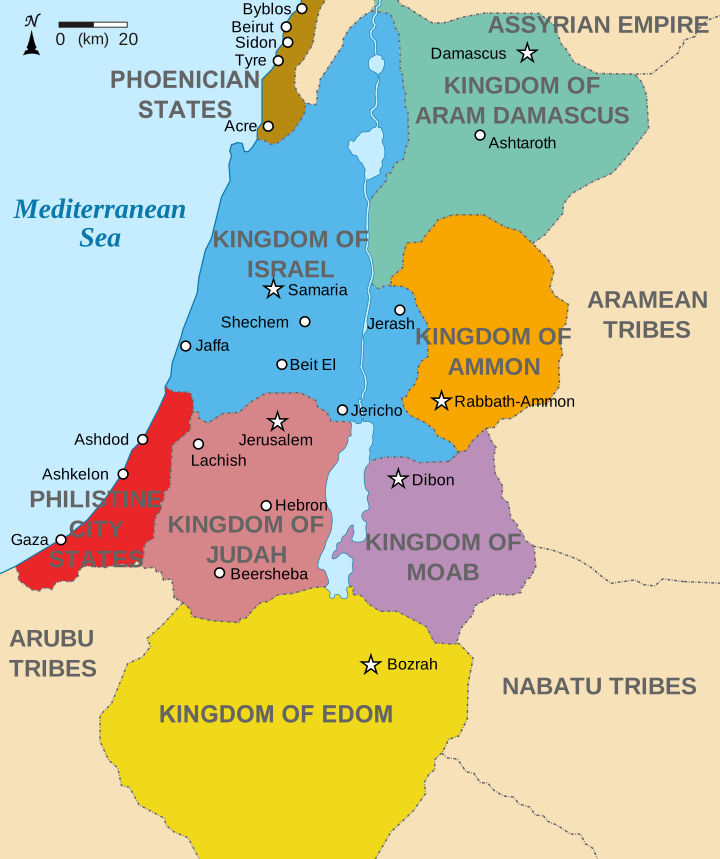
The Kingdom of Judah was the southern Israelite kingdom centered upon Jerusalem and ruled by the dynasty of David. It emerged as a distinct political kingdom after the division that followed the death of Solomon.

Judah included the Judean hill country and, at various periods, territory extending through the Shephelah toward the coastal plain and south toward Beersheba and the Negev.

The kingdom survived the Assyrian destruction of northern Israel but eventually fell to Babylon. Jerusalem and the First Temple were destroyed in 586 BC, and many Judeans were carried into exile.

Kingdom of Judah

Biblical Significance

After Solomon's death, the northern tribes rejected the rule of his son Rehoboam. Jeroboam became king of the northern kingdom, while Rehoboam continued to rule Judah from Jerusalem.

The biblical books of Kings and Chronicles trace the history of Judah through the Davidic dynasty. Kings such as Asa, Jehoshaphat, Hezekiah, and Josiah are remembered particularly for religious reforms, while other rulers are condemned for idolatry and covenant unfaithfulness.

Judah survived the Assyrian expansion that destroyed the northern kingdom of Israel. During Hezekiah's reign, the Assyrian king Sennacherib invaded Judah and captured many fortified cities but did not capture Jerusalem.

Babylon eventually conquered Judah. Jerusalem fell, the Temple was destroyed, and King Zedekiah was captured. The exile brought the independent Davidic monarchy to an end, although biblical prophets continued to proclaim hope for restoration.

Historical Background

Judah's geographical heartland was the Judean hill country centered upon Jerusalem, Bethlehem, and Hebron. The Shephelah formed an important western frontier containing fortified towns that protected routes ascending from the coastal plain.

Archaeological surveys and excavations document the development of settlements, administrative systems, fortifications, agriculture, and literacy within Judah during the Iron Age.

Assyrian inscriptions provide important external evidence for Judah. Sennacherib's records describe his campaign against Hezekiah and the capture of numerous fortified Judean towns, while reliefs from Nineveh dramatically depict the Assyrian conquest of Lachish.

Babylonian records and archaeological destruction layers provide additional evidence for the final decades of the kingdom and the Babylonian campaigns against Judah.

Modern Identification

The Kingdom of Judah occupied principally the Judean highlands and surrounding regions, corresponding broadly to areas around Jerusalem, Bethlehem, Hebron, the Judean Desert, the Shephelah, and portions of the northern Negev.

Its boundaries were never completely fixed. Territory expanded and contracted according to military and political circumstances, particularly along the western Shephelah, northern frontier with Israel, and southern Negev.

AVWJ should therefore represent Judah with period-sensitive boundaries rather than a single permanent outline.

Related Resources

Sources

Bible: 1 Kings 12-22, 2 Kings, 2 Chronicles, Isaiah, Jeremiah and other prophetic books; Sennacherib Prism; Lachish reliefs; Babylonian Chronicles; archaeological excavations and surveys of Jerusalem, Lachish, Arad, Beersheba, the Shephelah, and Judean hill country